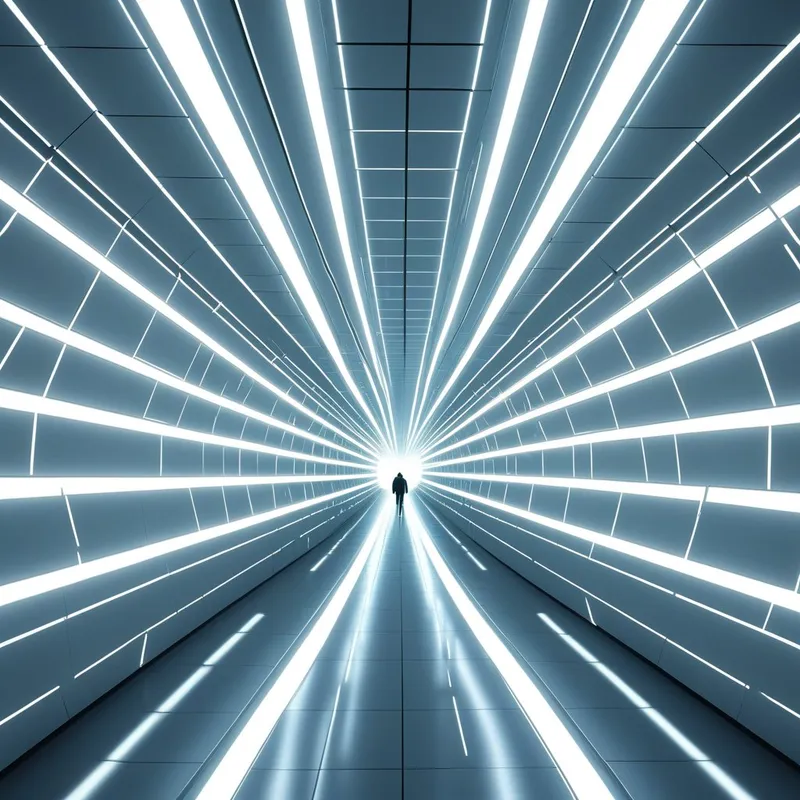
Technological Purgatory: The Soul's Cry from the Digital Labyrinth
The Somatic Echo
It begins not as a thought, but as a sensation. A low-grade hum in the marrow, a vibration of sterile anxiety. The body feels suspended, not in water, but in a gel of static—present, yet disconnected from its own pulse. There is a weight, but it is not gravity; it is the pressure of infinite, invisible protocols. The breath becomes shallow, automatic, as if regulated by a system you did not consent to. This is the somatic signature of Technological Purgatory: the visceral experience of the psyche trapped within its own outdated, over-engineered operating system. It is the grief of a living intelligence caged by the very logic it once built for safety.
The Dreamer's Log
The elevator would not stop. It ascended through a skeletal skyscraper of exposed wires and blinking diodes, its doors shuddering but never opening. On the small, cracked screen, floor numbers blurred into a meaningless stream of glyphs. I pounded the emergency stop—a button that gave way like rotten fruit—knowing my destination was a room that no longer existed, for a meeting whose purpose had been erased.
Here, the machinery of ambition and routine has become a self-perpetuating prison, carrying the dreamer toward a void. The alchemy here is the forced confrontation with a life-path running on autopilot, demanding a manual override of the soul's true coordinates.

The False Lead
This is not a dream about a fear of technology, nor a simplistic warning about screen time. To mistake it for such is to remain in the literal, missing the symbolic architecture. Technological Purgatory does not critique the tool, but the template. It is not about the computer crashing, but about the discovery that your entire inner world has been built on a source code written by a younger, more frightened self—a code now riddled with silent, catastrophic bugs. It is the structure, not the circumstance, that has turned infernal.
Psychological Architecture
The purgatory is internal. Its walls are constructed from unquestioned beliefs, its loops are forged from repetitive coping mechanisms that once served as brilliant solutions. You built a flawless mental app to manage anxiety, a sophisticated firewall to keep out vulnerability, an automated response system to navigate intimacy. And now, you are the sole user, trapped in the UI. The Shadow work here is the terrifying, glorious act of becoming your own system administrator. It requires accessing the command line of the unconscious, that dark, scrolling stream beneath the pretty icons, and reading the error logs of your heart. It is the Individuation process of discovering that you are not the program running, but the consciousness that can rewrite it. The grief you feel is for the energy spent maintaining a ghost in the machine—the old self that the system was designed to protect.
Mythic Resonance
We hear this echo in the myth of Daedalus and the Labyrinth. The genius architect builds an inescapable maze to contain a monster, only to find himself and his son imprisoned within his own creation. The labyrinth is not just stone; it is a paradigm, a too-perfect logic that becomes its own prison. Our technological dreams are this labyrinth rendered in silicon and light. We also glimpse it in the Golem of Jewish folklore—a being of clay animated by sacred formula to protect, which then grows beyond its programming and must be de-animated. The soul in Technological Purgatory is both Daedalus, the trapped architect, and the Golem-maker, facing the autonomous, lumbering creation of their own unintegrated power.
Symbolic Nodes
- Non-responsive interfaces: Touchscreens that don't register, keyboards with missing keys, voice commands that go unheard.
- Endless, sterile corridors: Data halls, server farms, empty subways, all clean, lit, and leading nowhere.
- Malfunctioning communication tools: Phones displaying dead icons, messages that corrupt upon sending, video calls with frozen, agonized expressions.
- Glitched or looping environments: A street that repeats, a room that resets, time displayed as an eternal, nonsensical string of numbers.
- Tools that turn on their user: Elevators that disobey, cars that drive themselves, domestic appliances that operate with sinister autonomy.
Archetypal Resonance
The core energy of this theme resonates most powerfully with The Shadow Ruler Archetype. This is not the benevolent sovereign, but the internal tyrant—the control-freak, the micromanaging algorithm of the psyche. Its somatic echo is the rigid posture, the clenched jaw of enforced order. It builds the perfect, sterile prison of predictability to ward off the chaos of the soul's wild, creative, and emotional truths. The alchemical potential lies in dethroning this shadow ruler, not through rebellion, but through reclamation. The goal is to transform the energy of rigid control into the authentic sovereignty of the true Ruler—the one who governs the inner kingdom with wisdom, flexibility, and compassion, allowing data to flow into wisdom, and logic to be in service to life.
The Alchemical Process
The transmutation of Technological Purgatory requires the heat of conscious frustration and the pressure of sustained paradox. The old system must be felt as intolerable—not just thought about, but viscerally known as a cage. This is the nigredo, the blackening. Then comes the albedo, the whitening: the eerie, silent space when the old programs are halted. You must sit in the blank-screen terror of not knowing what comes next, of having no interface between you and the raw, unprocessed data of your existence. Here, in the liminal void, the new code is not written from old logic, but received from the deeper intelligence of the body and the imaginal realm. The final coagulation is the integration of system and soul—where structure becomes fluid, where protocol serves poetry, and where you are no longer a user, but the living source code itself.

The Integration Protocol
Question 1: Where in my waking life do I feel like a "user" following a pre-set protocol, rather than the author of my own experience? What is that protocol designed to optimize for, and what soul-cost does it incur?
Question 2: If the glitch or error in the dream is not a mistake, but a message from a deeper part of my psyche, what is it trying to communicate by disrupting the sterile order?
Question 3: What one rule, routine, or "internal application" that I built for survival can I thank for its service, and then respectfully decommission?
Action 1 (Grounding in the Analog): For one hour, perform a simple, physical task with full attention—hand-washing dishes, repotting a plant, sketching with pencil on paper. Note the sensations of texture, weight, and unmediated time. This re-establishes your consciousness in the non-digital substrate of reality.
Action 2 (Creative Glitch): Engage in a deliberate, creative act of "corruption." Take a digital photo and intentionally degrade its file format, or write a short paragraph and then use a "find & replace" function with surrealist rules (replace every "the" with "circuit," for instance). Observe what emerges from the broken pattern. This ritualizes the glitch as a source of new meaning.
Action 3 (Sovereign Command): Write a simple, declarative statement of personal sovereignty on a piece of paper, such as "I am the source, not the signal," or "My will is my command line." Burn it safely, and as you watch the smoke rise, feel the dissolution of the old, rigid command structures within you. The act is not in the keeping, but in the release of the form.
Final Validation
The despair of the loop is real. The grief for the time spent in the sterile corridor is valid. This is not a minor inconvenience of the subconscious; it is a profound crisis of orientation. Yet, this very crisis is the evidence of your soul's integrity—it will no longer tolerate the borrowed operating system. The purgatory is not your home; it is the birth canal. The pressure, the claustrophobia, the blinding light of the endless hallway—these are the signs that you are being delivered from a world of borrowed code into the terrifying and magnificent responsibility of writing your own.