
The Dream of Sustainable Living: Building a Psyche That Can Endure
The Somatic Echo
It begins not as an idea, but as a hum in the bones. A low-grade fatigue that no amount of sleep mends. A brittleness in the joints, a sense that your internal resources are being drawn from a shallow, saline well. You feel like a system running on backup power, the warning lights blinking just behind your eyes. There is a visceral craving for clean lines and quiet circuits—a longing not for less, but for a different kind of more. It’s the body’s wisdom whispering of entropy, of psychic sprawl, of energy leaks in the architecture of the self. This is the somatic prelude to the dream of sustainable living: the deep self signaling that its current operating system is no longer viable.
The Dreamer's Log
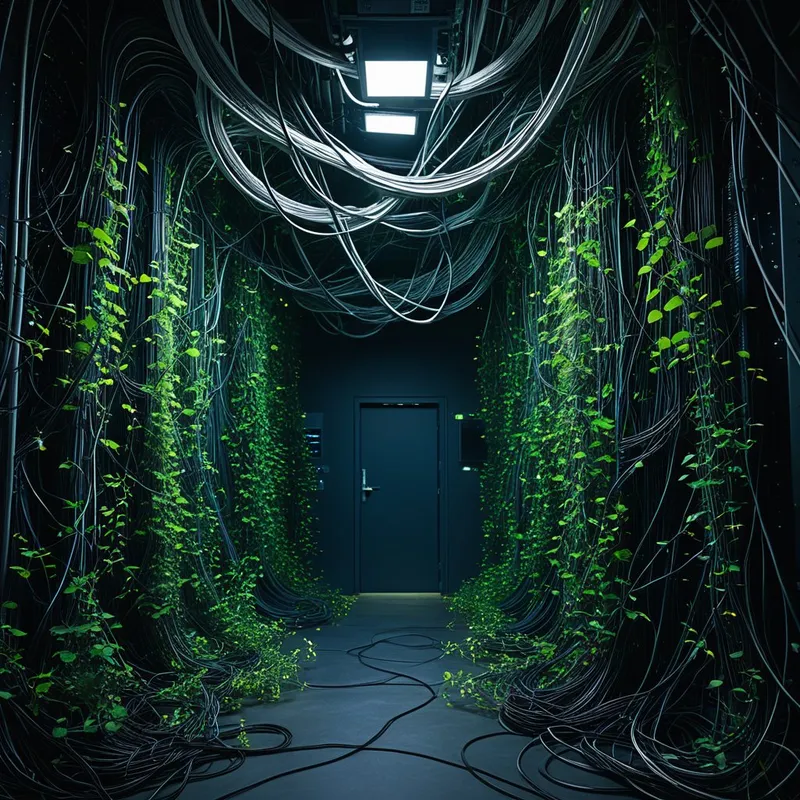
The dreamer finds themselves in a vast, derelict greenhouse. The glass is smudged, the irrigation pipes are clogged with luminous algae. They are not planting new seeds, but meticulously, almost mournfully, pruning back the aggressive, beautiful vines that have choked the light from the original fruit trees. Each cut releases not sap, but a sigh of static.
This is not a dream of mere gardening, but of conscious de-growth—the alchemical work of pruning a prolific but exhausting identity to restore flow to the core system.
The False Lead
Do not mistake this for a simple dream of eco-anxiety or a literal desire for an off-grid cabin. This is not about external virtue, but internal architecture. The shadow of this theme is not failure, but efficiency without soul—the sterile, hyper-optimized system that runs perfectly but has forgotten its purpose. It is the difference between a life that is merely productive and a psyche that is generative. A sustainable system in the soul is not a rigid austerity program; it is a resilient, adaptive ecology that knows how to compost its own pain into wisdom and redirect wasted energy into vital flow.
Psychological Architecture
The work here is Shadow work of the most foundational kind: the audit of the internal family. Which exiled part of you is burning through your emotional capital to be seen? Which manager-part is over-farming your attention, leaving the soil of your focus depleted? Sustainable living in the psyche demands we move from a monarchy—where a single, tireless ruler-part drives the system to exhaustion—to a benevolent ecosystem. It requires acknowledging the hungry ghosts within, not to starve them, but to learn what nutrient they are desperately seeking. The individuation process is the slow, deliberate rewiring of your inner economy from extraction—mining your past for trauma, over-harvesting your future for anxiety—to a closed-loop system of meaning. Here, every experience, even the waste products of grief and failure, is composted and returned to the whole as fertile ground.
Mythic Resonance
This is the labor of Dionysus, not just as god of ecstasy, but as the deity of the vine’s cycle: growth, furious proliferation, harvest, pruning, and the necessary decay that ferments the next vintage. The myth whispers that unrestrained, untended growth leads to madness—the Maenads tearing apart what they love. Sustainability is the sacred contract: you must tend the vine, prune it with a careful hand, and honor the fallow period, or the entire vineyard will consume itself. It is also the lesson of Arachne, the weaver whose artistry became a cage of her own making. Her transformation into the spider is not merely a punishment, but a dark gift: she becomes the architect of a perfect, sustainable system from her own substance, a living lesson in generating resilience from a shattered form.
Symbolic Nodes
- Overgrown Gardens / Cluttered Rooms: Unconscious proliferation, neglected subsystems, energy drains.
- Repairing Ancient Infrastructure: Mending foundational beliefs, updating internal operating systems.
- Finding a Hidden Spring / Clean Water Source: Reconnecting to a primal, unpolluted source of vitality and feeling.
- Compost Heaps / Recycling Centers: The active, alchemical process of transforming emotional and experiential waste into fuel.
- Architectural Blueprints / Circuit Diagrams: The psyche designing its next, more efficient and elegant structure.
- Pruning Shears / Surgical Tools: The necessary, precise act of cutting away what is alive but no longer serving the whole.
Archetypal Resonance
The energy here is that of The Ruler Archetype, emerging not as a tyrant, but as a steward-king. The Shadow Ruler seeks control through force and endless expansion, depleting the kingdom’s resources for the illusion of security. The integrated Ruler understands that true sovereignty is measured by the long-term health and resilience of the entire realm—the inner kingdom of the self. This archetype resonates with the somatic echo of systemic fatigue, recognizing it as a governance issue. Its alchemical potential lies in its shift from a mindset of conquest to one of cultivation, from issuing decrees to listening to the land of the body and the reports from the far provinces of the psyche, establishing a rule based on wise allocation and regenerative justice.
The Alchemical Process
The transmutation is from entropy to syntropy—from the gradual winding down into chaos, to the conscious winding up into enduring order. The prima materia is the exhausting, sprawling mess of your current psychic operations. The heat is applied through the courageous, often grief-laden act of conscious limitation. This is the pressure of saying "this, but not that." "Here, but no further." It is the fire of pruning a part of your life that is beautiful but unsustainable. The vessel is your conscious attention, held steady on the blueprint of wholeness rather than the seduction of more. In this heat, the terror of "not enough" and the grief of "letting go" are cooked down. They do not vanish; they change state. The fear of scarcity becomes the discernment of true nourishment. The grief for what is cut away becomes the rich humus that feeds what remains. The leaden weight of burnout transmutes into the gold of sovereignty: the unshakable knowledge that you are building a system that can hold all of you, without collapse.

The Integration Protocol
Question 1: Where in your life do you feel the most persistent "energy leak"—a situation, relationship, or internal pattern that consistently drains you more than it replenishes, and what is it secretly trying to irrigate?
Question 2: If your psyche were a landscape you had inherited and were responsible for passing on, what one practice would you institute today to ensure its soil did not turn to dust?
Question 3: What beautiful, prolific "vine" in your identity might need a loving but firm pruning, not because it is bad, but because it is blocking the light from the older, deeper "fruit trees" of your essence?
Action 1 (The Internal Audit): For one day, carry a small notebook. Do not track tasks. Instead, note the moments you feel a subtle dip in energy, a micro-contraction of resentment, or a flutter of low-grade anxiety. Do not judge or analyze in the moment; simply log the "event." In the evening, look not for causes, but for patterns. You are mapping the weak points in your psychic infrastructure.
Action 2 (The Ritual of Compost): Take a single sheet of paper. On it, draw or write freely about a current source of emotional "waste"—a frustration, a regret, a fear. Do not seek resolution. Then, physically compost it. Tear it up and bury the pieces in a plant pot, scatter them to the wind, or let them dissolve under running water. Accompany the action with the silent intention: "I return this to the cycle. Let it become something that feeds what grows next."
Action 3 (Blueprinting a Subsystem): Choose one small, contained area of your life (your morning routine, your digital workspace, a weekly commitment). Create a visual "blueprint" for it—a drawing, a diagram, a mood board—that represents not maximum productivity, but elegant resilience. How would this system look if it were designed to sustain your energy for the next decade, not just complete tasks for the next week? Implement one tiny change from this blueprint.
Final Validation
The longing for a sustainable life is not a sign of weakness, but a profound signal of strength—the soul’s refusal to live in a state of perpetual, quiet depletion. It is difficult because it asks you to become an architect of your own limits, a steward of your own finite resources. This is the most courageous form of self-love: to build an inner world sturdy enough, generous enough, and resilient enough to not just host your existence, but to celebrate it, season after season, without fear of the winter. You are not building a fortress against life. You are cultivating an ecology for it.