
The Sacred Disorientation: Dreaming of Spiritual Wandering
The Somatic Echo
It begins not as a thought, but as a hollowing. A subtle vacuum in the solar plexus, a quiet vertigo behind the eyes. The body knows the territory of the soul has shifted before the mind can name it. There is a lightness that feels like emptiness, a restlessness in the limbs that is the opposite of purpose. You feel untethered, a satellite whose orbit has decayed, drifting in a silence so profound it hums. The breath becomes shallow, searching for a ground that is no longer there. This is the somatic prelude to spiritual wandering—the visceral experience of the psyche’s map dissolving. It is the echo of a structure falling away, leaving you suspended in the raw, unscripted space between who you were and who you are becoming.
The Dreamer's Log
I am in a library of impossible scale, but all the books are written in a language of light that shifts when I try to focus. The aisles rearrange themselves behind me. I am looking for my own journal, but every cover bears my name on a different, unfamiliar spine.
This is the alchemy of the forgotten cipher: the conscious mind, the great cataloguer, is being deliberately obscured so the deeper, intuitive self can begin its navigation.

The False Lead
Spiritual wandering is not mere confusion or a symptom of failure. It is not the “bad luck” of a lost path or the anxiety of indecision. To mistake it for simple lostness is to pathologize a sacred process. The common misinterpretation is to see only the absence of direction and rush to fill it with the nearest, loudest signpost—a new dogma, a borrowed identity, a frantic productivity. This is the ego’s panic in the face of the void. True spiritual wandering is a presence—the active, if terrifying, engagement with a foundational deconstruction. It is not that you have lost your way; it is that the way you knew was a temporary bridge, and now you are being asked to learn the nature of the river itself.
Psychological Architecture
Beneath the dream of shifting libraries and disappearing paths lies a profound restructuring of the internal family. The parts of you that built your old identity—the Achiever, the Loyal Soldier, the Good Child—are standing in a council chamber whose walls have turned to mist. Their maps are blank. This is the Shadow work of the Orphan, not as victim, but as the ultimate realist confronting a fundamental truth: you are existentially alone in this next step of your becoming. No external authority can grant you the coordinates.
This is the core of individuation: the painful, glorious moment when you outgrow the internalized voices of tribe, tradition, and expectation. The psyche, in its infinite wisdom, orchestrates this disorientation to force a deeper connection. When the external compass fails, you must develop an internal gyroscope. The grief felt is for the self that was coherent, that fit. The terror is of the formlessness to come. But in that silent, unmapped space, a new sovereignty is born—not from knowing the path, but from consenting to be the one who walks it, step by unknowable step.
Mythic Resonance
We see this not as pathology, but as primordial human firmware in tales like the Babylonian Epic of Gilgamesh. After the death of his brother Enkidu, Gilgamesh is cast into a state of radical, grieving disorientation. He strips off his royal robes, the symbol of his known world, and wanders the wilderness in animal skins, seeking an answer to mortality that no city, no kingdom, can provide. His wandering is not aimless; it is a necessary dissolution of the “King” identity, forcing him to confront the raw, orphaned questions of life and death from a place of utter vulnerability. He does not find a simple answer, but he returns transformed, having integrated the wisdom of his journey into the very stones of Uruk’s walls. His wandering rebuilt his foundation.
Symbolic Nodes
- Endless, Changing Corridors/Landscapes: The psyche’s labyrinthine process of restructuring.
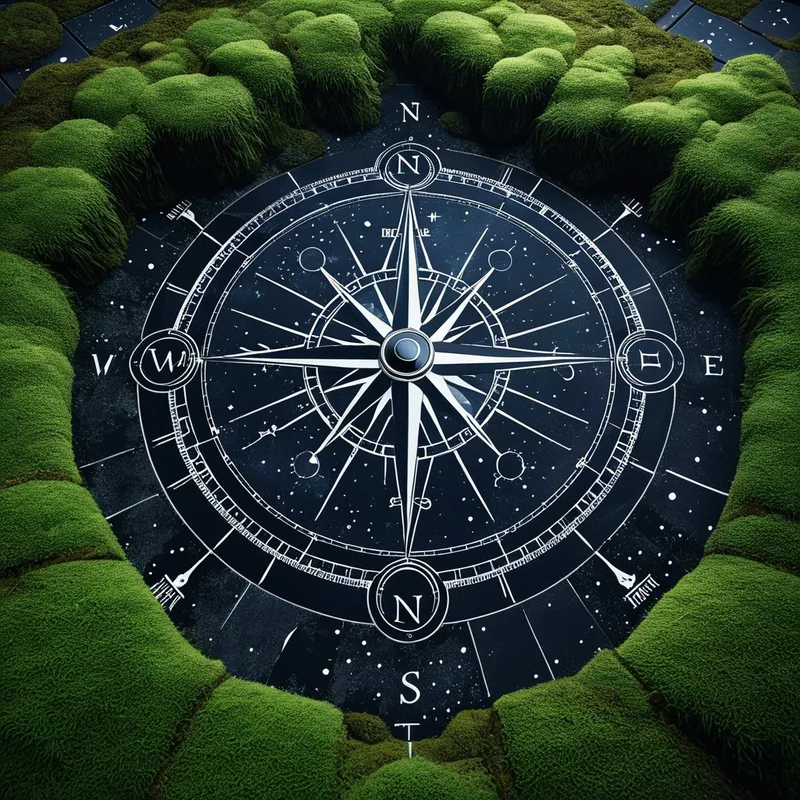
- Malfunctioning or Blank Maps/Compasses: The conscious mind’s tools failing, forcing intuitive navigation.
- Veils, Mist, Obscuring Fog: The necessary concealment of the old paradigm to allow the new to form.
- Fractured or Shifting Glyphs/Language: The breakdown of old meanings and the emergence of a personal, somatic lexicon.
- A Journey with No Visible Destination: The focus shifting from the goal to the quality of the walk itself.
Archetypal Resonance
The core energy of spiritual wandering is the purview of The Explorer Archetype in its most profound, and often shadowed, expression. Initially, this may manifest as the Shadow Explorer—the sense of being alienated, perpetually unsatisfied, and drifting without anchor. The somatic echo of hollowness and vertigo is the shadow’s signature, the cost of seeking without an inner home.
Yet, within this very disorientation lies the archetype’s alchemical potential. The true Explorer does not wander to escape, but to find. The pressure of being lost is the heat that forges the inner compass. The archetype’s core drive is autonomy and the freedom to discover one’s own truth through direct experience. Spiritual wandering is thus the Explorer’s deepest calling: to leave the mapped territories of the collective consensus and venture into the wilderness of the authentic self, willing to be transformed by the terrain. The aimlessness is temporary; it is the fertile ground from which a truly personal direction—a sovereignty of path—is born.
The Alchemical Process
The transmutation here is from Drift to Discovery. The prima materia, the leaden base state, is the grief of lost certainty and the terror of the void. The alchemical vessel is your own aware consciousness, willing to hold the tension of not-knowing.
The required heat is sustained vulnerability. It is the courage to refrain from grabbing the first lifeline, to dwell in the question without demanding an answer. The pressure is the weight of your own history, the pull of old identities begging for reinstatement. The process is one of dissolution: letting the old maps burn away in the hum of silence. In that calcined state, a slow revelation occurs. You begin to discern a different kind of guidance—not a shouted command, but a subtle magnetic pull in the gut, a synchronicity that resonates in the bones, a dream image that lingers with peculiar weight. This is the albedo, the whitening: the emergence of an inner moon to navigate by. The gold forged is not a final destination, but an unshakable trust in your own capacity to walk, and find meaning, in the dark.
The Integration Protocol
Question 1: In the dream’s landscape, what one quality or sensation (e.g., the texture of the air, the quality of light, a sound) felt most real or arresting to you, even amidst the confusion?
Question 2: If the part of you that feels most lost or untethered right now had a voice, what single, core question is it truly asking? (Not “Where am I going?” but perhaps, “What am I free of now?”)
Question 3: Imagine your life as a territory you are moving through. If you are not on a “path,” what are you? A river? A wind? A type of stone? What is your nature in this state of wander?
Action 1 (Somatic Anchoring): For three minutes, sit and place a hand on your solar plexus. Do not try to steady or deepen your breath. Simply observe its natural, shallow, “searching” rhythm. Acknowledge it as the breath of someone in an unmapped place. Whisper, “This is the breath of the journey.” This validates the somatic echo without forcing false calm.
Action 2 (Unstructured Cartography): Take a large sheet of paper. Without drawing a map or a path, create an abstract representation of your inner landscape right now. Use colors, textures, shapes, and scribbles only. Where is the fog? Where is the hollow? Where is a point of subtle, different energy? Let it be a non-linear portrait of your wandering state.
Action 3 (Ritual of the Unmarked Step): Go for a walk with no destination. At the first intersection, pause. Instead of choosing logically, ask your body to lean. Follow the slight pull in your knees or gut, however irrational. Walk for 15 minutes in that chosen direction, practicing trust in the impulse itself as a valid form of navigation.
Final Validation
This wandering is arduous. It can feel like a failure of spirit, a bankruptcy of purpose. Honor that feeling; it is the honest lament of the self that knew how to build. But understand this: the soul only dissolves a map when the territory has fundamentally changed. You are not lost. You are in the sacred, chaotic, and creative frontier between stories. The wilderness you fear is the raw material of your next world. The compass you are being forced to build within will point only to True Norths of your own making. Keep walking. The path is not in front of you; it is being inscribed with every conscious, consenting step you take into the unknown.