
The Spiritual Void: When the Altar is Empty
The Somatic Echo
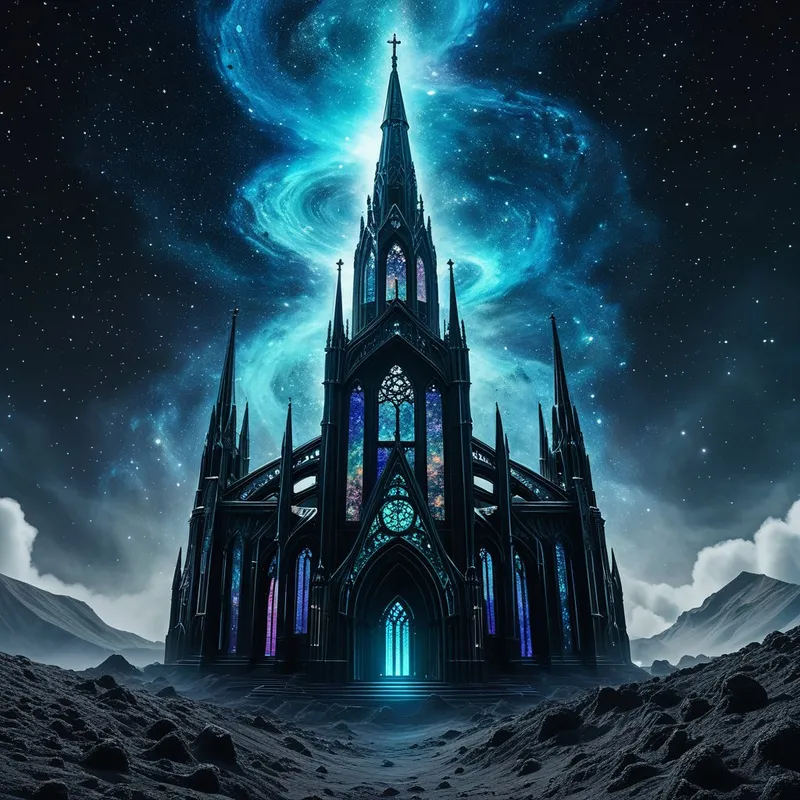
It begins not as a thought, but as a hollowing. A peculiar, resonant silence behind the sternum, a gravity well in the chest where meaning used to pool. The body knows this landscape before the mind dares to name it: a fatigue that sleep cannot touch, a chill in the bones that no fire warms. It is the visceral sense of standing in a familiar room and finding all the furniture gone, the walls stripped of paint, the air itself thin and inert. You feel weightless and yet unbearably heavy, as if you are both the abandoned temple and the ghost wandering its empty halls. This is the somatic prelude to the dream of the Spiritual Void—a cellular recognition that the old maps have dissolved, and the compass needle spins, finding no true north.
The Dreamer's Log
I am in a vast, silent library, but the shelves are empty. Not a single book. The light is a cold, blue glow from unseen panels. I walk for what feels like miles, my footsteps echoing in the cavernous space, searching for any text, any word. Finally, in the center of the main hall, I find a single, ornate lectern. Upon it rests an ancient, leather-bound tome. I open it with trembling hands. Every page is blank.
Alchemical Interpretation: The dreamer’s psyche has archived its old doctrines and dogmas, leaving the conscious self in the sterile server-room of a decommissioned belief system, confronting the terrifying blank page of a scripture not yet written.

The False Lead
This is not depression, though it may wear its cloak. Depression often says, “Nothing matters.” The Spiritual Void whispers a more terrifying, and ultimately liberating, question: “What matters?” It is not the absence of feeling, but the feeling of a specific, structural absence—the vacancy of a central organizing principle. It is not bad luck or a temporary lapse of faith; it is the deliberate, if unconscious, demolition work of the psyche, clearing a collapsed inner sanctuary to make space for a new foundation. To mistake this sacred demolition for mere despair is to pour cement over the excavation site, sealing the potential treasure beneath.
Psychological Architecture
The work here is shadow work of the most fundamental kind: the confrontation with the deus absconditus, the god that has absconded. This is the Individuation process in its most austere phase. You are not integrating a repressed anger or a hidden desire; you are integrating the void itself. The psyche, in its wisdom, has declared bankruptcy on borrowed meaning—the beliefs inherited from family, culture, or trauma that once provided a shaky cohesion. Now, you stand in the ruins, tasked with becoming the architect of your own cosmology.
This architecture is built from experience, not doctrine. Each brick is a moment of raw, unmediated perception—the taste of cold water, the texture of grief, the silent witness to a sunset—mortared together with the question “What is true for me?” It is a terrifying sovereignty. There are no pre-fabricated answers delivered from the mountaintop, only the slow, patient listening to the intelligence of your own nervous system, the quiet authority of your own lived reality. The Void is the blank canvas, and the act of painting is the creation of a soul.
Mythic Resonance
We see this in the Norse myth of Odin, who hangs himself on the World Tree, Yggdrasil, pierced by his own spear, for nine nights. He stares into the primal void, Ginnungagap, and sacrifices his eye to the Well of Mimir for a drink of wisdom. His ordeal is not about gaining power, but about surrendering his old way of seeing—the literal and metaphorical eye—to be rewired in the darkness. The wisdom he gains is not a list of facts, but a restructured consciousness born from enduring the formless. Similarly, the Buddha’s night under the Bodhi tree was a final, total confrontation with the void of Mara’s temptations—the emptiness of all worldly attachments and identities—from which an unshakable, self-born understanding arose.
Symbolic Nodes
- Empty Rooms, Halls, or Vast Plains: The internal landscape stripped of familiar content.
- Blank Pages, Screens, or Canvases: The potential for a new narrative, felt initially as loss.
- Silent Phones, Radios, or Communication Devices: A severed connection to external guidance or consensus reality.
- Deactivated Machinery or Power Sources: The feeling that one’s internal "system" is offline or has no fuel.
- Colorless or Monochrome Environments: The leaching of vibrancy and meaning from the perceptual world.
- Missing Central Objects (a throne, a heart, a light): The specific absence of a core organizing principle.
Archetypal Resonance
The Shadow Sage is the dominant energy in the early stages of the Spiritual Void. This is the archetype of the knower, the teacher, the philosopher—but in its shadow aspect, it becomes dogmatic, judgmental, and rigidly attached to a single, "correct" map of reality. The Void emerges when this internal Sage, the part of us that craves absolute answers and coherent systems, faces a paradox or experience its existing framework cannot explain. The shadow Sage’s response is to go silent, to declare the territory unmappable, and to leave the ego in a state of abandoned, academic despair. Its somatic echo is the cold, dry, analytical detachment that masks a profound grief for lost certainty.
Yet, this shadow holds the alchemical key. The pressure of the Void is what forces the Sage archetype to transmute. It must learn to trade its library of borrowed knowledge for the direct, often wordless, gnosis of experience. It must become less of a professor citing sources and more of a mystic listening to the wind. The potential is for the birth of an authentic Sage—one who teaches from the authority of having survived the emptiness, whose wisdom is rooted not in dogma, but in the fertile soil of the unknown.
The Alchemical Process
The transmutation of the Spiritual Void is the alchemy of Solve et Coagula—Dissolve and Coagulate—applied to the very substance of the self. The Solve stage is the heat: it is the terrifying, necessary dissolution of all that you thought you were, all you believed in, all the identities that once gave you shape. This is the pressure of meaninglessness, the grief for a god that died. It feels like annihilation.
The secret is that the Void is the crucible. You do not transform it; you are transformed by it, within it. The Coagula stage begins not with adding something new, but with a fundamental shift in perception. You stop trying to fill the emptiness and instead begin to perceive the emptiness itself as a substance. It is not a lack of spirit, but a different quality of spirit—one of pure potential, silent awareness, and unmediated presence. Sovereignty is born the moment you realize the blank page is not an indictment of your emptiness, but an invitation to your authorship. The altar is empty because you are being asked to become both the worshipper and the divine.
The Integration Protocol
Question 1: If the central story of my life so far were a book, and that book has now ended, what is the one true sentence—free of plot, character, or moral—that remains from its final page?
Question 2: What small, daily ritual or object did I once infuse with meaning that now feels hollow? Can I feel the hollow space around it without rushing to fill it?
Question 3: If my sense of self were a city, and the Spiritual Void is a district that has been demolished, what old, unsafe structures needed to come down? What is the quality of the light in this new, empty space?
Action 1 (The Empty Vessel Walk): Go for a walk with the sole intention of not seeking meaning, beauty, or insight. Do not listen to music or podcasts. Simply move through space as an empty vessel, noticing sensations—the air on your skin, the sound of your footsteps, the play of light—without weaving them into a narrative. Practice being the void that receives.
Action 2 (Automatic Writing on the Blank Page): Set a timer for 10 minutes. Place a blank piece of paper before you. Without thinking, begin writing the first words that come to mind, even if they are "I have nothing to say. This is stupid. The page is blank." Do not stop. Do not edit. Let the "nothing" express itself. The goal is not to produce content, but to witness the process of something—even if it is resistance—emerging from the void.
Action 3 (Constructing a Personal Relic): Find a small, plain object—a stone, a piece of wood, a simple ring. This object represents the Void. Over the next week, in moments of quiet, hold it. Imprint it with your silent attention, your unanswered questions, your raw presence—not with wishes or prayers, but with the simple fact of your being. Let it become an anchor to the potency of the empty space within.
Final Validation
To dream of the Spiritual Void is to be chosen for a profound and harrowing journey. It is a sign that you have outgrown the spiritual garments you were given, and the discomfort you feel is the friction of a soul expanding against the confines of a borrowed skin. This emptiness is not your failure; it is your eligibility. It means your psyche is courageous enough to dismantle a world that has become too small, trusting—even in its terror—that you contain the blueprints for a vaster one. The silence you hear is not the absence of the divine, but the pause between its old name and its new one, which you are now being asked to speak.