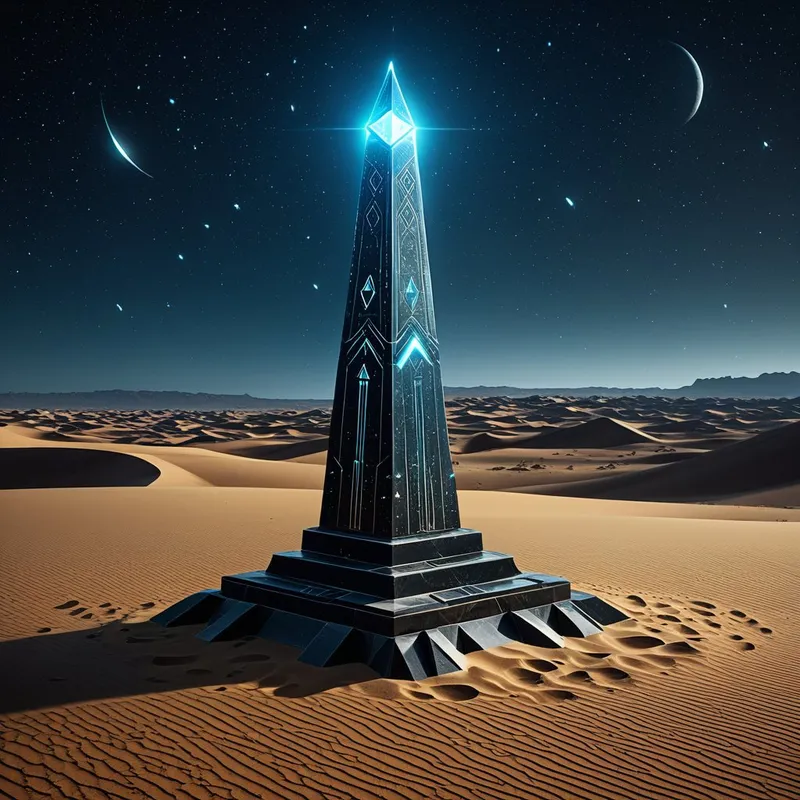
The Unanswered Question: Dreams of Spiritual Inquiry
The Somatic Echo
It begins not as a thought, but as a hollowing. A quiet, cavernous space opens just beneath the sternum, a silent atrium where certainty once hummed. The body knows the absence of meaning before the mind can articulate the question. You might feel a subtle vertigo while standing still, a gravitational anomaly where your internal compass spins freely, unmoored from its old magnetic north. There is a dryness in the throat, not of thirst, but of a voice that has forgotten its prayer. The skin becomes a sensitive membrane, registering the pressure of an unseen, immense question—a pressure that feels less like an attack and more like the atmosphere of a new, unfamiliar world you have already begun to breathe. This is the somatic prelude to the dream of Spiritual Inquiry: the visceral experience of your personal mythology undergoing silent, tectonic shift.
The Dreamer's Log
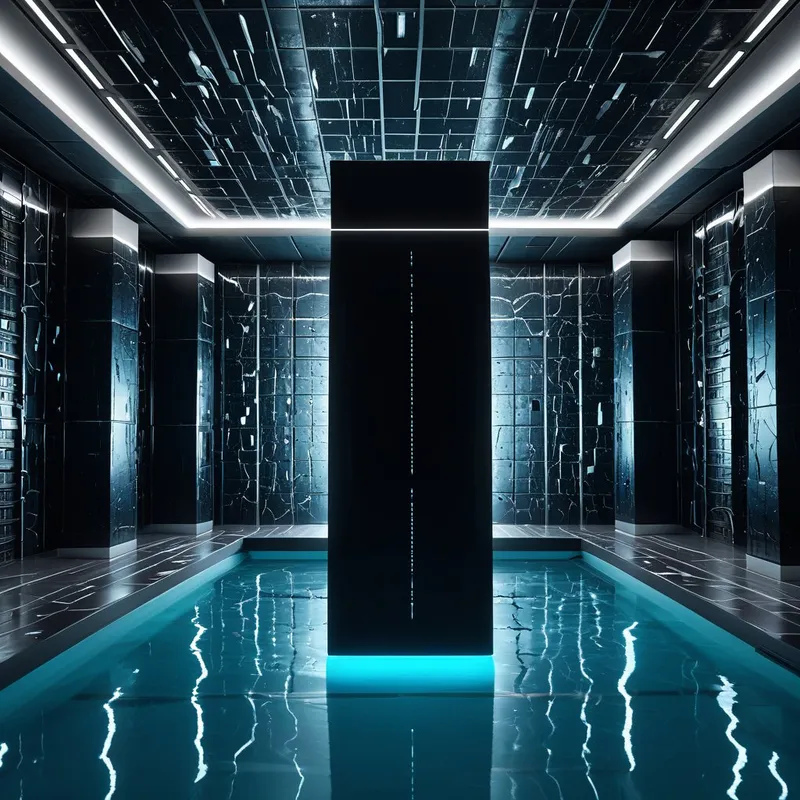
I am in a cavernous, abandoned server farm. Towers of silent, black monoliths hum with a residual energy. In the center of the room, a single obsidian tablet floats above a shallow pool of quicksilver. I approach, and a single glyph glows on its surface—not a word, but a pure, geometric question mark. I reach out, and as my fingers near the stone, the question mark fractures into a thousand shimmering fragments, each reflecting a different, distorted piece of my own face.
Alchemical Interpretation: The dreamer’s psyche has decommissioned the old, externalized servers of dogma and inherited belief, leaving them to confront the primal, liquid mirror of their own essential, unanswerable question.
The False Lead
This is not a dream of simple confusion or “bad luck” in the realm of ideas. Do not mistake the profound, structural silence of Inquiry for the noise of intellectual doubt or philosophical hobbyism. The latter argues with external concepts; the former experiences the internal collapse of the very framework that made argument possible. A dream of failing a theology exam is anxiety. A dream of standing in the vacuum where the exam hall, the textbook, and the professor have never existed—that is Inquiry. This theme is not about finding a better answer, but about enduring the dissolution of the question-answer paradigm itself. It is the death of the spiritual consumer and the agonizing gestation of the spiritual sovereign.
Psychological Architecture
To engage in true Spiritual Inquiry is to consent to a form of psychic demolition. The Shadow work here is the courageous act of becoming an orphan to your own most cherished assumptions. You are not integrating a repressed part of yourself; you are disintegrating the central, organizing principle that held all the parts in a familiar, often comforting, arrangement. This is the Individuation process at its most raw: the Self, in its drive toward wholeness, must first dismantle the incomplete god-image you have been worshipping—the internalized parent, the cultural savior, the logical absolute.
This architecture feels like a controlled collapse. The “I” that believed is not attacked by monsters, but is gently, irrevocably made obsolete by a vaster presence. You witness, from a terrifying new vantage point, the intricate clockwork of your former faith—seeing its beauty, its utility, and its ultimate limitation. The grief is real, for you are mourning a cosmos. The terror is valid, for you are floating in the nihil—the nothing—that is the prerequisite for a new creation. The psyche, in its infinite intelligence, uses the dream space to simulate this apocalypse in symbolic form, allowing you to rehearse the unbearable lightness of being uncreated, so you may later participate in your own re-creation.
Mythic Resonance
We see this universal firmware in the myth of the Buddha under the Bodhi tree. He did not add a new philosophy to his repertoire; he sat in the epicenter of Inquiry, allowing every system—asceticism, desire, the very concept of a permanent self—to arise and be seen through, until nothing remained but the unconstructed suchness of reality. His victory was not an answer, but the permanent embodiment of the question’s end. Similarly, in the Gnostic myth, the divine spark lies trapped in the material world, not by a villain, but by ignorance of its own origin. The quest is not a journey to God, but a remembering as God—a dissolution of the layered false architectures (the archons) of perceived reality. Both myths map the same terrifying, liberating territory: the path to the sacred goes directly through the de-sacralization of everything you thought was sacred.
Symbolic Nodes
- Empty Temples, Decommissioned Libraries, Silent Phones: Structures built for connection or knowledge, now void of their animating spirit.
- Fracturing/Melting Icons & Idols: Statues, crosses, or symbolic objects cracking, dissolving, or turning to sand.
- Vast, Silent Landscapes (Deserts, Tundras, Deep Space): The internal vista of the un-answered, the field of pure potential.
- Mirrors Showing Distortion or Nothingness: The failure of the old self-image to cohere.
- A Single, Glowing Unanswerable Question or Riddle: The irreducible core of the search itself.
- Meeting a Guide Who Offers No Answers, Only a Deeper Silence: The archetypal presence that validates the void.
Archetypal Resonance
The energy of Spiritual Inquiry resonates most powerfully with The Sage Archetype—specifically, the Sage in its crucible phase, before it claims its wisdom. This is not the Sage as a dispenser of knowledge, but the Sage as the eternal student of the abyss. Its core energy is not about having truth, but about holding a sacred, burning fidelity to the quest for truth, even when that quest dissolves the ground of being. The somatic echo of the hollow chest is the Sage’s empty cup, ready to be filled not with doctrine, but with direct experience. The alchemical potential here is the transmutation of dogma into gnosis—of swallowed beliefs into lived, embodied knowing. The Shadow Sage, the dogmatic judge, is precisely what must be sacrificed at this altar; its death throes are the fear that this inquiry is heresy or madness.
The Alchemical Process
The alchemy of Spiritual Inquiry is Dissolution (Solve) followed by a long, fallow period of Fermentation, out of which a new Coagulation may arise. The prima materia is your operating mythology—the unconscious set of beliefs that organize your reality. The intense heat and pressure are applied by the relentless, inner question that refuses to be satisfied with prefabricated answers. This is the athanor, the alchemical furnace: the sustained, uncomfortable state of “not-knowing.”
You must hold the tension between the profound grief of losing your spiritual home and the terrifying freedom of being spiritually homeless. This is the pressure that cracks the vessel. The old, crystalline structures of belief dissolve in this acid bath of sincere doubt. The terror is the fear of eternal emptiness; the grief is for the lost comfort of certainty. The transmutation occurs when you stop trying to rebuild the old temple and instead learn to breathe the open sky. Sovereignty is forged the moment you realize the question itself—the raw, aching pursuit—is more sacred than any answer you could possess. You become the author of your meaning, not the tenant of another’s.

The Integration Protocol
Question 1: What is the oldest, most foundational "truth" I was taught about the nature of reality or divinity? If I imaginatively remove that cornerstone, what happens to the structure of my inner world?
Question 2: In the dream's landscape of inquiry, what was absent? What person, symbol, or source of authority that I usually rely on was notably missing, and how did that absence feel in my body?
Question 3: If my sincere spiritual question were a living entity, not a problem to be solved, what would it look like? How would I relate to it—as a master, a servant, a companion, or a child?
Action 1 (Somatic Anchoring): For one minute each day, place a hand on the hollow of your chest. Breathe into that space without trying to fill it with an idea. Simply feel its dimensions, its temperature, its quality of silence. This grounds the inquiry in the body, preventing it from becoming a frantic, mental chase.
Action 2 (Unstructured Glyph): Take a blank page and with a pen, pencil, or charcoal, allow your hand to draw the "shape" of your unanswered question. Do not draw symbols you recognize (question marks, etc.). Let it be an abstract glyph, a topography of the feeling itself. This creative act externalizes the internal formlessness, giving it a witness.
Action 3 (Ritual of Decommissioning): Choose a small object that represents an old, outworn belief or answer that no longer serves you. In a private ritual, thank it for its service, then decommission it. This could be burying it, floating it down a stream, or placing it in a box marked "Archived Mythology." The physical act ceremonially validates the internal dissolution.
Final Validation
This terrain is not for the faint of heart. To allow your gods to die, to sit in the ruins of your own personal sanctuary, is perhaps the most courageous and disorienting work a soul can undertake. The loneliness is real. The vertigo is warranted. Yet, know this: your dreams are not mocking your confusion; they are honoring its profundity. They are building in you the neural and psychic architecture necessary to host a revelation that is truly your own. You are not lost. You are in the sacred, chaotic, and fertile wilderness between stories. The very ache of the question is proof that you are alive, seeking, and moving—however slowly—toward a dawn you must invent for yourself.