
The Dream of Spiritual Drought: An Alchemy of Emptiness
The Somatic Echo
It begins not as a thought, but as a hollow. A specific, resonant silence in the chest cavity, as if the heart’s chamber has become a dry well. The breath feels shallow, not from anxiety’s clutch, but from a lack of atmospheric pressure—as if the internal climate has shifted, and the air itself holds no nourishment. There is a weight to this lightness, a gravity in the absence. The body becomes a landscape in suspension: dust motes hang in shafts of remembered light, but the wind that once carried meaning has gone still. It is the visceral memory of connection, now experienced only as its ghostly imprint. The throat may feel parched, not for water, but for a word that has been lost. The hands may feel useless, not for lack of skill, but because the gesture they yearn to make has no destination. This is the somatic prelude, the body’s ancient logbook recording a depletion of the subtle, animating force. It is the echo of a spring that has retreated deep underground, leaving the familiar topography of the self eerily, terrifyingly intact, yet fundamentally deserted.
The Dreamer's Log
I am in my own kitchen, but everything is made of bleached, porous bone. I go to the sink, turn the tap. A thin, rusty dust trickles out, hissing as it hits the empty basin. I keep turning, but the handles come off in my hands.
This is not a dream of mere thirst, but of a broken covenant with the inner source. The domestic space turned skeletal reveals the infrastructure of a life stripped of its vital fluids. The act of seeking—turning the tap—only dismantles the mechanism itself, a stark alchemical truth: in a true drought, the old ways of drawing nourishment will not just fail; they will disintegrate in your grasp.

The False Lead
Do not mistake this for depression’s grey fog, though they may share a border. Depression often longs for the oblivion of sleep; a spiritual drought dreams of a well so deep it defies measurement. This is not the burnout of overwork, which is a fire banked to embers. This is the desert that appears after the fire, a landscape scoured clean. It is not a curse of bad luck or a failure of faith. To misinterpret it as such is to pour the last of your water onto salt sand, blaming yourself for the lack of growth. This drought is a structural event. It is the psyche’s necessary, brutal audit, the moment when the underground aquifers shift. The old, accessible wells must run dry so that you are forced to map the deeper, forgotten waterways. It is the indifference of geology, not the cruelty of fate.
Psychological Architecture
Beneath the conscious ache of “feeling nothing” lies a furious, hidden architecture. The drought is a symptom of a profound Shadow negotiation. What has been exiled? Often, it is a core aspect of the Self deemed too wild, too grieving, too passionate, or too demanding for the curated identity you present to the world. You have, perhaps unconsciously, placed an embargo on a certain quality of feeling—a deep grief you cannot afford, a rage that feels dangerous, a creativity that seems frivolous. The psyche, in its infinite wisdom, does not simply hide these exiled parts. It enforces a total embargo. If this cannot flow, then nothing shall flow. The entire system goes into arrears. The lush inner landscape becomes a controlled burn, then a barren plain. This is the Individuation process in its most severe phase: the conscious personality must feel the full cost of its exclusions. It must wander in the desert of its own making until it is humbled, until it is willing to bargain with the very shadows it damned. The ego, the ruler of the conscious realm, must kneel in the dust and listen for the faint, seismic rumble of the underground river it has ignored.
Mythic Resonance
We see this in the stark journey of the Sumerian goddess Inanna. To descend to the underworld and meet her dark sister Ereshkigal, she must pass through seven gates, surrendering a piece of her royal regalia at each—her crown, her lapis beads, her gown. She arrives naked and bowed. The myth is not about loss, but about the necessary divestment of all that defines one in the upper world. The spiritual drought is that stripping. Each forgotten joy, each sense of connection, each certitude is a garment left at a gate. You are not being punished; you are being reduced to your essence. Likewise, the Fisher King of Arthurian legend presides over a Wasteland, a kingdom where the crops fail and the rivers run dry, mirroring his own unhealed wound. The land and the king are one. Your inner drought is your own wasteland, a direct reflection of a sovereignty that has forgotten how to ask the vital, healing question.
Symbolic Nodes
- Deserts of Glass or Bone: Sterility taken to a polished, reflective extreme. A landscape that shows you only your own isolation.
- Empty Pipes, Taps, Aqueducts: The man-made systems of delivery are intact but void. A critique of relying solely on engineered, controlled channels for spirit.
- Dust that Refuses to Settle: An atmosphere charged with absence, a suspended state where nothing can grow or truly rest.
- A Sun that Provides Light but No Warmth: Illumination without nourishment, knowledge without wisdom, seeing the path but feeling no pull to walk it.
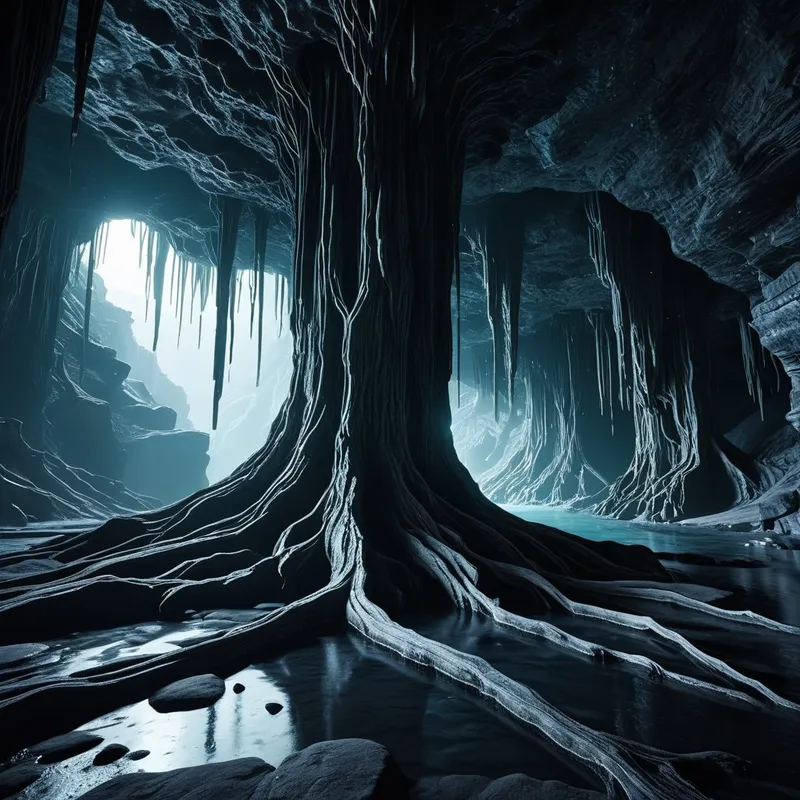
- Petrified Trees or Forests: Life frozen in a moment of gesture, form without flow, memory without sap.
Archetypal Resonance
The Shadow Ruler is the archetypal governor of this barren land. This is not the benevolent sovereign, but the control-freak, the tyrant of the interior. It is the part that, in a desperate bid for order and predictability, has dammed the wild rivers of instinct and emotion, has clear-cut the forests of messy creativity, and has mandated efficiency in the realm of soul. The somatic echo of dryness is the direct result of this tyrannical over-management. The Shadow Ruler believes it is preventing chaos, but it is enforcing a deadening peace. Its alchemical potential, however, is immense. The drought is its ultimate failure, the crisis that forces this tyrannical aspect to its knees. In that surrender, the true Sovereign can emerge—not as a controller, but as a steward who understands that true power lies in collaboration with the wild, deep, and often unpredictable forces of the psyche. The Ruler must learn to serve the kingdom of the Self, not enslave it.
The Alchemical Process
The transmutation here is from Barren Control to Fertile Surrender. The alchemical agent is not fire, but absence itself—the Vacuum. In the laboratory of the soul, nature abhors a vacuum. But the psyche requires it. The intense pressure of the drought, the heat of a meaningless sun, creates this vacuum. This is the nigredo, the blackening, where all color and life seem to flee. The old, contaminated waters must fully evaporate. This process feels like annihilation. Yet, within this vacuum, a profound recombination becomes possible. Particles of memory, shards of discarded passion, and atoms of unlived life, stripped of their old associative forms, begin to resonate at a different frequency. They are no longer bound by the old ruler’s laws. The first hint of transmutation is often a subtle, almost imperceptible shift in the quality of the emptiness—from a hollow of lack to a chamber of potential. It becomes a listening vessel. Then, from a place deeper than the old wells, a new kind of moisture begins to seep. It is not the familiar water of old feelings, but a living, silver mercurial fluid—the spontaneous, intelligent life of the psyche that arises when control finally relinquishes its grip.
The Integration Protocol
Question 1: Where in my life have I, consciously or not, declared an embargo on a specific emotion or desire, believing it was too dangerous or costly to feel? Question 2: If this inner drought is not a punishment, but a necessary clearing of an outdated system, what old "irrigation method" (a belief, a goal, a identity) is finally breaking down? Question 3: What tiny, "useless" thing still holds a faint charge of aliveness or curiosity for me in this barren landscape? (A forgotten object, a fragment of music, a memory of a texture.)
Action 1 (The Useless Gesture): Once a day, perform a small, deliberate action that serves no practical purpose. Pour water onto a stone and watch it evaporate. Draw a shape in the dust. The goal is not creation, but to re-establish a relationship with gesture itself, outside of utility. Action 2 (Mapping the Aquifer): Engage in unstructured, non-linear writing. Let the pen move without a topic. If you feel nothing, write "I feel nothing" until the sentence morphs. Do not seek insight; act as a scribe for the emptiness, mapping its contours. This is creative archaeology of the void. Action 3 (The Dust Ritual): Go outside at dusk. Take a handful of dry earth or sand. Hold it and acknowledge it as the raw material of your current inner state. Then, slowly let it fall from your fingers, whispering one thing you are allowing to be empty, to be fallow. Do not ask for rain. Simply consecrate the fallowness.
Final Validation
This aridity is real. The thirst is not an illusion. To feel this hollowing out is one of the most disorienting trials of a conscious life. It is the universe within you contracting to a single, silent point before a new expansion. You are not broken; you are in geologically significant time. The very dust you walk upon is the powdered residue of what once was, and what will be again, in a form you cannot yet imagine. Your sovereignty is not found in forcing the spring, but in having the profound courage to stand in the desert, to feel its full, terrible clarity, and to declare: I am here. And even this, is part of me. From that acceptance, the first, secret drop begins to form.