
The Desert Within: Alchemy of Spiritual Aridity
The Somatic Echo
It begins not as a thought, but as a texture. A hollowness behind the sternum, a cavity where resonance used to live. The body becomes a vessel of absence. The breath feels shallow, drawn into a space that offers no echo, no return. There is a subtle, pervasive dryness—not of the skin, but of the spirit’s membrane. The world’s colors mute, not to grey, but to a kind of high-resolution beige; everything is technically present, yet fundamentally distant. This is the somatic signature of spiritual aridity: a living system experiencing a critical drop in its own internal pressure, a silent alarm that the wellsprings of meaning have retreated deep underground.
The Dreamer's Log
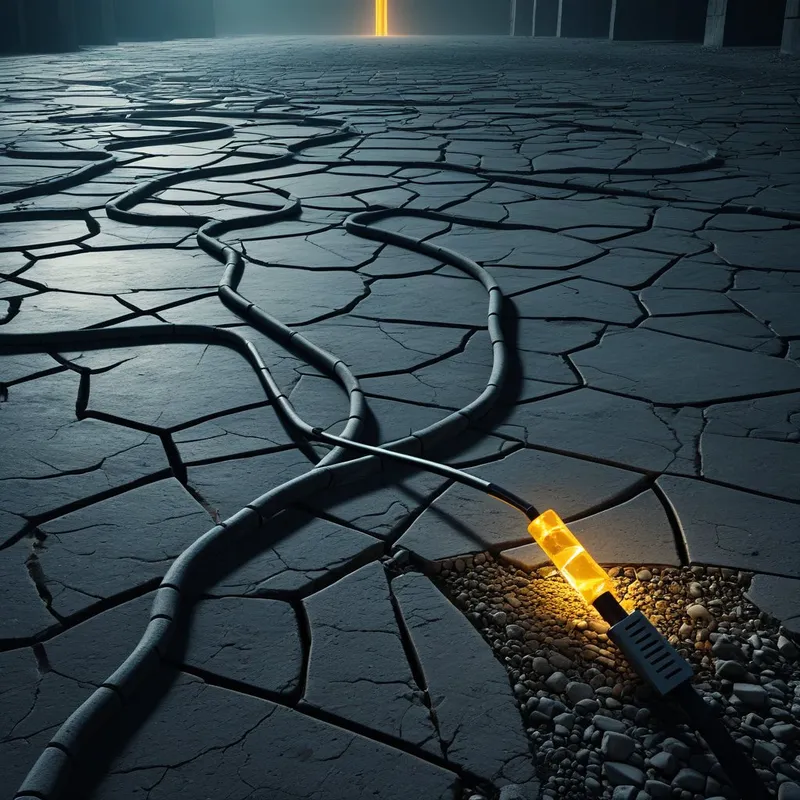
The dreamer stands in the center of a vast, derelict server farm. Endless rows of monolithic towers hum with a low, exhausted frequency. They trace a single, brittle fiber-optic cable along the concrete floor. It leads not to a terminal, but to a dry riverbed etched into the concrete, the cable lying like a dead root in its center. The dream ends with them placing a hand on a cold server face, feeling only the vibration of meaningless computation.
Alchemical Interpretation: The psyche maps its inner drought onto the image of a once-potent system now running on empty, its vital data-streams reduced to a barren, symbolic riverbed.
The False Lead
This is not depression, though it may share its climate. Depression often feels like a heavy, wet blanket; spiritual aridity is the absence of moisture itself. It is not mere boredom, the restless seeking of novelty. Nor is it the logical conclusion of atheism or skepticism. Those are positions of the mind. Aridity is a condition of the soul. It is the specific terror that arises when the internal symbols—the gods, the values, the inner figures that once organized your love and your fear—have completed their lifecycle and dissolved, leaving a governance vacuum. It is the structural silence between mythologies.
Psychological Architecture
To understand this silence, we must speak of the Shadow’s most subtle operation. We often imagine Shadow work as confronting a monster in a basement. But what of the Shadow that is not a repressed figure, but a repressed void? Spiritual aridity is the experience of that void becoming conscious. It is the "Orphan" part of the psyche, having outgrown its old familial gods—the inherited beliefs, the borrowed passions—and now standing utterly alone in the universe, waiting for a sovereignty it cannot yet imagine.
This is the Individuation process in its most austere phase. The ego, accustomed to being a citizen in a populated inner kingdom, finds the streets empty. The temples are vacant. The old prayers echo and return unanswered. This is terrifying because it feels like a failure of the spirit, but it is, in fact, a ruthless act of psychic hygiene. The psyche is clearing the stage. It is dissolving the worn-out internal objects so that what is truly yours, not inherited or implanted, can eventually coalesce from the formless potential of that very void. The drought kills off the shallow-rooted plants so the deep taproot may finally be forced to seek its own source.
Mythic Resonance
We see this in the myth of the Fisher King, ruler of a land that mirrors his own inner wound—a barren kingdom where the rivers are clogged, the crops fail, and life is suspended in a state of impotent waiting. The wasteland is not outside him; it is his spiritual condition made manifest. The quest for the Grail, the vessel of ultimate sustenance, cannot begin until the aridity of the land (and the king) is fully acknowledged as the central problem. Similarly, the biblical forty years in the desert was not merely a punishment, but a necessary alchemical process. A generation born into slavery—a psyche structured by external oppression—had to die off. The desert’s merciless aridity burned away the slave mentality, creating the empty, cleansed vessel capable of entering a covenant of self-governance. The promised land cannot be reached by those who still dream of Egypt’s onions.
Symbolic Nodes
- Deserts & Wastelands: The classic landscape of the theme, representing a psychic ecology devoid of nourishing symbolism.
- Empty Wells, Dry Pipes, Dead Batteries: Images of failed conduits, systems designed for flow that now deliver nothing.
- Static, White Noise, Blank Screens: The sensory correlate of meaninglessness—data without signal, presence without communication.
- Dust, Ash, Fine Sand: The residue of something that has been burned away or ground down to its inert essence.
- Derelict Megastructures: Empty temples, abandoned libraries, silent server farms—architectures of meaning that now stand vacant.
Archetypal Resonance
The Shadow Sage is the archetypal governor of this terrain. The Sage seeks truth, understanding, and the fundamental principles of reality. Its shadow emerges not as outright dogma, but as the chilling realization that all current frameworks of understanding have become empty, that the maps no longer describe the territory. The somatic echo of aridity—the hollow, dry, distant feeling—is the Shadow Sage’s "knowing" that it does not know, and that its previous knowledge was an illusion. This is not the folly of the Innocent, but the devastating clarity of the Sage turned inward upon its own foundations. The alchemical potential here is immense: this arid, deconstructive force is the necessary solvent that dissolves the philosopher’s stone of borrowed wisdom, creating the pristine emptiness in which a personal, lived gnosis—a true, embodied Sage—might one day crystallize.
The Alchemical Process
The transmutation of spiritual aridity is the alchemy of Calcination—the burning down to white ash. The heat is not dramatic passion, but the slow, relentless pressure of the void itself. The grief is for the lost gods; the terror is of the unformed self. The process demands a paradoxical action: one must fully consent to the desert. Do not rush to plant flags in the dunes or pretend to see mirages as oases. Sit in the dryness. Feel the hollow. Let the winds of meaninglessness scour you.
This is where the false self, the identity built upon received meaning, is incinerated. It is a death, but a necessary one. The sovereignty that emerges is not a new set of answers, but a radical change in your relationship to the questions. You are no longer a tenant in a house of meaning built by others; you become the silent, open ground upon which any authentic structure must be founded. The ash left from this calcination is not worthless; it is the prima materia, the essential, stripped-basic self, purified of attachment and ready for the eventual, mysterious infusion of a water that comes from a deeper aquifer than you knew existed.

The Integration Protocol
Question 1: Where in my life have I been performing the rituals of meaning (seeking, striving, believing) without feeling the corresponding inner resonance? What has become a dry habit?
Question 2: If this inner emptiness is not a failure, but a cleared space, what is the most terrifying possibility that this space could allow to form?
Question 3: What small, dry, or "dead" thing in my current reality (a routine, an object, a relationship dynamic) might be the exact, perfect symbol of this inner aridity?
Action 1 (The Dry Inventory): For one week, carry a small notebook. Do not write about feelings. Instead, objectively log every instance where you encounter a literal "dryness," "emptiness," "static," or "silence"—a dead plant, an empty gas tank, a dropped call, a stale cracker, a silent room. Note only the fact. This grounds the vast theme in tangible, daily phenomena.
Action 2 (Unstructured Mark-Making): Take a large piece of paper and a drawing tool (charcoal, pastel, ink). Set a timer for 5 minutes. Without intending to draw an "image," allow your hand to make marks that feel like the somatic echo of aridity—scratchy, faint, hesitant, hollow-centered, dusty. Let the body express the texture directly, bypassing the mind's need for a symbol. Then, place the drawing somewhere you will pass by, without analyzing it.
Action 3 (The Vessel Ritual): Find a bowl or cup. Each morning for a week, go outside (or to a window) and place it on the ground. State aloud: "I am an empty vessel." Leave it for an hour. Bring it in. Do not fill it with water. Simply observe it as an object that is clean, open, and capable of receiving. This ritualizes the state of receptive emptiness, transforming it from a condition of lack to one of potential.
Final Validation
The desert is not your enemy. It is your most severe and honest mentor. To feel this aridity is not a sign of a broken spirit, but of a spirit that has outgrown its old containers and is now, courageously, enduring the terrifying grace of being unmade. The silence you hear is not the absence of the divine, but the pause between its old name and its new, unknown one. Your willingness to stand in this drought, without fleeing into the first oasis of easy meaning, is the deepest act of faith you can currently perform. It is from this purified, empty ground that the only water worth drinking will eventually, and inevitably, rise.