
The Crucible of the Soul: Dreaming of Spiritual Adversity
It begins not as a thought, but as a hollowing. A visceral vacancy in the solar plexus, a cold, leaden weight where warmth and certainty once resided. The breath becomes shallow, held captive by an invisible constriction around the ribs. There is a metallic taste on the tongue, the somatic echo of a prayer that turned to ash before it could be spoken. This is the body’s knowing, long before the mind can articulate the crisis: the sacred ground is shaking. The inner sanctuary, once a place of refuge, now feels like a sealed tomb or a betrayed covenant. This is the prelude to the dream of spiritual adversity.
The Somatic Echo
The architecture of faith, whether in a god, a purpose, or the essential benevolence of existence, is held not in the intellect but in the nervous system. Its collapse is first a physiological event. The gut, that ancient seat of intuition, tightens into a knot of dread. The heart-space, the chamber of connection, feels armored, its door slammed shut from the inside. There is a profound fatigue in the bones, the weariness of an exile carrying the weight of a homeland that no longer recognizes them. This is the alchemical nigredo, the blackening—not a mood, but a cellular truth. The body is preparing the psyche for a dismantling so complete, only a new foundation can be built upon its ruins.
The Dreamer's Log
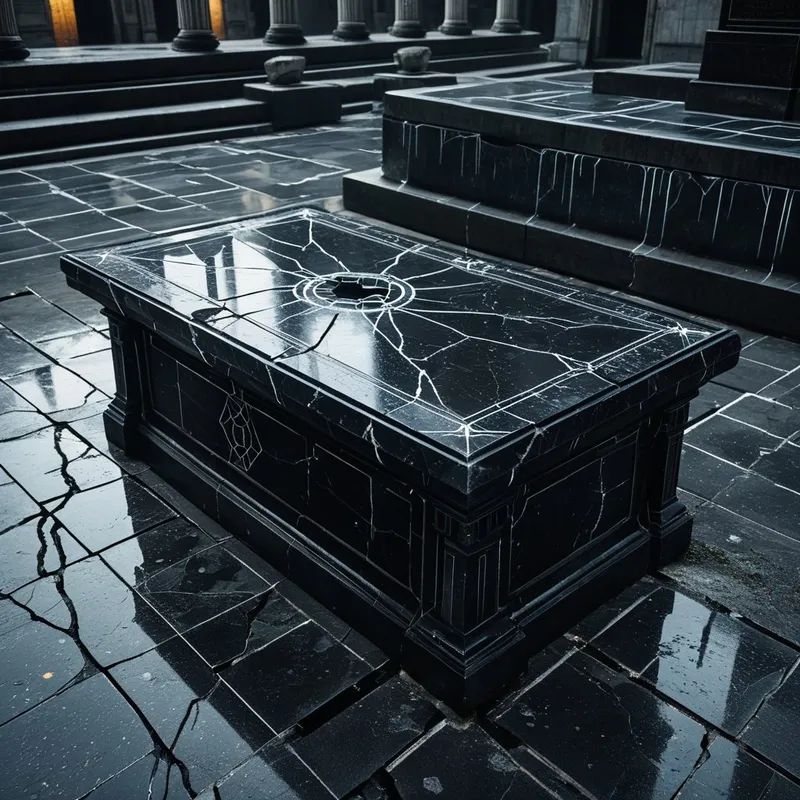
The dreamer stands before a familiar altar, but it is made of cracked, cold marble. They try to light a candle, but the wick is damp stone. They reach for a sacred text, but the pages are blank, the ink bled away into the paper’s grain. A voice, once a guide, now echoes as a distorted, mechanical hum from rusted speakers overhead.
This is not a dream of mere doubt, but of a sacred language failing. The symbols have lost their charge; the rituals, their connective power. The alchemical interpretation is clear: The old covenant is dead, and the dreamer is being forced to author a new one, word by silent, terrifying word.
The False Lead
This theme is not a sign of personal failure, divine punishment, or simple "bad luck" in one's spiritual life. To mistake it for such is to remain in the role of the victim, the orphaned believer. Spiritual adversity in dreams is not the absence of the sacred, but its most intense, paradoxical presence. It is the sacred itself, in the form of the deus absconditus—the hidden god—initiating a contact so profound it must first destroy all previous forms of contact. It is the difference between losing your map in a familiar park and having the very stars by which you navigate wink out, one by one, in an alien sky. The latter is not abandonment; it is an invitation—a brutal, necessary one—to learn a deeper form of navigation.
Psychological Architecture
Here, the psyche performs its most daring act of shadow work. The part of us that constructed our spirituality—the inner priest, the devoted student, the faithful child—comes face-to-face with its own limitations. This is not an enemy, but a loyal servant whose contract has expired. The adversity dream forces a confrontation with the shadow aspects of our faith: the dogma we clung to for safety, the idealized projections onto gurus or concepts, the unspoken bargaining (“If I am good, I will be protected”). The individuation process demands we reclaim these projections. We must become the author of our own meaning, the keeper of our own mystery, even when—especially when—the old templates crumble. It is the death of spiritual consumerism and the birth of spiritual sovereignty.
Mythic Resonance
We see this in the harrowing of Inanna, the Sumerian goddess who must descend through seven gates, stripped of her regalia at each one, to meet her shadow sister Ereshkigal in the underworld. Her ascent, and her return to power, is only possible after this utter desolation. Similarly, the biblical Jacob wrestles the angel not in a temple, but in a lonely, dark river crossing. He does not receive a blessing for his piety, but for his relentless, wounded grappling. He is injured in the process and walks with a limp ever after—a permanent somatic echo of the night his spiritual identity was broken and remade. These are not stories of reward for faith, but testaments to the transformation forged in its apparent withdrawal.
Symbolic Nodes
- Broken or Desecrated Altars/Temples: The failure of former sacred containers.
- Muted or Distorted Sacred Sounds: Prayers that don't echo, hymns that sound like static.
- Unreachable Guides: Teachers who turn away, statues with blindfolded eyes.
- Barren Ritual Objects: Empty chalices, extinguished flames, blank pages.
- Hostile or Indifferent Sacred Landscapes: A once-beautiful grove now petrified or overgrown with thorns.
- A Testing Figure: An impersonal judge, a sphinx, a silent guardian blocking a sacred path.
Archetypal Resonance
The energy here is most potently that of The Shadow Sage. The Sage archetype seeks truth and understanding, offering guidance from a place of hard-won knowledge. Its shadow, however, manifests as the dogmatic, judgmental inner voice that claims absolute truth while being severed from lived, experiential wisdom. In spiritual adversity, this Shadow Sage is the internalized critic that declares the search over and failed, that judges the dreamer’s doubt as a terminal flaw. Its activation is the crisis. Yet, within this very energy lies the alchemical potential: to transmute the Shadow Sage’s harsh, final judgments into the authentic Sage’s humble, curious, and ever-questioning pursuit of a personal, experiential truth. The pressure of the adversity is meant to break the dogma to free the wisdom.
The Alchemical Process
The transmutation of spiritual adversity is the alchemy of the mortificatio and sublimatio. The mortificatio is the necessary death: the dissolution of the spiritual ego, the idealized self-image as "the enlightened one" or "the faithful devotee." This is the intense heat—the grief, the terror, the profound disorientation. The psyche is pressured until every borrowed belief, every unexamined assumption, cracks open.
Then, through sublimatio, the essence trapped within those rigid forms is released. The raw longing for the divine, the pure yearning for meaning, is separated from the outdated symbols that once carried it. It rises, like a vapor, to reconstitute at a higher level of complexity. You do not rebuild the same temple. You discover that the sacred was never confined to the temple at all, but is the very ground of being upon which you stand, shivering and awake. The sovereignty gained is not over a spiritual answer, but over the sacred question itself—the capacity to hold the mystery without needing to solve it.
The Integration Protocol
Question 1: Where in my dream, or in my waking sense of emptiness, can I detect not just an absence, but a specific, painful pressure? What exact shape of certainty is being dissolved?
Question 2: If my old spiritual language (prayers, concepts, practices) has gone silent, what is the most honest sound my soul can make right now? A groan? A sigh? A single, unadorned word?
Question 3: What small, forgotten, or "unholy" part of myself did my previous spirituality ask me to exile? How might this very part hold a key to a more authentic connection?
Action 1 (Somatic Re-grounding): For one week, perform no spiritual practice you "should" do. Instead, each day, place both hands on your solar plexus. Breathe into the hollow or the tension there for five minutes. Do not seek to fill it or fix it. Simply acknowledge its presence as a real, valid landscape within you.
Action 2 (Unstructured Writing): Set a timer for 10 minutes. Write a letter to the "Silent God" or the "Absent Meaning." Do not write what you think you should say. Write from the hollowness, the anger, the confusion, the petulant child, the weary adult. Let the letter be blasphemous, messy, and true. Do not send it. Burn it or bury it as a ritual of releasing the old dialogue.
Action 3 (Found-Object Altar): Create a small, private space. Do not place any traditional sacred objects there. Instead, place three objects you find in the next 48 hours that, for reasons you cannot logically explain, call to you. A peculiar stone, a piece of weathered wood, a discarded cog. Let this be an altar not to known gods, but to the mystery of your own attraction. Observe it without interpretation.
Final Validation
The path of spiritual adversity is the most lonely and the most universal. To feel this fracture is not a sign that you have lost the way, but a brutal, sacred evidence that you are on the way—the real way, which always leads through the desert of your own unmet expectations. The darkness you navigate is not the absence of the light, but its birthplace. You are not being abandoned. You are being asked, in the most profound way possible, to become the very thing you seek.