The Somatic Echo
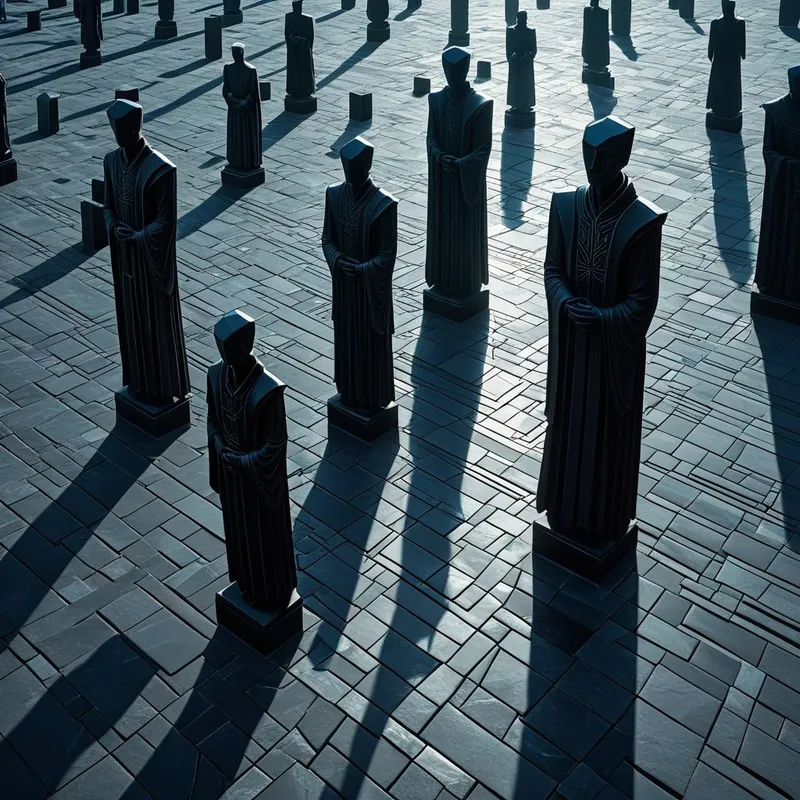
Before the mind conjures the courtroom, the ballroom, or the silent, judging crowd, the body knows. It is a cold, metallic weight in the solar plexus—a sinking anchor. It is the sudden, hollow chill that floods the chest, as if the heart has been replaced by a vacuum. The skin prickles with a phantom awareness of unseen eyes, a sensation of being microscopically examined and found wanting. The breath becomes shallow, held captive by an invisible corset of expectation. This is the somatic echo of social standing: not a thought of hierarchy, but a visceral, pre-verbal experience of existential placement. It is the ancient, limbic system firing its oldest signal—the terror of exile from the tribe, translated into the modern vernacular of status anxiety.
The Dreamer's Log
I am standing at the edge of a grand, silent ballroom. The floor is polished to a liquid black, reflecting the chandeliers like drowned stars. Everyone is dancing a complex, perfect waltz, their movements synchronized to a music I cannot hear. I look down and see I am wearing simple, rough-spun clothes. A single, ornate silver chair sits on a dais at the far end, empty. I know, with absolute certainty, that I am meant to sit in it, but my feet are rooted to the spot. The dancers do not look at me, yet I feel the entirety of their silent judgment.
This dream is not about literal ambition, but the alchemy of the authentic self confronting the internalized protocol of belonging. The empty throne is not a goal, but a symbol of the sovereign space one fears to occupy.

The False Lead
Do not mistake this theme for a simple desire for popularity or a fear of embarrassment. Those are its surface ripples. The deep current is not about moving up a ladder, but about the fundamental architecture of the ladder itself within your psyche. It is not a dream of "bad luck" or social clumsiness. It is a profound signal about the negotiation between your innate, wild authenticity and the internalized social contract—the invisible rules you absorbed about worth, visibility, and permission to exist in your full form. A dream of social standing asks not "How do I rise?" but "Upon what ground do I truly stand?"
Psychological Architecture
The work here is shadow work of the most intimate kind: an excavation of the internal council. Imagine your psyche not as a single self, but as a chamber populated by various "parts" or internal family members. There is the part that learned to be small to avoid a parent's criticism, the part that performs excellence to earn love, the part that rebels against all structure, and the ancient child who just wants to belong. The dream of social standing is often this internal council in session, debating your right to take up space. The judgmental crowd in the dreamscape is frequently a projection of these internalized voices—the critic, the conformist, the exile—masquerading as strangers. The individuation process demands you turn toward this internal assembly, not the phantom external jury. It requires you to differentiate your own voice from the chorus of inherited shoulds and conditioned musts, to move from being a subject of an internal kingdom to becoming its conscious sovereign.
Mythic Resonance
Consider the story of Psyche. Her tasks are not trials of strength, but of social and spiritual navigation: sorting a mountain of seeds (differentiating the true from the false), gathering golden fleece from violent rams (harvesting value from dangerous, masculine energy), and descending to the underworld (facing the ultimate shadow). Each task is set by a jealous Venus, the archetype of sanctioned, celestial social standing. Psyche’s journey is one of moving from a position of being gazed upon (as a mortal beauty) to becoming a conscious actor who must negotiate impossible hierarchies—divine, natural, and chthonic—to claim her own divinity. Her apotheosis is not a promotion, but a transformation of her very nature, earned through navigating the terrifying architecture of a cosmos that initially had no place for her.
Symbolic Nodes
- Empty Thrones, Head Tables, or Podiums: The unclaimed space of personal authority.
- Ill-Fitting or Absent Clothing: A dissonance between the role one is playing and the skin one inhabits.
- Silent, Watching Crowds: The internalized chorus of judgment and expectation.
- Invisible Barriers (Glass Walls, Force Fields): The perceived, often self-constructed, limits of one's social sphere.
- Being Late or Unprepared for a Ceremony: Anxiety about missing one's moment or being fundamentally unready for one's own life.
- Shifting, Unstable Ground (Ice, Sand): The perceived lack of a solid foundation for one's social identity.
Archetypal Resonance
The energy at the core of the social standing dream is most potently that of The Shadow Ruler. This is not the sovereign in their power, but the tyrant in its anxiety—the part that seeks control over external perception because it feels no true authority within. Its somatic echo is that cold, controlling grip in the gut, the rigid posture belying a fear of collapse. It manifests as the dream's silent, judging crowd and the obsession with the empty chair—a focus on the symbol of power because the substance of inner sovereignty feels absent. The alchemical potential lies in recognizing this shadow not as a monster to slay, but as a terrified guardian of a fragile, internal kingdom. By listening to its fears of chaos and exile, we can begin the work of building genuine, internal governance based on authentic law, not inherited dogma, thus transmuting the shadow ruler's need for external control into the true ruler's capacity for inner order and compassionate authority.
The Alchemical Process
The transmutation here is from hierarchy to ecology. The base metal is the leaden belief that worth is a scarce resource doled out from above, creating a psychic landscape of ladders, thrones, and excluded spaces. The alchemical fire is the intense, often painful, heat of self-confrontation—the pressure of asking, "Who am I when no one is watching? What do I value when no one is awarding points?" This process dissolves the rigid, internal caste system. In its crucible, the need for standing is broken down into its elemental parts: the need for belonging, the need for respect, the need for expression, the need for safety. These are then reconstituted not into a pyramid, but into a network—a personal ecology where each part of the self has a rightful, respected place, connected not by rank but by mutual necessity. The gold produced is sovereignty: the unshakable, internal knowing of your own center of gravity, from which you can engage with any external social field without losing your fundamental ground.

The Integration Protocol
Question 1: In the dream's social landscape, what is the one rule you are most afraid of breaking? Where did you learn that rule?
Question 2: If the judging figures in the dream were parts of your own psyche, what is each one most desperately trying to protect you from?
Question 3: What would your body feel like if you were standing on ground that was completely, irrevocably your own?
Action 1 (Somatic Re-grounding): When you feel the somatic echo—the cold weight, the shallow breath—place both feet firmly on the floor. Imagine roots descending from your soles, not into dirt, but into a bedrock of your own choosing. With each exhale, send a pulse of acknowledgment down those roots, not seeking stability from the earth, but declaring your own presence to it.
Action 2 (Council of Parts): Create a simple, unstructured drawing. Sketch a circle. Inside, using symbols, colors, or abstract shapes, map out the "internal council" from your dream—the performer, the critic, the exile, the rebel. Do not judge the art. Then, on a separate page, write a single sentence from the perspective of the empty chair or the silent space you were meant to occupy. Let it speak.
Action 3 (Ritual of Re-contextualization): Take a small, ordinary object that feels somehow "beneath" you or unworthy of your current desired standing (a pebble, a cheap pen, a simple cup). For one week, treat this object with absolute, deliberate reverence. Place it prominently. Handle it with care. This is not about the object, but a practice in withdrawing projected value judgments and reinvesting authority into your own act of attention.
Final Validation
It is profoundly human to feel this tremor in the soul's foundation, to dream in the language of courts and crowds. This anxiety is not a sign of personal failure, but a testament to your psyche's engagement with one of the most complex human dramas: the dance between the individual and the collective. The very discomfort is the friction necessary for creation. By turning toward this dream, you are not admitting weakness; you are initiating the most courageous act of sovereignty—auditing the invisible laws of your inner kingdom so you may, with clear eyes and a steady heart, begin to write your own.