
The Mirror in the Dark: Dreams of Self-Perception
The dream of self-perception is not a thought. It is a tremor. It arrives not as a concept, but as a seismic event in the inner landscape, a shift in the bedrock of who you believe yourself to be. Before the mind can narrate, the body registers the fault line.
The Somatic Echo
It begins in the hollow of the throat—a constriction, a sense of a mask fused to skin. It spreads as a cold, metallic taste, the flavor of a lie you’ve been swallowing. You feel it in the disconnect between your hand and the reflection’s wave, in the vertigo of stepping forward and feeling the ground give way beneath an identity you thought was solid. This is the visceral signal of the psyche’s mirror neurons firing at their own reflection, encountering not a familiar face, but a stranger wearing your history. The echo is one of profound disorientation, a homesickness for a self you have not yet met.
The Dreamer's Log
You stand before a bathroom mirror in a house you don’t recognize. The glass is fogged and cracked. You wipe it clean, but your reflection remains a blurred, pixelated distortion. From the edges of the frame, thin streams of glowing, liquid data begin to drip, pooling at the sink’s basin, which is filled not with water, but with a dark, viscous oil.
This is the dream of the fractured interface, where the technology of identity—the stories, roles, and masks—has corrupted the signal of the essential self, leaving only noise and leakage where clarity should be.

The False Lead
This theme is not about mere insecurity or a “bad self-image.” Those are its symptoms, its surface weather. To mistake it for simple low confidence is to confuse the earthquake for the rattling window. This is deeper: it is the structural revelation that the foundation upon which you’ve built your “I” is comprised of borrowed materials—parental expectations, cultural scripts, trauma responses, the curated persona. The terror here is not of being ugly or incompetent, but of being unreal. The grief is not for a flawed self, but for a true self you have been exiled from.
Psychological Architecture
The work here is the most intimate form of archaeology. It is Shadow work of a foundational order. You are not just retrieving a repressed emotion or a denied talent; you are dismantling the ego’s citadel, brick by psychic brick. This is the Individuation process in its raw, middle passage. It feels like betrayal—betrayal of the family system that needed you to be a certain way, betrayal of the social self that earned you love and safety. You meet the internal orphans who adapted, the rebels who were jailed, the rulers who were overthrown by external demands. To perceive yourself truly is to sit in council with these exiled parts, not as a dictator, but as a sovereign listening for the first time to the true needs of the realm. The architecture that falls is the false self; the one that emerges, often painfully slow, is built on the bedrock of authentic experience.
Mythic Resonance
We see this in the tale of Narcissus, but misunderstood. The tragedy is not his love of a beautiful image, but his failure to recognize it as an image. He falls for the reflection, the surface, and dies of thirst inches from the nourishing pool. The myth warns of the fatal error: mistaking the persona for the soul. Similarly, in the Japanese legend of Yuki-onna, the snow woman appears as a breathtaking beauty, but her true, icy nature is revealed only in intimate proximity. She mirrors the danger of a self-perception built on ethereal, untouchable ideals that cannot sustain the heat of real relationship and will freeze the heart that tries to hold them.
Symbolic Nodes
- Distorted/Missing Reflections: In mirrors, water, windows.
- Unrecognizable Homes or Rooms: The inner architecture is foreign.
- Malfunctioning Technology: Glitching screens, static, corrupted files.
- Ill-Fitting or Changing Clothing: Roles that no longer suit the form beneath.
- Being an Imposter/Unmasked: In a familiar setting where you “belong.”
- Faceless Figures or Beings: The unknown, unintegrated aspects of self.
Archetypal Resonance
The core energy here is that of The Sage Archetype, specifically in its latent or emerging state, and its shadow, The Shadow Sage (Dogmatic/Judgmental). The Sage’s quest is for truth and self-knowledge. The somatic echo—the metallic taste, the vertigo—is the Sage’s inner compass detecting false data. The entire alchemical process is a Sage’s journey: to question every assumption, to seek the underlying pattern beneath the personality’s noise. Yet, the Shadow Sage is the active force we initially contend with: the internal, dogmatic voice that insists the old, borrowed identity is the truth, that judges any deviation from the known script as failure or madness. The struggle is between the Shadow Sage’s rigid, inherited narrative and the true Sage’s patient, penetrating drive to see what is, not what should be. The potential is to move from being judged by an internal dogma to becoming the compassionate witness of your own becoming.
The Alchemical Process
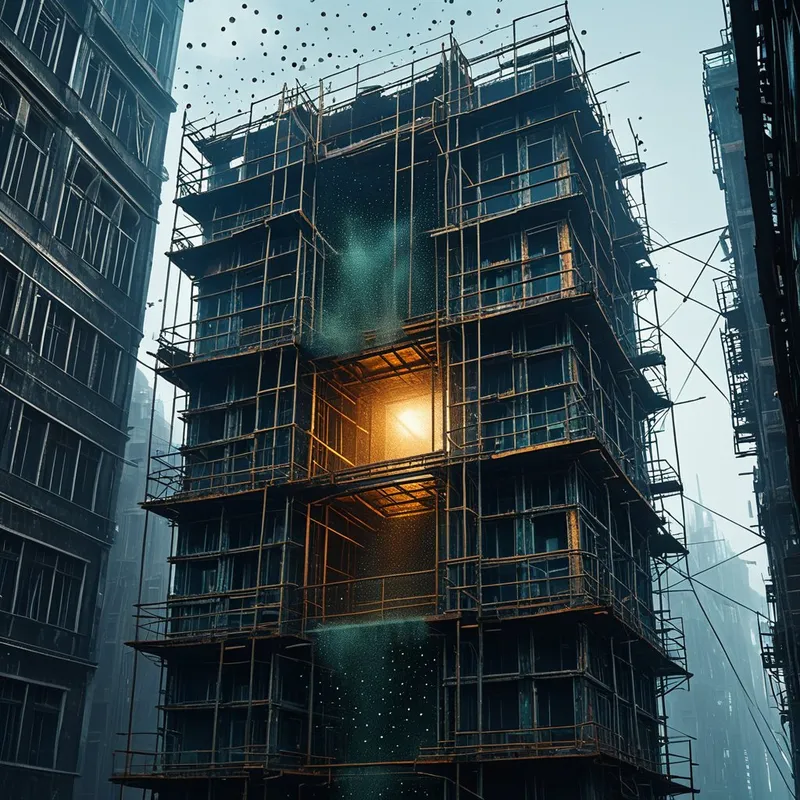
The transmutation of self-perception is the Solve et Coagula—dissolve and coagulate—applied to the psyche itself. The prima materia is the conglomerate self, the sticky amalgam of who you were told to be. The heat is applied through conscious disillusionment: the searing, grief-filled moments where you see the cracks in the mirror, where a relationship, a failure, or a quiet despair forces you to admit, “This story about me is not true.” This heat is unbearable; it feels like annihilation. The pressure is the sustained courage to stay in that void, to not rush to paste a new, prettier mask over the raw space. In that liminal crucible, the false elements burn away. What remains is not “better,” but authentic: the core pattern, the essential signature of your being. The coagulation is not a rebuilding from scratch, but a reorganization around this newfound center. The lead of a confused identity becomes the gold of sovereignty—not a perfect, finished self, but a real and responsible one.
The Integration Protocol
Question 1: When in my waking life do I feel that same throat-constriction, that metallic taste of inauthenticity? What person, role, or situation triggers the “imposter” signal?
Question 2: If the “me” in my dream is a distorted reflection, what is the pure, undistorted signal it is trying—and failing—to receive? What truth about my needs or nature is being pixelated?
Question 3: Which part of me is most afraid of what I might see in a clear mirror? What old identity does that part protect, and what did that identity once help me survive?
Action 1 (Somatic Re-Mapping): For one week, pause three times daily. Place a hand on your sternum. Do not ask “Who am I?”—that is the mind’s puzzle. Instead, ask the body: “What is true here, now?” Note the first sensation, image, or word that arises, without judgment. This grounds perception in the present sensorium, not the old story.
Action 2 (Mirror-Gazing Ritual): In a quiet moment, light a candle and sit before a mirror. Look not at your features, but into your own eyes. Soften your gaze. For five minutes, simply witness the being looking back. If critical thoughts arise (the Shadow Sage), acknowledge them—“There is the judgment”—and return to witnessing. This practice builds the muscle of the true Sage: compassionate, non-judgmental observation.
Action 3 (Unstructured Portrait): With non-dominant hand, or eyes closed, use charcoal, mud, or paint to create a “portrait” of the self you perceived in the dream. Do not draw a face. Let the hand move instinctively to convey the texture of the distortion—the blur, the crack, the static, the leak. Then, on the same page, make a mark or shape that represents the “signal” trying to come through. This externalizes the internal schism, making it an object of contemplation, not a prison of experience.
Final Validation
To dream of a fractured self is a brutal grace. It means the psyche can no longer tolerate the lie. It is dismantling the stage because the actor is tired of the script and the soul demands to speak its own lines. The disorientation is not a sign you are broken, but a sign you are outgrowing a shell. The courage required is not to build a new fortress, but to learn to live, authentically and vulnerably, in the open air of your own truth. The mirror may have been dark, but it was, and always is, pointing you home.