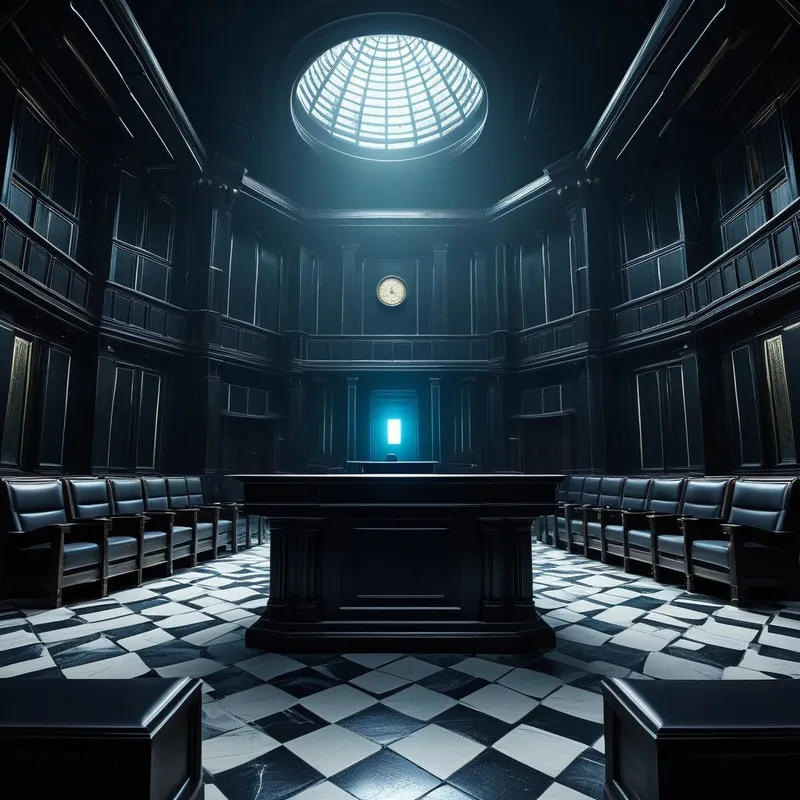
The Inner Court: Alchemy of Self-Judgment in Dreams
The Somatic Echo
It begins not as a thought, but as a climate. A cold, dense pressure settles in the chest, a weight that pulls the shoulders forward into a silent apology. The breath becomes shallow, held hostage in the upper lungs. There is a metallic taste at the back of the tongue—the flavor of dread, of being found out. The body knows the verdict before the mind can form the charge. It is the visceral prelude to a trial where you are simultaneously the accused, the witness, and the executioner. This is the architecture of self-judgment: a closed system, a silent chamber where the air itself has turned to glass, fragile and waiting to shatter.
The Dreamer's Log
In the dream, I am standing before a vast, silent terminal in a cavernous data archive. My entire life is rendered as lines of code on the screen, and a relentless, automated voice is reading back every mistake, every hesitation, every poorly chosen word as a critical system error. I am frozen, unable to shut down the feed or delete the record.
This dream is not about past failures, but about the present algorithm of self-scrutiny that runs in the background, auditing your very existence. The alchemical key lies in who—or what—programmed the audit.

The False Lead
This theme is not about simple regret or the natural consequence of a mistake. It is not the fleeting thought, “I wish I hadn’t said that.” That is the weather of the psyche. Self-judgment is the climate. It is the permanent, internalized courtroom, the belief that your worth is contingent on a flawless performance reviewed by an invisible, merciless authority. To mistake this profound structural reality for mere “being too hard on yourself” is to confuse the prison with a single locked door. The prison is the belief that you deserve to be inside it.
Psychological Architecture
The work here is shadow work of the most intimate kind. It is the process of Individuation calling you to reclaim the gavel from an internalized judge. This judge is often a composite—a fragment of a critical parent, a harsh teacher, the collective voice of “shoulds” you absorbed before you had a filter. In the language of Internal Family Systems, this judge is a “manager” part, a protector that took on a brutal role: to criticize you before anyone else could, to keep you small and safe from external rejection by meting out the punishment in-house.
To confront this is not to slay the judge, but to see it for what it truly is: a exiled, terrified part of your own psyche that believes cruelty is the only form of care that ensures survival. The integration happens when you can stand before this internal tribunal and ask, with genuine curiosity, “What are you trying to protect me from?” The answer is never about your present failure, but about an old, childhood terror of abandonment, of being unlovable. The judge is a loyal, if misguided, guardian. Seeing its devotion beneath its cruelty is the first crack in the glass chamber.
Mythic Resonance
We see this eternal drama in the myth of Psyche. Her tasks, set by a jealous Aphrodite, are impossible trials of sorting, fetching, and descending. But the true, unspoken trial is the one she sets for herself: the belief that she is not enough, that she must earn her divine love (Eros) through flawless execution. Her journey is not about completing the tasks perfectly, but about shattering the vessel of her own perceived inadequacy. Each “failure”—spilling the seeds, falling asleep before retrieving Persephone’s beauty—forces a deeper surrender, a reliance on aid (the ants, the talking tower), and ultimately, a descent into her own underworld. The myth tells us that the path to wholeness is paved with forgiven failures, not avoided ones.
Symbolic Nodes
- Courtrooms, Trials, Judgement Seats: The architecture of internalized authority.
- Failing Tests or Missing Critical Deadlines: The terror of not measuring up to an internalized standard.
- Being Naked or Improperly Dressed in Public: The fear of exposure, of your authentic, unprepared self being seen and condemned.
- Broken Mirrors or Distorted Reflections: A fractured self-image, seeing yourself only through the lens of flaw.
- Voices (Disembodied, Automated, Echoing): The internal critic divorced from your own conscious mind.
Archetypal Resonance
The energy here is most potently that of The Shadow Sage. The Sage archetype in its essence seeks truth and wisdom. Its shadow, however, is dogmatic, judgmental, and coldly analytical. It mistakes the map for the territory, the rule for the spirit, the flaw for the whole person. The somatic echo of the Shadow Sage is that cold pressure in the chest—the weight of immutable law. Its voice is the relentless, logical listing of errors, devoid of context or compassion. Yet, its alchemical potential is immense. This same energy, when integrated, becomes the true Sage’s gift: the ability to discern with clarity, to assess without condemnation, and to hold the complexity of the self with wise, compassionate understanding. The critic, transmuted, becomes the wisest of inner guides.
The Alchemical Process
The transmutation of self-judgment is the alchemy of Mercy into Sovereignty. The required heat is the unbearable warmth of raw, unedited feeling. You must sit in the fire of the shame, the grief, the rage that the judgment has been locking away. The pressure is the conscious choice to stay present with the accused part of you—the one who “failed”—and to listen to its story without the judge’s commentary.
This is the solve et coagula: first, you dissolve the rigid identity of “the flawed one” by feeling the pain it carries. Then, you coagulate a new form. You do not replace the judge with a cheerleader; that is just another performance. You become the sovereign who presides over the entire inner kingdom. You acknowledge the judge’s concern, you honor the pain of the accused, and you render a new verdict based not on old laws, but on present-moment wisdom and compassion for the whole being. The gavel you take up is not for punishment, but for integration. The cold glass of the chamber melts into a clear, flowing stream.

The Integration Protocol
Question 1: If the inner critic’s voice were a person standing in front of you, what does its body language convey? Is it rigid with fear? Exhausted from its vigil? What might it be afraid would happen if it stopped judging you?
Question 2: What is one “failure” or flaw that the judge relentlessly prosecutes? Can you identify the original, younger version of you who first learned to fear that flaw? What did that young part need to hear then that it never did?
Question 3: Imagine your sense of self-worth as a structure. Is the judge the foundation, the walls, or a painting hanging inside? What would it mean to relocate it?
Action 1 (The Silent Court): For one minute, sit in silence and consciously invite the critical thoughts. Do not argue with them. Simply watch them arise like petitioners in your court. Acknowledge each with a neutral, internal nod—“I see you”—and let it pass. This drains the charge of resistance.
Action 2 (The Flaw Document): Take a page and write, in detail, about one trait or mistake you judge harshly. Now, write a counter-document from the perspective of a compassionate ally. How might this “flaw” be a misplaced strength? A necessary lesson? A testament to your humanity? Engage in creative, unstructured writing to reframe the evidence.
Action 3 (The Ritual of Nullification): Find a small stone. Hold it and imbue it with the energy of your most persistent self-judgment. Speak it aloud to the stone. Then, take it to a body of water—a river, the sea, even a sink. As you place it in the water, state: “I return this verdict to the flow from which it came. I am the source of my own law.” Let the water carry the energy away.
Final Validation
To dream of judgment is to touch one of the heaviest stones in the human heart. It is wearying, this endless trial. Please, first, acknowledge the profound courage it takes to even look at this dream material—to not look away from the internal mirror. This difficulty is not a sign of failure, but a measure of the depth you are willing to go. The path out is not upward into perfection, but inward into mercy. You are not meant to live as a flawless defendant in your own life. You are meant to be the sovereign, the compassionate witness, the wise holder of the entire, beautifully imperfect tapestry. The gavel is yours. The court awaits your final, liberating decree.