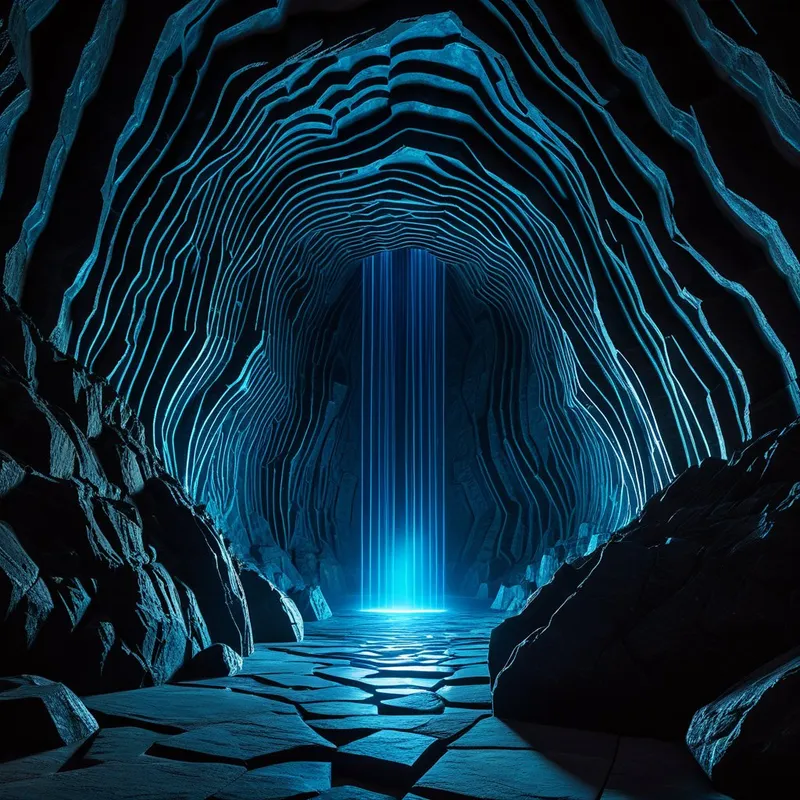
Rhythmic Trance: The Pulse of the Sleeping Psyche
It begins not as a thought, but as a tremor in the substrate of being. A deep, sub-auditory hum that vibrates in the marrow before it reaches the ear. It is the somatic echo of a pattern so ingrained, so fundamental to your internal operating system, that it has become the very background noise of your existence. You feel it in the clenched jaw upon waking, the tightness across the shoulders that feels like a permanent shrug. It’s in the phantom sensation of movement when you are still—the ghost of a commute, the after-image of a scrolling screen, the autonomic pulse of a habit you can no longer name. This is the body’s testimony to the Rhythmic Trance: a state where the psyche’s necessary routines have hardened into psychic automation, where the beat that once organized life has become a cage of repetition.
The Dreamer's Log
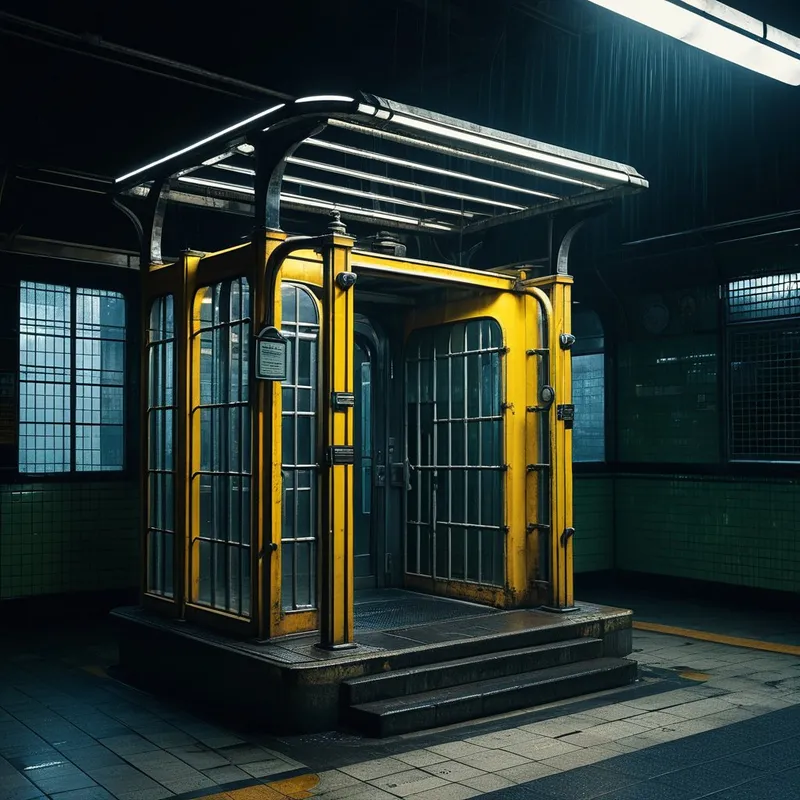
The dream is always the same. I am standing before an ancient, iron turnstile in a deserted subway station. There is no train, no destination posted. Only the turnstile, which rotates with a slow, heavy, mechanical clunk… clunk… clunk… I know, with a dread that is both weary and absolute, that I must push through it. But with each rotation, it becomes heavier, the clunk echoing longer, until the sound is not outside me, but is the very beat of my own heart. I wake with my pulse throbbing in my ears.
The alchemy here is stark: the turnstile, a mechanism of permitted passage, has become the ritual of imprisonment, its rhythm syncing with the dreamer’s own vital pulse, signaling a life where motion is mistaken for progress.
The False Lead
This is not about mere boredom or a “rut.” To dismiss it as such is to commit a profound error of self-neglect. The Rhythmic Trance is not the absence of feeling, but the systematization of it. It is not a lack of rhythm, but a rhythm that has achieved total sovereignty, operating below the level of conscious choice. It is the difference between walking and sleepwalking, between singing a song and being a needle stuck in a groove. The terror of the trance is not in its chaos, but in its perfect, sterile order.
Psychological Architecture
To engage with this theme is to undertake the most delicate of shadow operations: the dismantling of your own autopilot. The architecture here is one of layered protocols. In the language of Internal Family Systems, you are not confronting a single exiled “part,” but the managerial system itself—the inner Ruler or Caregiver that instituted these rhythms for safety, efficiency, or predictability long ago. This manager, now fossilized, confuses the map for the territory, the schedule for the life. The individuation process demands you respectfully depose this automated governor. It requires you to sit in the silence between the clunks of the turnstile and ask, “Who programmed this? And what was it meant to protect me from?” The answer is often a forgotten grief—the grief for a spontaneity sacrificed, a curiosity shelved, a wilder rhythm abandoned for the security of the metronome.
Mythic Resonance
We see this eternal firmware in the myth of Sisyphus, forever rolling his boulder up the hill only to watch it fall. But the deeper tragedy is not the labor, but the trance of the labor—the moment his push and the rock’s weight achieve a perfect, hopeless rhythm, and the horizon of any other possibility vanishes. Similarly, in the tale of the Myth of Er from Plato’s Republic, souls choose their next lives not from wisdom, but often from the haunting rhythms of their previous one—the warrior choosing war again, the ruler seeking dominion—trapped in the karmic echo of their own deepest habits. The trance is the wheel they cannot step off.
Symbolic Nodes
- Metronomes, Pendulums, Clocks: Time itself made mechanical, dictating action.
- Conveyor Belts, Assembly Lines, Turnstiles: Systems where individual agency is subsumed by relentless, impersonal motion.
- Heartbeats, Pulses, Flashing Lights (in sync): The colonization of your organic rhythm by an artificial one.
- Looped Music, Chants, Mantras (repetitive): Sound as a spell that binds rather than liberates.
- Treadmills, Stationary Bikes, Spinning Wheels: The illusion of journey within absolute stasis.
Archetypal Resonance
The energy of the Rhythmic Trance is most potently embodied by The Shadow Ruler. The Ruler archetype’s core desire is for control, to create order and stability from chaos. In its shadow form, this need for order metastasizes into a tyrannical, automated control system. It is the psyche’s own internal bureaucracy, enforcing laws long after their purpose has expired. The somatic echo of the trance—the tightness, the rigidity—is the body living under this shadow regime. Its alchemical potential lies in the coup: not to create anarchy, but to transform the rigid, fear-based control of the Shadow Ruler into the wise, flexible sovereignty of the integrated Ruler—one who governs a living kingdom, not a frozen archive.
The Alchemical Process
The transmutation of the Rhythmic Trance is an alchemy of jamming the signal. The required heat is not fury, but the sustained, uncomfortable heat of conscious interruption. It is the pressure of choosing to not reach for the phone in the first silent moment, to take a different route home, to break the ritual simply to prove it can be broken. This creates a psychic short-circuit. The grief that surfaces is for all the life lived on autopilot, the moments missed while attending to the program. The terror is the vertigo of true freedom—the “what now?” that follows the cessation of the drumbeat. In that silent, empty space after the rhythm stops, the pure metal of your own volition can finally be sensed, cold and real in your hands. Sovereignty is born in that quiet.

The Integration Protocol
Question 1: Where in my waking life do I feel a sense of “weightless obligation”—a task or rhythm I maintain not out of desire or clear purpose, but because the thought of not doing it creates a vacuum of anxiety?
Question 2: If the rhythmic pulse in my dream had a voice, what one-sentence command would it be repeating? Is it “Keep moving,” “Don’t stop,” “Stay safe,” or “You must”?
Question 3: What forgotten or abandoned part of myself might be imprisoned by this rhythm, and what would its first act of freedom be?
Action 1 (The Conscious Skip): For one day, intentionally break a minor, unconscious rhythm. Miss your usual coffee, take a left instead of a right on your walk, sit in a different chair. Do not replace it with a new activity. Simply observe the empty space and the somatic response (anxiety, relief, irritation) that floods into it.
Action 2 (Trance Mapping - Creative): With non-dominant hand, draw the rhythm from your dream or waking trance. Don’t illustrate the scene; draw the pattern itself. Is it a jagged line, a perfect circle, a spiral? Let the hand move to the remembered pulse. Then, with your dominant hand, deliberately alter the drawing. Cross the lines, break the circle, color outside. This is a neural handshake between your automated and executive selves.
Action 3 (Ritual of Desynchronization): Find a natural rhythm (waves, wind in trees, a candle flame) and spend 10 minutes simply witnessing it. Then, introduce your own, counter-rhythm—a breath that is slower, a finger-tap that is faster. Practice holding both rhythms in your awareness without letting one subsume the other. This cultivates the capacity to be in a system without being of it.
Final Validation
The Rhythmic Trance is, in its way, a masterpiece of psychic engineering—a fortress built so well you forgot you were inside it. To feel its walls is not a failure, but the first, crucial tremor of awakening. The path out is not through brute force, but through the subtle, relentless art of introducing choice into the automated sequence. Remember: the drumbeat only has power as long as you believe you must dance to it. You are both the dancer and the one who holds the drum. The trance ends the moment you decide to listen to the silence between the beats, and find your own song waiting there.