
The Alchemy of Letting Go: Dreams of Purification and Release
The Somatic Echo
Before the dream forms an image, before the mind can name the story, the body knows. It is a pressure in the chest that is not quite pain, but a dense, liquid weight. It is a metallic taste at the back of the tongue, the ghost of swallowed tears or unsaid words. The skin feels tight, like a vessel stretched thin, holding a solution that has turned toxic. There is a profound, cellular ache for expulsion, for a sigh that empties the lungs completely and leaves a vacuum for new air. This is the somatic prelude to purification—not a gentle washing, but the visceral, often terrifying, recognition that something within has reached its terminus. It must be metabolized or released. The body is the first crucible.
The Dreamer's Log (Case Vignette)
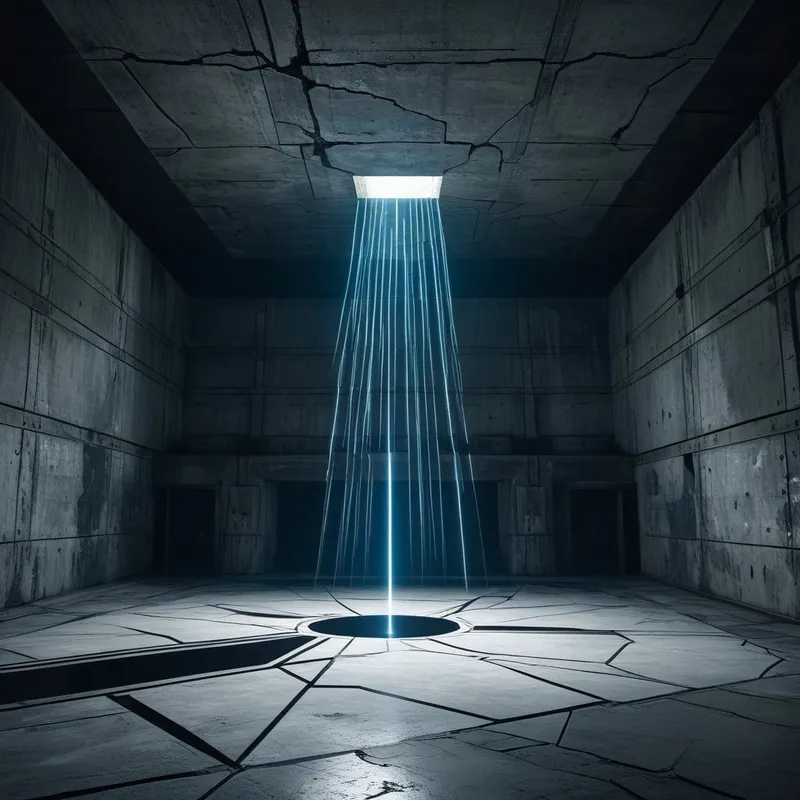
I am in a sterile, concrete room, a forgotten bunker. In the center, a black, tar-like substance oozes from a crack in the floor, thick and silent. I am not afraid of it; I am tasked with holding it. Then, from a vent in the ceiling, a single beam of pure white light, cold and precise, strikes the center of the pool. The tar does not catch fire, but begins to evaporate, rising not as smoke but as intricate, geometric patterns of grey ash that dissolve before they touch the walls.
This is the alchemy of conscious witnessing: the focused light of awareness applied to the formless shadow, transmuting its substance from a burden into dissipating information.
The False Lead
This theme is not an instruction to flee your life, to discard relationships, or to blame external circumstances for your internal weather. It is not the superficial "decluttering" of a bad day. A dream of vomiting rust is not about food poisoning; it is about a systemic corrosion you have ingested and made your own. The false lead is to mistake the profound, structural release of an internal pattern for the mere occurrence of external "bad luck" or a need for escapism. The purification is always of the self, by the self, for the self. The world you release is the world you have constructed within.
Psychological Architecture
To understand this dream is to enter the silent chamber of Shadow work where Individuation is forged. Here, you are not battling monsters, but meeting exiled parts of your own psyche—the grief you silenced to be strong, the rage you cooled to be kind, the need you shrank to be independent. These are not flaws, but energies that were frozen in time, often for excellent, survival-based reasons. The process of purification is the slow, often agonizing application of warmth to these frozen rivers.
Think of it as your internal family system undergoing a compassionate revolution. The protective Manager who demands constant control, the exiled Firefighter who numbs with distraction or drama, the vulnerable Exiles carrying old wounds—all are heard not as enemies, but as parts of a whole self. Release occurs when these parts are no longer fighting for dominance, but are reintegrated into the flow of your consciousness. The "tar" in the dream is the conglomerate of all these unmetabolized experiences. Purification is the act of finally giving them dignified attention, allowing their locked energy to move, to transform, and to find its rightful place in your expanded being.
Mythic Resonance
This universal firmware echoes in the story of the Goddess Inanna's Descent. She does not take a casual trip; she passes through seven gates, stripped of every symbol of her power—her crown, her lapis beads, her royal robe—until she stands naked and dead, hung on a hook. Her return is not a given; it is negotiated. She must send a substitute back in her place. The myth does not speak of easy cleansing, but of necessary, total dissolution. The ego's regalia must be surrendered at each gate for the true self to pass. What you release is not dirt, but identity. The Babylonian myth of Tiamat, the primordial saltwater chaos, slain by Marduk to form the world from her body, speaks to this too: creation itself is an act of violent, necessary differentiation from a unified, undifferentiated whole. Release is the ongoing act of world-making from the substance of our own inner chaos.
Symbolic Nodes
- Water in all forms: Turbulent oceans, cleansing rains, stagnant ponds being drained, tidal waves.
- Fire: Purifying flames, forest fires that clear undergrowth, the controlled fire of a forge.
- Vomiting/Expulsion: Vomiting strange substances (coins, insects, black fluid), coughing up dust or hair.
- Shedding Skin/Molting: Snakes, insects, peeling one's own skin to reveal new flesh beneath.
- Washing/Scrubbing: Endlessly scrubbing a floor, washing clothes in a river, being bathed by an unknown force.
- Dissolving Structures: Buildings made of salt melting in rain, sandcastles succumbing to the tide, ice sculptures thawing.
- Cutting Cords/Unbinding: Severing ropes, chains falling away, untying complex, endless knots.
Archetypal Resonance
The energy of Purification and Release finds its most potent vessel in The Rebel Archetype. This is not the Shadow Rebel's chaotic destruction for its own sake, but the Rebel in its essential, revolutionary function: to dismantle the internal tyranny. The somatic echo of tightness and pressure is the feeling of a self-imposed law, a rule of being that has outlived its purpose. The Rebel arises to dynamite that inner statute. Its alchemical potential lies in its ruthless commitment to authenticity over comfort; it applies the pressure necessary to break the seal on the vessel, allowing the stagnant contents to finally flow. This archetype does not seek to destroy the self, but to destroy everything within the self that prevents it from being whole.
The Alchemical Process
In alchemical terms, this is the operation of Solve—to dissolve. But dissolution is not destruction. It is the breaking down of a compound into its constituent parts so that a new, more conscious synthesis (Coagula) can occur. The psychological heat required is the sustained, non-judgmental attention you bring to your own pain, shame, or grief. The pressure is the courage to stay present with the dissolving sensation, to feel the identity you clung to losing its shape.
The terror is the fear of annihilation; the grief is for the self you believed you were. The transmutation occurs in the moment you realize you are not the compound being dissolved, but the alembic itself—the conscious vessel containing the process. The heavy lead of a fixed identity (the "I am always the victim," "I must be perfect," "I cannot need") is subjected to this heat until it releases its captive spirit. What remains is not nothing, but a liberated, sovereign gold: the ability to choose your responses, to hold your history without being defined by it. Sovereignty is born from the ashes of a burned contract you never agreed to.

The Integration Protocol
Question 1: What is the one story I tell about myself or my life that feels most like a "fact," but when I touch it, carries the heaviest emotional charge? Where did I learn this law?
Question 2: If the dense substance in my dream (the tar, the rust, the stagnant water) could speak, what single sentence would it whisper? Not a complaint, but a core truth it has been holding for me.
Question 3: What small, daily ritual or environment have I constructed that actively maintains the very thing I dream of releasing? How does this structure protect me, and what cost does that protection now incur?
Action 1 (Somatic Grounding): For three minutes, place your hands on the area of your body that feels most dense or tight. Breathe into that space. Do not try to change it. With each exhale, imagine your breath is not pushing the sensation away, but gently dislodging it, grain by grain, as wind reshapes a dune.
Action 2 (Unstructured Writing): Set a timer for seven minutes. Write without stopping, without editing, beginning with the prompt: "What I no longer need to carry is..." Let the writing be illogical, repetitive, messy. At the end, burn or shred the paper. The action is in the release of the words from your mind to the page, and from the page to the elements.
Action 3 (Elemental Ritual): Find a small, natural object—a stone, a leaf, a twig. Hold it and imbue it with a single, specific attitude or memory you wish to release (e.g., "the need for this old resentment"). Go to a moving body of water—a river, the sea, even a steady rain gutter. Thank the object for its service, and surrender it to the water. Watch it be carried away. The ritual is the physical enactment of trust in a process larger than your own will.
Final Validation
This work is not shallow. It is the archaeology of the soul, conducted in the dark, with your own hands as the only tools. To dream of purification is to have encountered the cost of your own carried weight, and that recognition is itself a form of courage. The path of release is often walked with a trembling heart, for it asks you to unclench your hands from treasures that have turned to stone. Yet, in that unclenching, you do not find emptiness. You rediscover the original shape of your own hand—open, capable, and ready to hold not a burden, but the next, fleeting, beautiful moment of your unbound life.