The Dream of Psychological Paralysis: A Call from the Frozen Threshold
The Somatic Echo
It begins not as a thought, but as a density. A leaden weight in the marrow of your intention. You feel it first in the body’s silent language: a breath that catches and refuses to complete its arc, a limb that feels like a foreign object grafted onto your will, a tongue that turns to clay in your mouth. This is the somatic echo of psychological paralysis—a visceral, pre-cognitive knowing that the bridge between impulse and action has been severed. The mind races, a frantic council of voices mapping escape routes, but the body remains a monument to stillness. It is the feeling of being a conscious statue, aware of the world flowing past while anchored to a single, impossible point of internal conflict. This is the freeze response of the soul, a total systems check initiated not by external threat, but by an internal schism too profound to bypass.
The Dreamer's Log
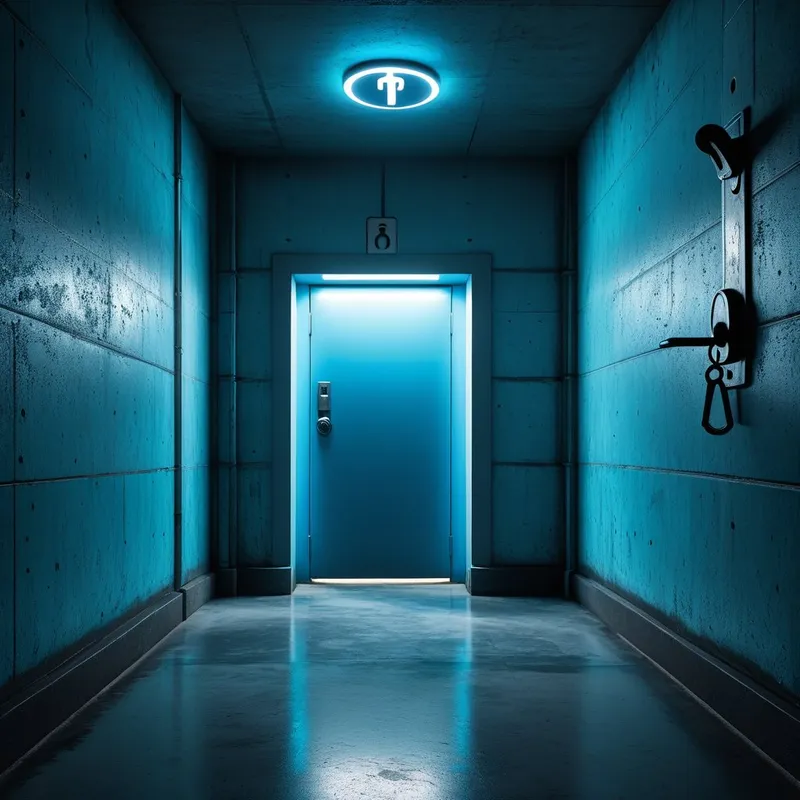
The dream is always the same. I am in a long, institutional hallway. The exit sign glows at the far end. I know I must run—something is coming. But my legs are pillars of concrete. I try to scream for help, but my voice is a silent vibration trapped in my throat. I am awake inside the sleep, screaming at a body that will not obey.
This is not a dream of mere fear, but of arrested volition. The alchemical interpretation: The psyche has encountered a directive from the core self so vital that all peripheral systems must be shut down to receive the transmission.
The False Lead
Do not mistake this paralysis for laziness, cowardice, or simple “bad luck.” It is not the absence of desire, but its catastrophic multiplication. It is the gridlock of a parliament where every faction—the inner critic, the wounded child, the ambitious achiever, the yearning lover—has veto power. This is a systemic deadlock, not a character flaw. The terror of the dream is not that you cannot move, but that a part of you, a sovereign part you have yet to fully acknowledge, has chosen this stasis as the only honorable response to a life path that demands a fundamental reinvention. It is the ego’s interpretation of the soul’s ultimatum.
Psychological Architecture
Beneath the frozen surface churns the deep work of Shadow and Individuation. Psychological paralysis occurs when a new, more authentic pattern of being attempts to emerge, but its birth is blocked by the entrenched, older structures of the personality—what we might call your internal governance. The paralysis is the experiential symptom of this civil war. The part of you that clings to the known (the secure job, the familiar story, the old identity) and the part of you that yearns for the true (the creative calling, the necessary ending, the un-lived life) have equal claim to the throne of your will. The result is a canceling out of conscious action. This is the psyche’s brutal, elegant forcing function. It stops you in your tracks so you are forced to turn inward and negotiate, not with a single “shadow,” but with an entire internal family system in revolt. The goal is not to defeat one side, but to facilitate a dialogue where the protector who fears change and the explorer who demands it can recognize they serve the same sovereign: your wholeness.
Mythic Resonance
We see this eternal moment in the myth of Arachne. The boastful weaver, challenged by Athena, creates a tapestry of flawless, audacious beauty. Upon seeing it, the goddess does not simply destroy it in rage. She touches Arachne’s forehead, filling her with such a profound shame and awareness of her own hubris that Arachne tries to hang herself. Athena then “saves” her by transforming her into a spider, condemning her to weave eternally, suspended in her art. The paralysis is in that touch—the devastating, full-body comprehension of a truth that shatters your current self-concept. The transformation that follows is not a punishment, but a reconfiguration into a new form of existence, one forever connected to the source of its own tension. Likewise, the Gordian Knot represents not just a problem, but a paralyzing one—a tangle so complex it defies conventional, piece-by-piece problem-solving. The true solution required Alexander’s decisive, non-linear stroke. Our internal knots often demand the same: not patient unpicking, but a revolutionary shift in perspective that cuts to the core.
Symbolic Nodes
- Frozen or Heavy Limbs: The specific tools of agency (reaching, moving forward, pushing away) rendered inert.
- Muted or Silent Voice: The loss of expression, boundary-setting, and call for help.
- Broken Phones or Unsendable Messages: The severing of communication between different parts of the self or with the outer world.
- Sinking in Quicksand or Setting Concrete: The feeling of being actively consumed or immobilized by your own environment or choices.
- Malfunctioning Vehicles: The failure of the structures (the ego, the personality) meant to carry you through life.
- Watched or Pursued While Unable to Move: The hyper-awareness of a critical, often internalized, judgment that holds you in its gaze.
Archetypal Resonance
The energy at the heart of this theme is that of The Shadow Ruler. The Ruler archetype seeks to create order, structure, and sovereignty. In its shadow aspect, this drive curdles into a tyrannical need for total control, where any uncertainty or potential chaos must be preemptively shut down. The somatic echo of paralysis is the Shadow Ruler’s ultimate decree: “If I cannot guarantee the outcome, if I cannot control the process, then nothing shall move.” This internal tyranny locks down the entire system to avoid the perceived threat of collapse or failure. The alchemical potential lies in recognizing this paralysis not as weakness, but as a distorted, extreme form of self-protection. The journey is to depose the inner tyrant not through rebellion, but through compassionate understanding, transforming its rigid control into the Ruler’s true gift: the capacity to establish wise, flexible, and authentic order from within the chaos.
The Alchemical Process
The transmutation of psychological paralysis is the alchemy of The Great Pause. The prima materia is this very sensation of being utterly stuck. The necessary heat is not frantic activity, but its opposite: the courageous, agonizing heat of suspended action. It is the pressure of staying present with the full, screaming discomfort of not knowing, not doing, not deciding. This is the nigredo, the blackening, where all your familiar identities and strategies dissolve into the void of potential.
In this crucible of stillness, a separation occurs. You learn to distinguish the voice of fear (which shouts in panic) from the voice of intuition (which whispers in the silence). The albedo, or whitening, is the moment of clarity that emerges not as a booming command, but as a quiet, somatic “yes” or “no”—a slight relaxation in the diaphragm, a subtle leaning in the heart. The new sovereign is not born in a burst of effort, but in the recognition of a fundamental internal alignment. The paralysis breaks not when you force movement, but when you finally hear the directive that the paralysis itself was protecting. The leaden weight of stuckness becomes the gold of deliberate, aligned action, taken not from a place of frantic escape, but from a deep, reclaimed center of authority.
The Integration Protocol
Question 1: In the dream, what is the one thing you are most desperate to do (run, scream, fight)? What current life situation mirrors this feeling of arrested action?
Question 2: If the paralysis is not a barrier, but a boundary erected by a protective part of you, what is it trying to prevent you from experiencing or confronting?
Question 3: Imagine the moment just before the paralysis sets in. What choice, thought, or realization was presenting itself? What if the freeze is the soul’s way of saying “Stop. This path requires a different kind of strength.”
Action 1 (Somatic Re-Mapping): For five minutes, sit in silence and bring your attention to the felt sense of “stuckness” in your body. Instead of trying to change it, describe its qualities to yourself in neutral, curious language. “It feels dense, cold, located in my chest, about the size of a grapefruit.” This begins to separate your awareness from the sensation, creating the first crack in the monolith.
Action 2 (Council of Parts): Engage in a free-form, unstructured writing dialogue. Let the part of you that feels paralyzed speak. What is its name? What is it afraid will happen if movement resumes? Then, let the part of you that is desperate to move speak. Facilitate a written conversation between them, not to force a resolution, but to allow each to feel heard by your conscious self, the ultimate sovereign.
Action 3 (Ritual of the Unmade Choice): Find a small stone. Hold it, imbuing it with the energy of the paralyzed choice. Go to a crossroads—a literal intersection, a fork in a path, or a shoreline. Speak aloud the two paths you perceive. Then, throw the stone into a body of water, over a cliff, or bury it, symbolically relinquishing the burden of the binary choice itself. Walk away without looking back, creating a psychic space for a third, unforeseen option to emerge.
Final Validation
The dream of paralysis is one of the most terrifying gifts the psyche can offer. It means you are standing at the very edge of your old world, and the birth of the new demands a death of the way you have known yourself to move. Honor the freeze. It is a profound intelligence, not a failure. Within its absolute stillness lies the blueprint for a movement so authentic, so wholly yours, that it could only be born from the utter dissolution of everything that came before. The key is not in the locked door ahead, but in the weight of your own hand, now learning, pulse by slow pulse, to feel its own power again.