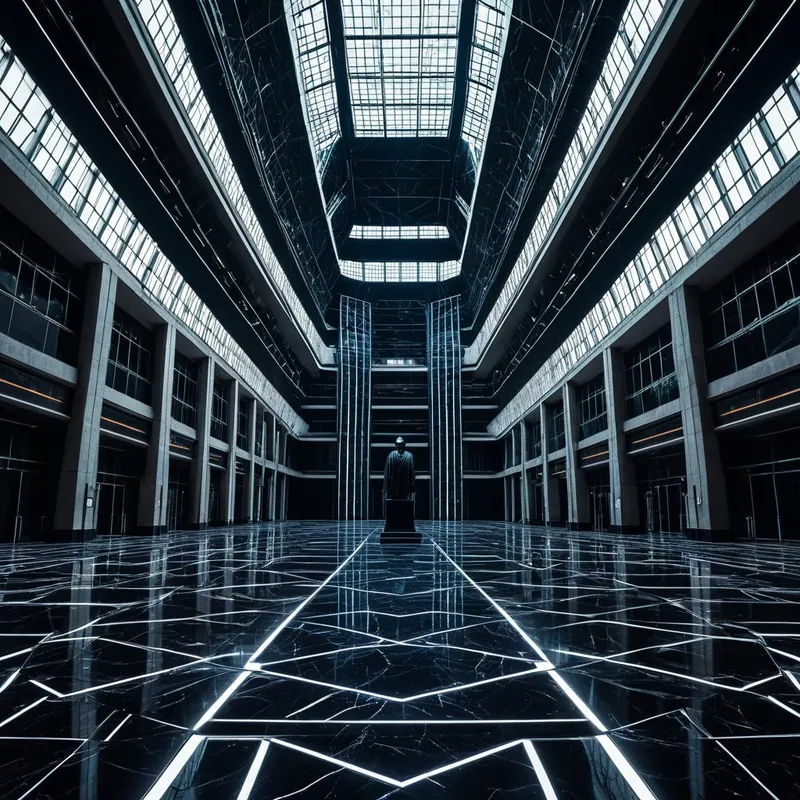
The Somatic Echo
Before the mind conjures the boardroom, the missed deadline, or the silent, judging panel, the body knows. It is a specific, cold tension. Not the fire of rage or the flutter of fear, but a deep, systemic chill—a feeling of being encased. The breath becomes shallow, held in the upper chest as if the diaphragm has turned to polished stone. The shoulders lock into a precise, unnatural geometry, a carapace of acceptable posture. The jaw sets, not in anger, but in the grim determination of a vault door sealing shut. This is the somatic signature of the Professionalism dream: the visceral experience of the persona hardening into an exoskeleton. It is the feeling of the inner wilderness being paved over with the smooth, featureless concrete of competence. You feel yourself becoming a system, efficient and sterile, and the grief of that transformation echoes in a silent, cellular hum.
The Dreamer's Log
I am in my office, but it is too quiet, a vacuum. My desk is a sheet of flawless obsidian. On it sits only my white porcelain mug, empty. I know, with dream-certainty, that I must fill it with coffee before the meeting. But when I reach for the carafe, my hand passes through it like a ghost. The mug remains empty, pristine, a monument to my inability to perform the most basic ritual of readiness.
Here, the alchemical vessel—the mug—is present, but it holds only the void of expectation; the dreamer’s vital energy cannot engage with the ritual substance of the role, revealing a profound disconnect between the inner self and the outer performance.

The False Lead
This theme is not a simple anxiety about job performance or a literal premonition of career failure. To interpret it as such is to stay on the polished surface, mistaking the symptom for the disease. The dream of Professionalism is not about the content of your work, but the container of your identity. It is not signaling that you are bad at your job, but that the costume of the job has begun to fuse to your skin. The terror here is not of external critique, but of an internal vanishing—the fear that the performance has consumed the performer, leaving only a resonant shell executing flawless, empty code.
Psychological Architecture
Beneath the dream of the immaculate desk or the speech given in a silent tongue lies a profound architectural shift within the psyche. This is the Shadow work of the persona, Carl Jung’s term for the mask we wear for the world. In its healthy form, the persona is a necessary interface, a bridge between the private soul and the public sphere. But in the Professionalism dream, this bridge has become a walled city, and you are its sole, trapped citizen.
The individuation process at play here is one of reclamation. It involves descending into the corporate basement of your own psyche to meet the exiled parts you left there to maintain the polished facade: the messy creative, the tired caregiver, the irreverent jester, the vulnerable orphan. These are not “unprofessional” selves; they are the vital substrates of your humanity that the monolithic “Professional” identity has suppressed to maintain its sterile order. The dream is the pressure valve, showing you where the seal is too tight, where the living water of your authentic being is threatening to crack the porcelain.
Mythic Resonance
We see this eternal drama in the myth of Psyche and her tasks. Aphrodite, the embodiment of established, perfect order (a kind of divine professionalism), sets Psyche impossible, meticulous labors: sorting endless grains, gathering golden fleece, fetching water from the Styx. These are not tests of strength, but of impossible, soulless precision—tasks designed to break her spirit through sheer bureaucratic despair. Psyche only succeeds when she surrenders the ego’s attempt to “professionally” manage the impossible alone; ants help her sort, a reed whispers advice, an eagle carries her vessel. Her victory comes through alliance with the wild, instinctual, and overlooked parts of the world—the very aspects her “task-master” consciousness deems unprofessional.
Similarly, the Golem of Jewish folklore is a being of perfect, literal obedience, animated by sacred words to perform a duty. But it is a creature of clay, without a soul, and without the guiding hand of its creator, it becomes a mindless, destructive force, following its programming to a terrifying conclusion. The Professionalism dream often features this golem—it is you, moving through motions with a hollow efficiency, a soul-less entity of pure function.
Symbolic Nodes
- The Immaculate Desk/Suit/Office: The perfected persona, sterile and lifeless.
- Forgotten Passwords/Malfunctioning Keycards: The conscious ego losing access to its own constructed identity.
- A Speech with No Sound/A Presentation with Blank Slides: The disconnect between inner truth and outer communication.
- Endless, Meaningless Data Entry or Sorting: The soul’s experience of work devoid of essence or creativity.
- A Clock with Missing Numbers or Melting Hands: The distortion of natural time and rhythm by the demands of the role.
- A Room That is Slowly Becoming a Vacuum or Sealing Shut: The feeling of the persona becoming an airtight prison.
Archetypal Resonance
The energy at the core of the Professionalism dream is most acutely that of The Shadow Ruler.
The Ruler archetype in its fullness seeks to create order, structure, and stability—to steward a kingdom (which can be a project, a team, one’s own life) with wisdom and responsibility. The Shadow Ruler, however, is obsessed with control for its own sake, enforcing rigid order to mask inner chaos, and valuing the stability of the system over the sovereignty of the individual soul. The somatic echo of the professional carapace is the Shadow Ruler’s armor. Its alchemical potential lies in the terrifying, necessary dissolution of that control—to allow the inner kingdom to be governed not by the iron fist of “should” and “must,” but by the more nuanced, compassionate, and authentic law of the integrated self. The dream is the rebellion within the castle walls.
The Alchemical Process
The transmutation here is from Sterile Persona to Authentic Sovereignty. The prima materia is the rigid, constructed identity of “The Professional.” The required heat is the intense friction generated when this persona inevitably fails to contain the full spectrum of your humanity—when grief, rage, wild creativity, or simple exhaustion leak out at the “wrong” time. This friction feels like shame, anxiety, or the deep chill of the somatic echo.
The alchemical fire is applied through conscious disobedience. Not a reckless burning of your life, but the subtle, internal act of refusing the persona’s dictates. It is allowing yourself to feel tired when the schedule says “productive.” It is scribbling in the margins of the official report. It is the internal “no” to one more hour of polishing the mask. This heat cracks the porcelain. In that fissure, the lead of performative control is exposed to the air and begins its slow, agonizing transformation into the gold of authentic authority—an authority that comes not from flawless execution of an external script, but from the grounded, imperfect, and wholly owned power of being exactly who you are, in the room, without apology.

The Integration Protocol
Question 1: Where in my waking life do I feel the "cold tension" of the somatic echo? What specific action, interaction, or expectation triggers that feeling of becoming an encased system?
Question 2: If my professional persona were a character in a film, what is its one secret, hidden longing that it could never admit in the boardroom?
Question 3: What wild, "unprofessional," or seemingly useless part of myself did I exile to build this current identity? What gift did it hold that I now miss?
Action 1 (The Micro-Resistance): For one day, consciously introduce a tiny, benign imperfection into your professional facade. Mis-match your socks. Use a pen of a surprising color for notes. Place a small, natural object (a stone, a pinecone) on your desk. Observe the internal reaction to this deliberate "flaw."
Action 2 (The Exile's Journal): Engage in 10 minutes of completely unstructured, messy writing. Use a pen and paper. Let the exiled part—the tired one, the messy one, the rebellious one—speak. Do not censor for grammar, sense, or propriety. Let it complain, grieve, or dream wildly. This is creative reclamation.
Action 3 (The Ritual of Unsealing): At the end of your work day, perform a deliberate, physical ritual to shed the persona. This could be changing your clothes immediately, washing your hands with intentionality as if washing off a role, or stepping outside and taking three deep breaths, exhaling fully with a sound, releasing the day's contained energy back into the world.
Final Validation
It is profoundly difficult to feel the very structure of your identity—the one that provides safety, recognition, and purpose—begin to harden into a cage. The grief is real. The fear of the void beneath the persona is legitimate. Honor that. You built this shell for a reason; it once protected you. But the dream is a messenger from the core of your being, telling you that the protection has outlived its purpose. Now, the only way forward is the courageous, alchemical work of letting the shell crack. Not to collapse into chaos, but to allow a more fluid, resilient, and authentic form to emerge—a sovereignty that holds both competence and soul, both responsibility and wildness, in a sacred, unbreakable vessel.