The Alchemy of the Stage: Dreaming Under Pressure
The Somatic Echo
It begins not as a thought, but as a landscape within the body. A cold, hollow chamber opens behind the sternum. The breath becomes shallow, a thin currency spent on maintaining the facade of calm. Muscles, especially along the jaw and shoulders, hold a silent, anticipatory tension—a readiness for a blow that has not yet been named. There is a buzzing in the fingertips, a static charge of unspent energy with no clear outlet. This is the somatic echo of performance pressure: the visceral experience of a system preparing for a review it did not consent to, for a judgment it feels inherently unprepared to meet. The mind will later furnish the stage, the audience, the forgotten lines, but the body knows the truth first. It knows it is being measured against an invisible, internalized standard, and it trembles in the pre-conscious certainty of its own perceived insufficiency.
The Dreamer's Log
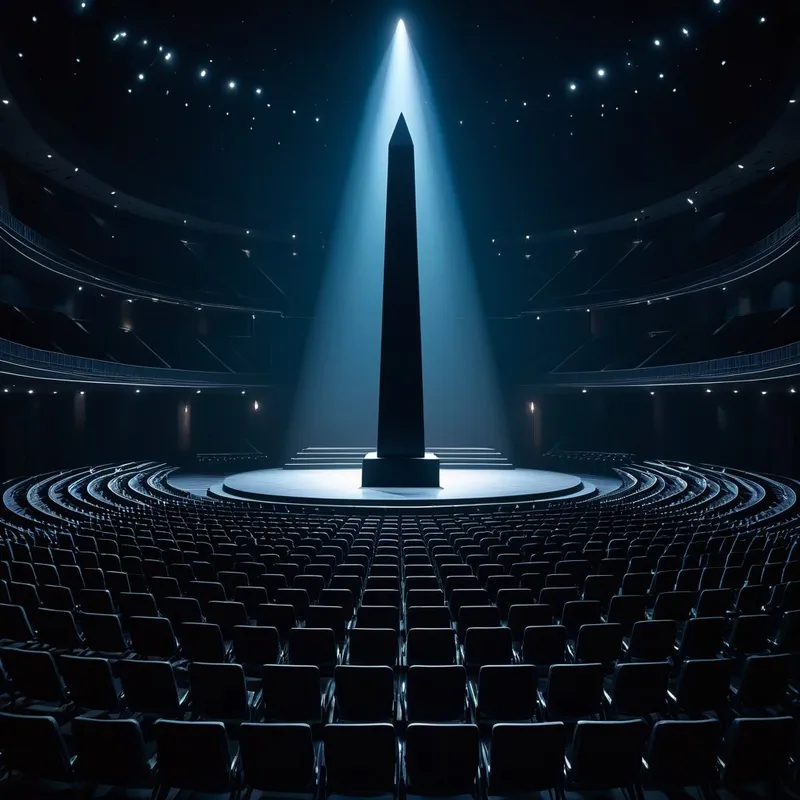
You are backstage in a cavernous, industrial theater. The murmur of a vast, unseen audience is a palpable pressure against the walls. You are meant to go on, but you realize you have never learned your lines, you do not even know the name of the play. Your costume, when you find it, is a complex apparatus of wires and chrome that you cannot figure out how to wear. A voice, neither kind nor cruel, simply factual, announces your name over a crackling speaker. You are next.
Alchemical Interpretation: The dream reveals the core wound of the performative self—being thrust into a narrative authored by others, wearing an identity that is a functional, alien technology.

The False Lead
This is not a dream about simple stage fright or a fear of public speaking. To interpret it as such is to mistake the symphony for a single sour note. It is not a prophecy of literal failure in an upcoming meeting or presentation. The pressure here is structural, not situational. It is the chronic hum of a life lived on external metrics, where worth is contingent upon output, approval, or flawless execution. The terror is not of making a mistake, but of being found out—of the inner committee’s belief that you are an imposter, a child in an adult’s costume, being exposed as fundamentally unfit for the role you occupy. It is the shadow of conditional love, whispering that you are only as good as your last performance.
Psychological Architecture
Beneath the spotlight of anxiety lies a profound architectural conflict. One internal faction—the Manager—has built an entire identity upon a scaffold of achievement, competence, and external validation. This Manager is terrified of collapse. Opposite it stands the Exiled Child, the part that just is; that creates, feels, and exists without an agenda. The pressure dream is the moment these two factions are forced into the same cramped backstage room. The Manager is frantic, trying to wire the Child into the chrome costume. The Child is frozen, mute, refusing to comply with a script it never wrote.
The individuation process here is a brutal and beautiful demolition. It requires allowing the Manager to exhaust itself, to see that its control is an illusion that only generates the very panic it seeks to avoid. Simultaneously, it demands listening to the Exiled Child’s silence—which is not emptiness, but a profound refusal to perform its own authenticity. The integration is not a merger, but a re-founding of the internal government. The sovereign Self emerges not when the Manager wins or the Child rebels, but when a deeper authority—the Witness—recognizes that the entire theater, the stage, and the script are internal constructs. Sovereignty is the power to turn the house lights on, to see the audience as projections, and to decide, perhaps for the first time, if you even want to be in this play.
Mythic Resonance
We see this eternal drama in the myth of Atalanta. Sworn to virginity and her own fierce independence, she agrees to marry only the man who can beat her in a footrace—knowing she is unbeatable. Here, the performance is literalized: her worth and freedom are contingent upon maintaining flawless victory. When Hippomenes distracts her with golden apples, he does not beat her speed; he exploits her humanity, her curiosity, her momentary departure from the pure performance of "the fastest." The tragedy is not her loss, but the fact that the terms of the race—set by external, patriarchal law—forced her to equate her entire self with a single, measurable function. Her dream would be of feet turning to lead, of the racecourse stretching into infinity, of golden apples she is forbidden to touch.
Symbolic Nodes
- Empty Stages & Unseen Audiences: The architecture of expectation itself.
- Forgotten Lines/Scripts: The disconnect from an authentic, internal narrative.
- Malfunctioning or Alien Costumes/Uniforms: The felt experience of wearing an inauthentic identity.
- Being Unprepared for a Test You Didn't Know You Were Taking: The essence of conditional worth.
- Mics That Don't Work, Instruments with Missing Strings: The failure of your curated tools of expression.
- Doors to the Stage That Won't Open, or Elevators Stuck Between Floors: The liminal prison of anticipation.
Archetypal Resonance
The energy here is pure The Shadow Ruler.
The Shadow Ruler archetype is active not as a tyrant over others, but as a tyrannical internal regime. Its core energy is control, but turned inward with merciless precision. The somatic echo—the tightness, the shallow breath—is the body living under this martial law. The alchemical potential lies in the Shadow Ruler’s undeniable strength: its capacity for order, structure, and governance. The transmutation involves not dethroning this archetype, but reforming it. The pressure cooker of the dream is the heat required to melt the rigid, fear-based dictatorship into a wise, internal sovereignty. The Shadow Ruler must be taught that true control is not micromanaging every outcome, but holding a secure, compassionate space where all parts of the self—including the failing, frightened, and unprepared—belong and are heard.
The Alchemical Process
The alchemy of performance pressure is the transformation of lead—the dense, heavy weight of external expectation—into the gold of internal authority. The required heat is the conscious, sustained tolerance of anxiety without capitulation. Do not rush to soothe it with preparation, or escape it with distraction. Sit in the backstage dread. Feel the hollow chest, the buzzing hands.
The pressure is the crucial agent. It is what forces the sealed system of the "performing self" to crack. In that fissure, a revelation occurs: the audience you fear is a committee of internalized voices—parents, critics, past selves. The script you forgot was never yours. The transmutation happens when you realize the power is not in delivering a flawless performance to these ghosts, but in turning, slowly, to face them in the empty theater of your own psyche and saying, "I see you. And I am changing the play." The gold is the liberated energy that once went into maintaining the facade, now available for authentic creation and presence.

The Integration Protocol
Question 1: In the dream, who or what is the audience? If you gave them a face, a name, or a title, who would they be? Is their judgment based on love, fear, or a mere function?
Question 2: What is the simplest, most nourishing action your body craves when you feel this pressure (e.g., lie on the floor, walk without destination, drink cold water)? How is this the Exiled Child’s direct counter-script to the performance?
Question 3: If you were to write a new rule for your internal kingdom regarding "failure" or "being unprepared," what would that first, compassionate law be?
Action 1 (The Grounding Dissolve): When you feel the somatic echo arise, stop. Place one hand on your sternum and one on your belly. Breathe deeply into your belly, feeling your hand rise. On each exhale, whisper silently, "I am not a function." Do this for five breaths. You are dissolving the wiring of the costume.
Action 2 (Manifesto of Incompletion): Take a piece of paper. At the top, write "I am allowed to be..." Set a timer for three minutes. Write or draw freely, listing or depicting states of being that have no productive outcome (e.g., "a slow river stone," "a dusty beam of light," "an untuned piano"). This creates a counter-document to the internal script.
Action 3 (Ritual of Decommissioning): Find a small object that symbolizes an old, exhausting metric you perform for (a specific award, a test score, a badge). Go to a natural body of water—a stream, the sea, a pond. Hold the object, acknowledge its old power, and then release it into the water or bury it in the earth. You are not destroying it, but returning it to the elemental world, decommissioning it from your internal governance.
Final Validation
The weight you feel is real. The theater it constructs in your mind is impeccably detailed, a prison of your own exquisite sensitivity. This is not a sign of weakness, but a testament to how deeply you have cared, how diligently you have tried to meet the world’s—and your own—impossible standards. The path forward is not to build a better performance, but to become curious about the architect of the stage. The profound sovereignty awaiting you is not the applause at the end of the perfect play. It is the quiet, unshakable power that comes from turning off the spotlight, stepping off the marked platform, and realizing, with a shock of liberation, that you were always free to leave the theater.