
The Sacred Weight: Ornamentation and the Dream of the Curated Self
The Somatic Echo
Before the mind conjures an image of a jeweled crown or a gilded frame, the body knows ornamentation. It is a specific density in the chest, a weight that is both precious and burdensome. It feels like the pull of a heavy, beautiful pendant against the sternum, a simultaneous anchoring and a drag. There is a tightening across the shoulders, as if bearing an invisible mantle of expectation. The hands may feel restless, fingers twitching with the ghost-memory of polishing, arranging, or fastening something just out of sight. This is the somatic signature of value made manifest, of inner worth translated into external code. It is the physical echo of the question: What have I hung upon myself, and what is hanging upon me? The breath becomes shallow, held in a display case of ribs, waiting to be seen and appraised.
The Dreamer's Log
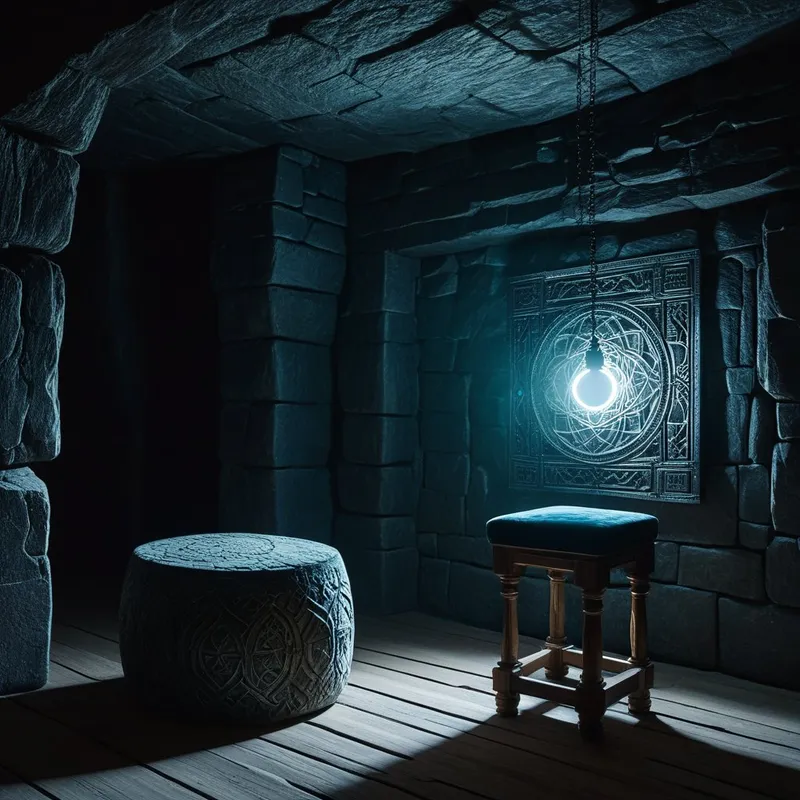
In the dream, I am in a cavernous, silent hall. My task is simple: to place a single, breathtakingly ornate silver necklace upon a velvet pillow on a stool. But the necklace is cold and impossibly heavy. Each link is a tiny, intricate scene from my life I no longer recognize. As I lift it, I know its weight will crush the pillow, the stool, the floor. I am holding the total catalog of every role I’ve ever performed.
Alchemical Interpretation: The dream presents the unbearable mass of a curated identity, challenging the dreamer to discern the difference between a chosen adornment and an inherited burden.
The False Lead
This theme is not a simple directive to “take off your mask” or reject beauty. To interpret ornamentation dreams as merely about vanity or inauthenticity is to commit a profound error. The ornament is not the enemy; the unconscious fusion with it is. The dream is not criticizing the necklace, but the paralysis that comes from believing you are the necklace, or that you must carry its full, unintegrated weight forever. It distinguishes between the sacred act of adornment—a conscious offering of one’s complexity to the world—and the profane state of being adorned upon, where the decoration becomes a cage of others’ expectations or one’s own frozen self-concept. The terror here is not of exposure, but of permanent, beautiful entombment.
Psychological Architecture
Beneath the glittering surface lies the deep Shadow work of individuation. Ornamentation dreams expose the internal family system in conflict: the inner Child who wants to play with shiny things, the inner Caregiver who wants to present a respectable front, the inner Rebel who wants to smash the gaudy displays, and the inner Sovereign who must ultimately decide what regalia is fitting for their realm. The psyche uses ornamentation to perform a brutal audit. Each dream-bauble, each piece of filigree, corresponds to a belief, a trauma-response, a talent, or a borrowed ideal we have sewn onto our essential nature.
The process is one of painful discernment. What in this dazzling array is yours? What was given in love but never fit? What was taken up as armor and has since rusted into your skin? The individuation journey here is the slow, meticulous work of unfastening. Not to become a bare, blank wall, but to become the conscious artist of your own display. It is the reclamation of the right to choose your symbols, to polish some and melt down others, to understand that the core self is not diminished by adornment, but is the only stable armature that can give adornment meaning and light.
Mythic Resonance
We see this eternal process in the myth of Arachne. The mortal weaver, whose skill was so great it became a defiant ornament to her pride, challenged the goddess Athena. Her tapestries were not just fabric; they were ornate testaments to her own identity. When punished and transformed, Arachne did not cease to weave. Her ornamentation became her very form and function—a web, both a beautiful, intricate trap and her means of survival and connection. The myth whispers that our most skilled self-display can become our cage, but also that within that cage, the impulse to create pattern, to connect threads, remains the irreducible core. Our ornaments can become our anatomy, for better or worse.
Symbolic Nodes
- Overly Elaborate Jewelry: Weighted values, inherited roles, burdens of status.
- Gilding/Foil on Cracked Surfaces: The attempt to beautify or hide fragmentation.
- Trophies or Awards in Empty Rooms: Recognition divorced from lived experience.
- Intricate Locks or Fastenings on Clothing: Complicated psychological defenses.
- A Single, Stark Object in an Ornate Room: The authentic self amidst the performance.
- Tarnished or Fading Decorations: Outgrown identities, neglected aspects of the self.
Archetypal Resonance
The energy of ornamentation pulses most strongly with The Ruler Archetype, specifically in its shadow dance with the Shadow Ruler. The core Ruler seeks to create order, value, and a meaningful kingdom—to consciously adorn their realm (the self) with symbols of its truth. The Shadow Ruler, however, becomes obsessed with the trappings of sovereignty—the control, the perfect appearance, the unassailable facade—mistaking the ornament for the authority itself. The somatic echo of the heavy pendant is the Shadow Ruler’s crown grown too tight. The alchemical potential lies in the Ruler’s journey from a tyranny of image-management to a true sovereignty where adornment is an authentic expression of inner law and cultivated worth, not its desperate substitute.
The Alchemical Process
The transmutation of ornamentation is the alchemy of conscious curation. The prima materia is the chaotic, dazzling heap of all you present to the world. The heat is applied through the relentless question: Does this serve my essence, or does it demand I serve it? This is not a cool analysis, but a forge-hot engagement. Grief arises as you identify ornaments you loved but which were never truly yours—the career path that looked prestigious but feels hollow, the personality trait adopted for safety that now stifles. Terror surfaces at the thought of removing them, fearing nothing will remain.
The pressure is the sustained willingness to sit in the provisional emptiness between identities, to tolerate the unadorned self. The transmutation occurs in the moment you pick up a symbol—a belief, a way of relating, a creative pursuit—and, instead of blindly wearing it, you hold it in your hands. You feel its weight, its history, its texture. You then make a conscious choice: to fasten it to your being with intention, to alter it, or to respectfully set it aside. The gold produced is sovereign authenticity: a self that is decorated not with the borrowed plumage of others’ expectations, but with the consciously chosen insignia of its own hard-won kingdom.
The Integration Protocol
Question 1: When you feel the “weight of the pendant” in your waking life—a sense of performative burden—what specific ornament (a role, an attitude, a commitment) feels most foreign to your inner touch?
Question 2: If you were to imagine your psyche as a sacred chamber, what one ornament within it feels most alive, most resonant with your core? What one feels like a static, dusty display?
Question 3: What forgotten or rejected part of yourself might be waiting, not to be displayed, but to become the very armature upon which new ornaments could be hung?
Action 1 (The Inventory): In a quiet moment, perform a somatic scan. Identify one place in your body that feels “adorned” (protected, presented, stiff) and one that feels “bare” (vulnerable, unseen, free). Spend two minutes simply breathing into the “bare” space, without needing to change it.
Action 2 (Unstructured Unfastening): Take a large sheet of paper. Without thinking, using any medium (pen, paint, collage), create a chaotic, “ornate” mess of marks, words, and images that represents the “weight” you carry. Then, with a different color or by physically tearing, consciously remove or alter one element of the mess. Observe the new composition.
Action 3 (Ritual of Selection): Choose one small object from your living space that feels like a mere “decoration.” For one week, each time you pass it, ask it: “What value do you truly hold for me?” At week’s end, based on the silent answers, consciously decide to keep it with renewed meaning, relocate it, or let it go.
Final Validation
It is profoundly difficult to sort the treasury of the self. The ornaments we collect are often gifts, armors, and loves; to question them can feel like betrayal. This weight is real. Yet within that difficulty lies your profound authority. You are not the passive mannequin upon which life hangs its decorations. You are the curator, the archivist, and the living gallery itself. The dream of ornamentation does not call you to austerity, but to a more sacred extravagance—the courage to wear only what resonates with the deep, silent song of your own sovereign stone, and in doing so, transform every chosen piece from a burden into a beacon.