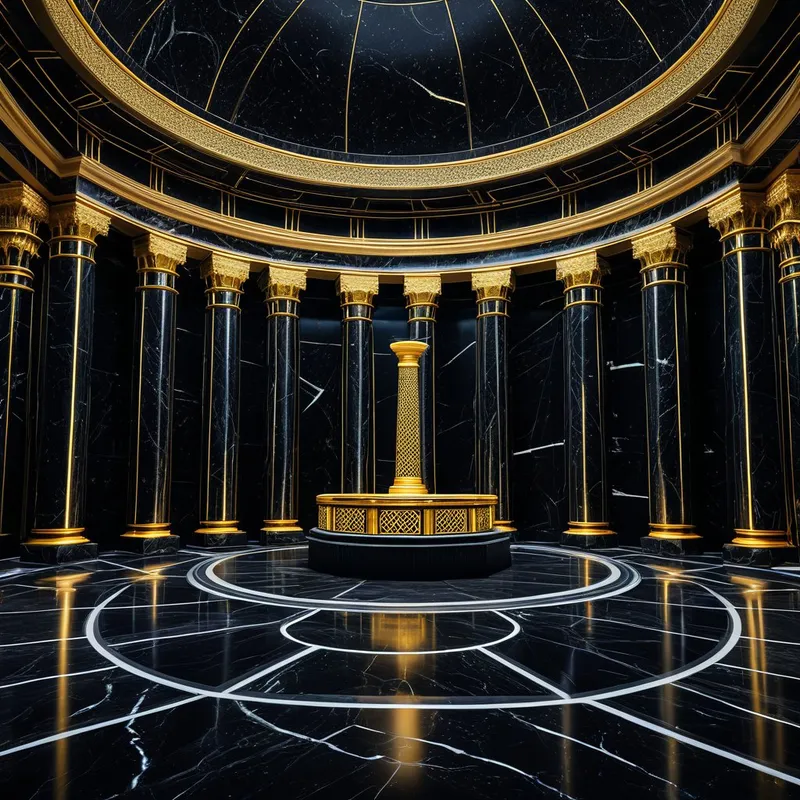
Ornament vs. Function: The Soul’s Audit of the Essential
The Somatic Echo
It begins not as a thought, but as a hollow ache behind the sternum—a cavity where certainty used to reside. There is a tightness in the jaw, the clenching of a smile that no longer reaches the eyes. The body carries the weight of gilded emptiness. You may feel a profound fatigue, not from exertion, but from the endless, silent labor of upholding a facade that has become its own reason for being. Your hands might feel useless, elegant perhaps, but disconnected from any task that matters. This is the somatic signature of a system—a life, a psyche, a role—that has prioritized adornment over architecture, where the glittering surface has begun to betray the crumbling foundation. It is the visceral realization that you are expending energy on the polish, while the engine sputters.
The Dreamer’s Log
The dreamer stands in a cavernous, humming server room. Banks of machinery pulse with silent data. But one server rack, more beautiful than the others, is encased in frosted glass etched with delicate, swirling patterns. It glows with a soft, decorative violet light. The dreamer knows, with absolute dream-certainty, that this beautiful server is utterly redundant; its only function is to be looked at. A sense of dread rises as they notice the vital, thick cables that should connect it are severed, lying coiled and dead on the floor.
Alchemical Interpretation: The psyche presents a stark image of a prized identity or capability that has been aestheticized into irrelevance, its true connective power deliberately cut off to preserve its pleasing appearance.

The False Lead
This is not a dream about simple inefficiency or bad luck. It is not a lament that things are “not working.” That is the language of the Orphan, who blames external circumstances. The Ornament vs. Function dream is a confrontation initiated from the deepest layers of the Self. It is a targeted revelation about a chosen misallocation of soul-energy. The terror here is not that something is broken, but that something you have cherished, polished, and displayed as a trophy of your identity is, in the cold calculus of the soul’s purpose, beautifully useless. It is the horror of realizing you have been the curator of your own museum of obsolescence.
Psychological Architecture
To dream of ornament failing function is to be summoned to the most ruthless kind of shadow work: the audit. The psyche, in its move toward wholeness (individuation), must periodically dissolve the calcified structures of identity. We all have internal “families”—subpersonalities that took on roles. One part became the Ornament: the achiever whose trophies gather dust, the charming persona that secures love but feels nothing, the rigid morality that looks impeccable but forbids real compassion. Its counterpart, Function, is often buried, a silenced engineer in the basement of consciousness who knows how things actually work, what actually nourishes, what truly connects.
The conflict arises when the Ornament, initially created for protection or love, becomes autonomous. It demands more energy, more polish, more validation, while functionally, the system starves. The dream is the Function’s rebellion. It is the moment the wiring behind the beautiful wall-panel smokes and sparks. The grief that follows is not for the loss of the ornament itself, but for the life-force we poured into it—time, love, attention that could have built something real. The individuation process here is a brutal economy: reclaim that energy. Strip the gilding. Feel the shame of the plain, unadorned substrate beneath. And in that raw, functional state, discover what it was actually meant to do.
Mythic Resonance
We see this in the tale of Daedalus and Icarus. The focus is often on Icarus’s fall, but the core is Daedalus’s invention: functional wings of wax and feather to escape a prison. Icarus, seduced by the ornament of flight—the sun’s glory, the feeling of godhood—forgets their function. The wings were not for transcendence; they were for transit. Their purpose was humble, specific, and grounded. The ornament of hubris destroys the function of freedom. Similarly, King Midas is granted a function—the golden touch—and immediately perverts it into an ornament, coating his world in a beautiful, deadly veneer that renders food inedible and his daughter a statue. The myth is not about wealth, but about the fatal error of making a utility into an aesthetic, starving the living system for the sake of a glittering principle.
Symbolic Nodes
- Beautiful but Broken Tools: A gorgeously carved pen that leaks, a stunning clock with stilled hands, a sword with a jeweled hilt and a blunt edge.
- Useless Intricacy: Locks with no doors, staircases that lead to walls, maps of fictional places drawn in exquisite detail.
- Vital Systems Disguised or Disconnected: Electrical wires wrapped in decorative sheathing that has frayed, a beating heart encased in crystal, a water pipe feeding an ornate fountain while the roots of a tree wither.
- The Plain, Unnoticed Object that Works: A simple clay cup that holds water, a rough-hewn lever that moves the world, an unlabeled key that fits the dream’s final door.
Archetypal Resonance
The energy at the core of this theme is that of The Shadow Ruler Archetype. The Shadow Ruler is not merely a tyrant over others; it is the internal dictator obsessed with control through image, order, and the perfect presentation of a kingdom (the psyche) that may be hollow. It mistakes the ornament—the crown, the decree, the flawless facade—for the actual function of rulership: wise governance, sustainable systems, and true sovereignty. The somatic echo of a clenched jaw and a hollow chest is the body living under this regime. The alchemical potential lies in dethroning this shadow and reclaiming the true Ruler’s mandate: to discern, from a place of deep self-knowledge, what structures are essential for the soul’s kingdom to thrive, and to have the courage to dismantle the beautiful, empty monuments to a false self.
The Alchemical Process
The transmutation here is From Gilding to Grain. The prima materia is the spent energy trapped in the ornament. The heat is applied through the intense, shame-adjacent vulnerability of seeing your own beautiful constructions as superfluous. This is the nigredo, the blackening: the moment the gilded statue tarnishes and you are left with base metal. The pressure is the sustained, uncomfortable gaze that asks, “What does this do? What does it feed? Does it connect me to life, or only to an image of life?”
The alchemical fire burns away the decorative layer, not to destroy, but to reveal the raw, functional material beneath. A persona crafted for lovability (ornament) is reduced to the simple, functional need for connection. An obsession with status (ornament) dissolves into the functional need for purpose and respect. This is not destruction, but distillation. The soul’s gold was always there, not as a surface coating, but as the core conductive element. The process ends not with something new, but with something true: a tool, a conduit, a foundation that works because it is honest. Sovereignty is born when you choose the functional grain of your own truth over the borrowed glitter of an impressive lie.

The Integration Protocol
Question 1: In my life right now, what is the most beautifully presented thing (a role, a skill, a relationship, a possession) that, in my quietest moments, I suspect serves more to be seen than to be used or felt?
Question 2: If I were to strip that thing of all its decorative value—its social prestige, its aesthetic pleasure, its role in my story—what is the bare, functional core that remains? Is it essential?
Question 3: What one, plain, unglamorous action have I been avoiding because it lacks the “ornament” of drama, recognition, or immediate satisfaction, yet I know it is functionally vital for my integrity?
Action 1 (The Functional Audit): For one day, conduct a silent internal audit. With each task, conversation, or purchase, ask internally: “Is this primarily for ornament (image, comfort, validation) or function (growth, connection, sustenance)?” Do not judge, only observe the ratio.
Action 2 (Unadorned Expression): Take a simple, functional object from your home (a mug, a hammer, a spoon). Spend 10 minutes writing about it from its own perspective. Describe its purpose, its wear, its honest interactions. Do not metaphorize it into something grand. Honor its sheer, plain utility.
Action 3 (Ritual of Decommissioning): Choose one small “ornament” in your life—a profile bio that feels inauthentic, a social media post crafted for image, a commitment made for appearances. Consciously and respectfully decommission it. Edit the bio to something true. Delete the post. Graciously bow out of the commitment. Feel the energy that is released back into your system.
Final Validation
It is a profound and disorienting grief to discover that something you have cherished, something you may have built your identity upon, has become a beautiful cage. Honor that grief. It is the proof that your soul is not dead; it is stirring, and its standards for truth are higher than your ego’s standards for splendor. The path from ornament to function is the path from a portrait to a living face, from a map to a territory, from a perfectly arranged museum to a wild, fertile, and functioning garden. It is the courage to trade the applause of the gallery for the silent, generative satisfaction of soil under your nails. Your sovereignty awaits in what works, not in what shines.