
The Architecture of the Psyche: Dreams of Order & Structure
The Somatic Echo
Before the image forms, the body knows. It is a sensation of crystalline tension, a silent hum in the marrow. It feels like a held breath waiting for the correct sequence to exhale, a spine aligning itself to an invisible plumb line. There is a profound ache for symmetry, not as a sterile ideal, but as a deep, biological remembering of balance. This is the somatic ground from which dreams of order and structure arise—a visceral longing for the internal scaffolding that can hold the weight of a becoming self. It is the body’s prayer for a form sturdy enough to contain its own chaos, a vessel worthy of its contents.
The Dreamer's Log
I am in a room I know is my study, but it is utterly empty. There is a desk of polished obsidian, and on it rests a single, ornate brass key. I understand, without words, that it opens a cabinet I cannot see. The cabinet contains every document of my life, but they are all blank vellum pages, waiting.
Alchemical Interpretation: The psyche presents not a lack, but the pristine potential for self-authorization; the key is the conscious will to inscribe meaning onto the blank slate of one’s own narrative.

The False Lead
This theme is not about the ego’s desperate clutch for control over external circumstances—that is the shadow of order, a tyranny of lists and rigid schedules born from fear. A dream of a collapsing building is not a prophecy of bad luck or failure in your projects. It is not a warning to micromanage your calendar. The dream’s architecture speaks to the internal framework. The collapse is of an outdated inner structure, a psychological edifice that can no longer support the consciousness now dwelling within it. The terror is not of chaos, but of a necessary deconstruction.
Psychological Architecture
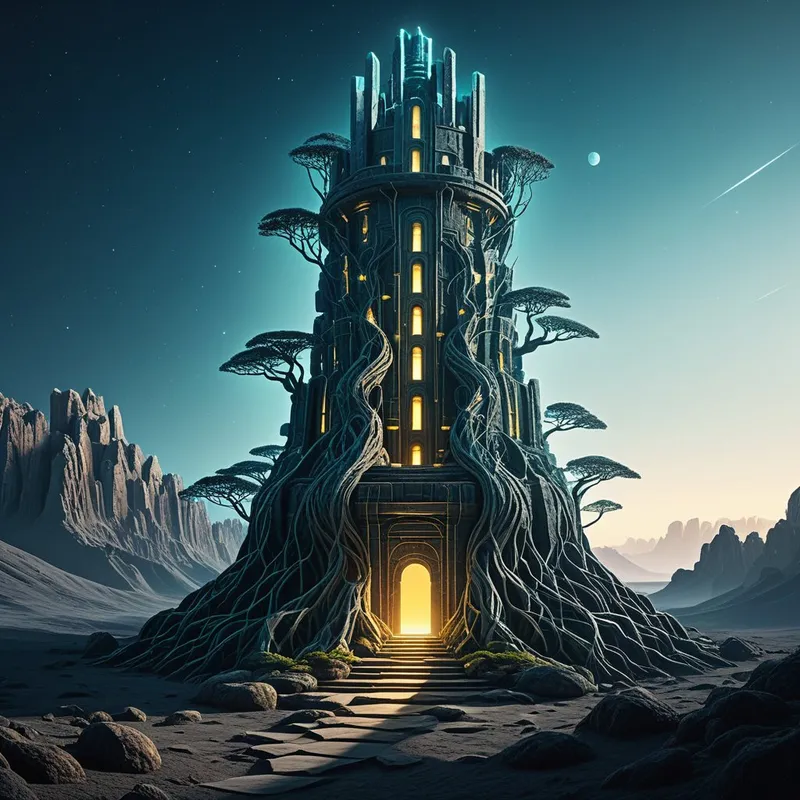
To dream of structure is to engage in the most intimate form of shadow work: confronting the internal family of psychic parts that vie for governance. There is the inner Tyrant, who mistakes rigidity for safety. The inner Victim, who believes any structure is a prison. The inner Architect, who draws blueprints in the dark. The individuation process here is the slow, often painful, assembly of a council from this chaos. It is the move from a fragmented psyche, where orphaned parts sabotage the whole, to an integrated sovereignty where each part has a dignified function within a greater design. You are not building a wall to keep things out; you are constructing a hearth to gather your scattered selves around.
Mythic Resonance
Consider the myth of the Minotaur in its labyrinth. The common reading is of a monster to be slain. But from the depth psychological view, the labyrinth itself is the central symbol—a vast, intricate, and deliberately constructed structure housing a raw, untamed instinct (the Minotaur). The hero Theseus does not destroy the maze; he navigates its precise, confounding order to meet what dwells at its center. The dream of order is this labyrinthine task: to have the courage to traverse the complex, winding structures of your own psyche to confront and integrate the powerful, instinctual self held within. The thread of Ariadne is not a cheat, but the guiding line of consciousness itself, allowing you to map the interior and return, whole.
Symbolic Nodes
- Empty Rooms, Hallways, Staircases: The architecture of potential; pathways of the psyche not yet inhabited or traversed.
- Grids, Blueprints, Schematics: The latent design of the Self, the underlying code of being.
- Keys, Combinations, Passcodes: The conscious insights or actions required to access locked-away potentials or truths.
- Foundations, Cornerstones, Load-Bearing Walls: The core beliefs and values that support your entire psychological edifice.
- Collapsing Buildings, Shifting Floors, Broken Locks: The disintegration of an outdated internal structure, making way for renewal.
- Catalogues, Filing Cabinets, Sorted Objects: The psyche’s process of organizing experience, memory, and identity.
Archetypal Resonance
The Ruler Archetype is the sovereign energy most active in this theme. Its essence is not domination, but the capacity to create order, allocate resources, and establish a kingdom where the self can flourish. The somatic echo of crystalline tension is the Ruler’s innate sense of responsibility for the inner realm. Its shadow—the Tyrant or Control-Freak—emerges when this ordering impulse, fueled by fear, turns rigid and oppressive, stifling the wild, creative, and vulnerable parts of the self. The alchemical potential lies in the Ruler’s maturation: transforming the need to control into the wisdom to govern, to establish a compassionate, flexible, and resilient inner sovereignty where all parts of the self are heard, valued, and integrated into a functional whole.
The Alchemical Process
The transmutation here is from rigidity to resilience, from control to sovereignty. The prima materia is the raw grief of things falling apart and the terror of perceived chaos. The alchemical fire is applied through the intense, sustained pressure of conscious deconstruction. You must willingly sit in the ruins of an old identity, a failed plan, a shattered belief. This is the calcinatio—the burning away of the ego’s attachment to a particular form. The heat comes from asking, “What remains when the structure I relied on is gone?” The pressure comes from refusing the quick fix, the new dogma, the borrowed blueprint. In this white-hot crucible, the soul learns its own tensile strength. The leaden fear of chaos is transmuted into the golden knowledge that you are not the building that collapses, but the architect who can dream a new one from the very stones of the old.
The Integration Protocol
Question 1: Where in my waking life do I confuse control (a rigid, fear-based grip) with structure (a supportive, life-giving framework)? What is the fear that demands the control?
Question 2: If my current sense of self were a building, what is its foundation made of? Is it bedrock or sand? What single "cornerstone" belief, if removed, would cause the whole structure to wobble?
Question 3: What exiled, chaotic, or "messy" part of myself is currently locked in the basement of my psyche, and what kind of room does it need to be brought upstairs and integrated?
Action 1 (Somatic Blueprint): Stand barefoot. Feel your feet on the ground. Imagine your spine as a central pillar. Now, in your mind’s eye, slowly construct a simple, beautiful structure around this pillar—a gazebo, a temple, a library. Don’t design it; let it build itself from your somatic sense of support and balance. Breathe into the space it creates.
Action 2 (Unstructured Cartography): Take a large sheet of paper. Without planning, draw the map of your inner world as it feels today. Not a literal mind map, but an expressive landscape. Where are the rigid fortresses? The wild, untamed forests? The crumbling bridges? The empty thrones? Let the lines, shapes, and shadings show you the current architecture of your soul.
Action 3 (Ritual of Keystone): Find a small, smooth stone. This is your keystone. Hold it and imbue it with a single, positive, foundational statement about yourself (e.g., "I am adaptable," "My worth is inherent"). Place it intentionally somewhere in your home—on a windowsill, by your bed, on your desk. Let it be a tangible anchor, a physical node in your external world that represents the conscious order you are cultivating within.
Final Validation
It is profoundly difficult to sit in the space between structures, to endure the silence of the empty room before the new furniture arrives. The mind, in its love for you, will scream for a plan, any plan, to end the discomfort. Honor that fear. And then, dare to wait. For the order that emerges from the soul’s own depths is not a cage of shoulds and musts, but the graceful, living architecture of a self that has finally come home to its own design. You are not building from scratch. You are remembering the blueprint you were born with.