
The Somatic Echo
Before the mind can name it, the body knows the dream of Order & Control. It is a specific, metallic taste at the back of the tongue—the flavor of static and cold iron. It is a tension not of chaos, but of a terrible, silent precision: a jaw clenched to a schedule, a spine held rigid against the threat of a single, misplaced thought. The breath becomes shallow, measured, as if counting its own arrivals and departures. The hands may feel like instruments, tools awaiting a command, rather than vessels of sensation. This is the visceral signature of a psyche that has mistaken the map for the territory, the clock for time itself. It is the echo of a system running on a logic so internalized it has become somatic law.
The Dreamer's Log
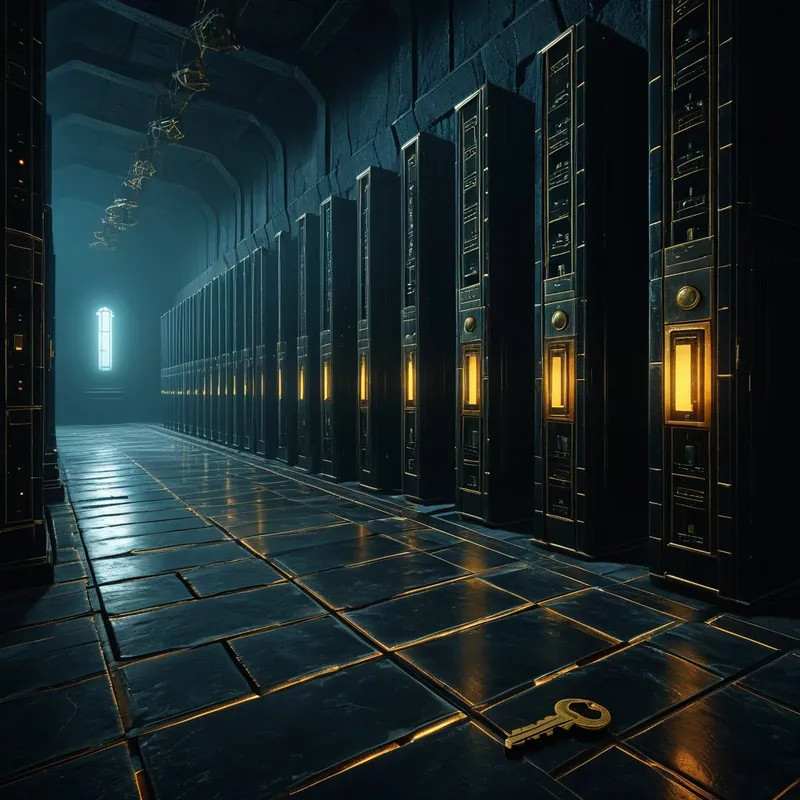
You stand in the heart of a cavernous, humming server farm. Rows of monolithic black towers stretch into darkness, their status lights a silent, rhythmic pulse. You know, with dream-certainty, that you are the administrator, the only keyholder. But the master console is a smooth, featureless obsidian slab. No commands respond. The system is perfect, immutable, and utterly beyond your reach. You search your pockets for the brass key you always carry, but find only fine, metallic dust sifting through your fingers.
The alchemy here is the realization that the key was never meant to operate the system, but to dismantle the console itself.
The False Lead
This theme is not about the simple frustration of a missed appointment or a spilled coffee. It is not mere "bad luck" or external inconvenience. To mistake it for such is to remain in the antechamber of its meaning. The terror of these dreams does not stem from a lack of control, but from a confrontation with the nature of the control you have authored. It is the shock of meeting your own internal governance—the silent protocols, the unconscious bylaws, the hidden hierarchies of the self—and finding them foreign, automated, and perhaps tyrannical. The dream is not reporting a failure of management, but initiating an audit of the entire regime.
Psychological Architecture
Beneath the dream of the failing system lies the shadow work of deconstruction. We build internal structures for excellent reasons: to survive, to cope, to make sense of a fragmented world. The Orphan within us learns to sort the world into safe and unsafe, building walls. The Child learns routines to ward off chaos. These structures become the silent government of the psyche. But Individuation—the process of becoming whole, not just organized—requires that we outgrow our own constitutions. The dream of Order & Control emerges when the Soul, the deeper Self, begins to press against the confines of a personality that has become too efficient, too rigid, a perfected prison. The pressure you feel is the tension between the structure you built and the life you are meant to live. The work is not to seize the controls, but to question the very need for that particular control panel. It is to dissolve the bureaucrat within and invite the sovereign.
Mythic Resonance
Consider the tale of the Minotaur in the Labyrinth. The common reading is of a hero conquering a monster. But from within, the myth speaks to the dream of Order & Control. King Minos, seeking to hide his shame (the monstrous offspring of his wife), commissions Daedalus to build a perfect, inescapable maze. The labyrinth is not merely a prison for the beast; it is a monument to a king's need for control, for tidying a chaotic truth into a complex, hidden geometry. The Minotaur itself is the unintegrated shadow, the wild, instinctual truth that the ordered kingdom cannot abide. The hero Theseus does not just slay the monster; he unravels the king's perfect system by following a thread back to its source—a thread provided by the king's own daughter, Ariadne, representing the connective, loving intelligence that rigid order excludes. The myth whispers: the most perfect system is often built to cage a part of your own soul.
Symbolic Nodes
- Malfunctioning or Locked Technology: Keypads with missing numbers, phones that won't dial, cars with no steering wheels.
- Impenetrable Architecture: Endless identical corridors, windows that don't open, doors that lead back to where you started.
- Unresponsive Systems: Talking to authorities who don't hear, trying to shout in a soundless vacuum, giving commands that echo back empty.
- Rigid, Fragile Objects: Glass schedules, porcelain routines, clockwork that seizes if a single grain of sand enters.
- Lost or Useless Keys: The symbol of agency that no longer fits the lock it was designed for.
Archetypal Resonance
The energy at the core of this theme is that of The Shadow Ruler. The Shadow Ruler is not merely a bossy inner critic; it is the internal architect of that perfect, suffocating labyrinth. It operates from a deep, often unconscious, fear of chaos and entropy, believing that total control is synonymous with safety and identity. Its somatic echo is that rigid spine and metallic taste—the body armored as a citadel. Its alchemical potential, however, is immense. The same energy that builds prisons can, when integrated, build a kingdom. The transmutation involves the Shadow Ruler's drive for order surrendering its tyranny and aligning with the deeper wisdom of the Self, learning to govern with compassion, flexibility, and true authority—becoming a steward of the inner realm rather than its jailer.
The Alchemical Process
The alchemical agent for this theme is not fire, but a slow, pervasive humidity—the pressure of a truth that cannot be systematized. It is the heat of shame when your perfect plan fails, the pressure of grief for the spontaneous life your routines have excluded. The prima materia is the entire edifice of your control: the lists, the shoulds, the hidden contracts, the anxiety that masquerades as diligence. The process begins with corrosion. The humid air finds the tiny flaw in the glass schedule, the rust forming on the iron will. This is the dream of the malfunctioning key. The system must tarnish, must fail, for the work to begin. Next is dissolution. The rigid structures must soften, become permeable. This is the terrifying phase where nothing seems to hold, where the old laws are suspended. Finally, in the coagulation, a new principle emerges from the dissolved matter: not control, but sovereignty. Sovereignty is fluid. It can impose order as a temporary, compassionate act, and dissolve it just as easily. It knows itself as the source, not the manager, of its experience.

The Integration Protocol
Question 1: Where in your waking life do you feel the cold, metallic taste of rigid control? Is it in a relationship dynamic, a work process, or a private ritual you dare not break?
Question 2: What monstrous or chaotic part of yourself might your most perfected systems be designed to keep hidden in a labyrinth?
Question 3: If your sense of control were to dissolve for one day, what forgotten sensation or neglected desire might begin to breathe again?
Action 1 (The Deliberate Glitch): Intentionally introduce a small, benign flaw into a rigid routine. Take a different path on your walk. Leave a dish unwashed. Break the sequence. Observe not the practical outcome, but the somatic and emotional resonance of the "error."
Action 2 (Mapping the Labyrinth): Engage in a creative, unstructured writing or drawing session. Let your hand move without a plan. The goal is not art, but trace-work. See what images, shapes, or words emerge when the inner administrator is put on leave. This is the thread Ariadne gives you.
Action 3 (Sovereignty Ritual): Go to a natural, open space—a field, a beach, a forest clearing. Stand firmly. Announce to the air, softly or loudly, "For this hour, I suspend all internal laws." Then, simply be. Follow an impulse, however slight. Sit where you want. Move how you want. You are not practicing chaos, but rehearsing the fluid authority of a sovereign in their own domain.
Final Validation
It is terrifying to feel the architecture you rely upon begin to shift. To question control is to stand at the edge of an apparent abyss, for we have been taught that order is the only bulwark against the void. But the dream comes not to destroy your foundation, but to show you that you have been living in the meticulously furnished basement of your own being. The integration of this theme is the courageous, gradual move upstairs, into the wider, airier, and less predictable rooms of your wholeness. The control you grieve was never yours to begin with; it was a borrowed blueprint. What awaits is the authority to design, from the ground up, a life that is not faultless, but authentically, fluidly your own.