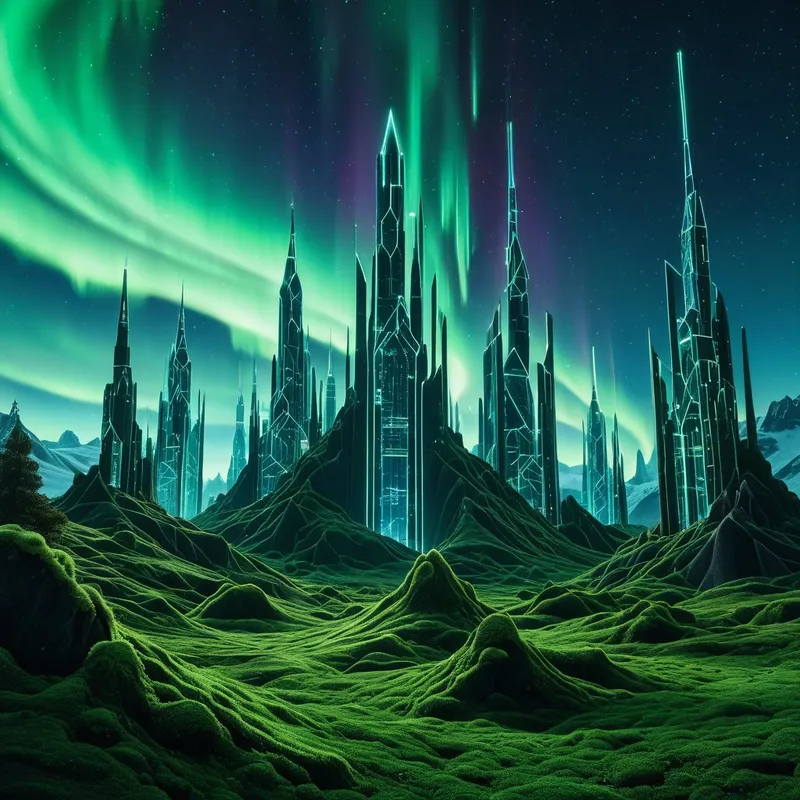
Natural Reclamation: The Dream of Dissolution and Wild Return
It begins not as a thought, but as a sensation. A deep, cellular sigh. A loosening in the jaw you didn’t know was clenched, a softening in the shoulders that carried the weight of a constructed world. It is the visceral relief of a wall, long thought permanent, finally showing a crack of green. It is the quiet, terrifying thrill of watching the meticulously ordered garden of your identity—the trimmed hedges of persona, the paved paths of routine—being gently, inexorably invaded by something older and far less polite. This is the somatic echo of Natural Reclamation: the body remembering it is not a machine, but an ecosystem, and the ecosystem is calling its own back home.
The Dreamer's Log
The dream is always of a place that was meant to be sealed. A sterile server room, its hum the only sound, now silent. From a hairline fracture in the concrete floor, a shock of vivid moss has erupted, cradling a dead circuit board like a sacred relic. Vines, thick as arteries, have pried open the server racks, their leaves softly brushing against silent drives that once held entire worlds of data. The air smells of ozone and damp earth.
In this silent cathedral of dead logic, life is not invading; it is simply resuming, performing the alchemy of turning information back into humus.

The False Lead
This is not a dream of mere decay or bad luck. It is not a passive nightmare of neglect, but an active, purposeful vision of transformation. The psyche is not depicting a failure of maintenance, but a success of a deeper, more ancient protocol. To misinterpret this as a symbol of personal collapse, of being "overgrown" by responsibilities or "crumbling" under pressure, is to miss the point entirely. This is not about being consumed by chaos, but about the artificial structures that contain you being consumed by truth. The terror you feel is not for the loss of the building, but for the loss of the identity that lived inside it.
Psychological Architecture
Natural Reclamation dreams are the psyche’s most elegant and ruthless form of shadow work. They visualize the process of Individuation—not as a gentle unfolding, but as a radical demolition project. The "city" in the dream is your complex of adaptations: the defensive walls, the efficient but soulless infrastructure of your persona, the controlled environments where certain feelings are permitted to grow and others are paved over. This city was built for survival, for belonging, for function. But it was built on top of a living field.
The reclamation is the shadow’s return. It is the wild, untamed, and repressed psychic material—instinct, raw emotion, forgotten trauma, uncensored creativity—breaking through the flooring. This is not a hostile takeover, but a homecoming. The vines are your neglected vitality. The moss is your muted sensitivity, returning to reclaim the cold, hard surfaces. The dream shows you that the process of becoming whole is not about building a taller, better-defended tower of self. It is about allowing the entire settlement of the false self to be decommissioned and composted, so the original, fertile ground of your being can breathe again.
Mythic Resonance
We see this not as a pathology, but as a primordial story. Recall the myth of the Hanging Gardens of Babylon. A king builds a monumental, artificial mountain of greenery to soothe his queen’s longing for her wild, mountainous homeland. It is a stunning feat of control, a civilization imposing its order on nature to mimic nature itself. Yet, the legend ends with the gardens lost, swallowed by the desert. The structure could not sustain the life it sought to emulate because it was not of that life; it was a beautiful, desperate substitute. The reclamation dream is the desert—or the forest, or the sea—finally claiming the substitute, insisting on the real, untamable thing.
Symbolic Nodes
- Vines/Creepers on buildings: The slow, persistent pressure of suppressed truth.
- Trees growing through floors/roofs: A core, authentic self breaking through layered adaptations.
- Animals in urban spaces (wolves in streets, birds in halls): Instinct reclaiming territory from intellect.
- Rust and corrosion on polished metal: The erosion of rigid defenses by the waters of feeling.
- Moss and fungi on technology: The organic processes of decay and transformation working on frozen thought-forms.
- Silent, dead electronics amidst thriving plant life: The obsolescence of old mental programs in the face of awakened vitality.
Archetypal Resonance
The energy here is not one of building, but of unbuilding. Not of ruling, but of deposing an inner regime. It is the force that dismantles prisons, even those we have lovingly decorated. This is the signature of The Shadow Rebel.
The Shadow Rebel is not the revolutionary with a cause, but the pure, anarchic force of deconstruction that arises when a system—be it a government or a personality—becomes too rigid, too life-denying. Its somatic echo is that crackling, liberating fear in the gut as the walls begin to shake. Its core energy is the ruthless, non-negotiable demand for authenticity over order, for flow over fixation. In its shadow aspect, it can feel like self-sabotage or chaotic collapse. But in its alchemical potential, this archetype provides the necessary violence—the wrecking ball—that clears the ossified structures of the ego, making space for a sovereignty that is organic, not imposed. It doesn't build the new world; it stops the old one from stopping the new world from growing.
The Alchemical Process
The alchemy of Natural Reclamation is Calcination by Humus. In classical terms, calcination is the burning away of impurities using intense, dry heat. Here, the heat is the profound discomfort of watching your inner world’s foundations be dismantled. The pressure is the grief for the identity that is passing. But the agent is not fire; it is the moist, dark, microbial process of composting.
Your rigid beliefs, your defensive narratives, your "shoulds" and "musts"—these are not burned away, but are broken down. They are subjected to the humid breath of forgotten tears, the patient acidity of long-stored anger, the gentle, relentless persistence of a truth you could no longer outrun. This process feels like dissolution, like a death. It is. It is the death of the artifact so the organism can live. The transmutation occurs when you stop fighting the vines and realize you are the vines, and you are also the city. The sovereignty gained is not control over the process, but identification with the larger field in which both construction and reclamation are simply phases of being.
The Integration Protocol
Question 1: What is one "polished surface" in my life—a role, a habit, a belief—that feels sterile, efficient, but lifeless? What tiny, hairline crack has recently appeared in it?
Question 2: If the reclaiming force in my dream (the vine, the moss, the water) could speak, what one sentence would it whisper about what it has come to retrieve?
Question 3: What forgotten or walled-off part of my own nature would feel most "at home" in the ruins of my dream?
Action 1 (Grounding in the Crack): For one week, perform a daily micro-ritual. Find a crack in pavement where a weed grows, or a spot where rust blooms on metal. Spend two minutes simply observing it. Do not analyze. Feel the silent, potent force of that reclamation in your body.
Action 2 (Unstructured Reclamation Writing): Set a timer for 10 minutes. Write with the prompt: "The instructions from the roots are…" Do not lift your pen or correct yourself. Let the writing be messy, cross over lines, "reclaim" the page. The content is irrelevant; the act is the integration.
Action 3 (Offering to the Humus): Choose a small, symbolic object that represents an "artificial structure" you are ready to release—a rigid schedule, an old grievance, a perfectionist ideal. Bury it in soil (a plant pot is fine). Pour water over it. Tend to nothing. Let it compost.
Final Validation
It is terrifying to dream of dissolution. To witness the walls that have housed your sense of self be rendered permeable, then obsolete. Honor that fear; it is the last guard at the gate of a familiar, if cramped, kingdom. But dare to listen past it. The green force breaking the concrete is not your enemy. It is your oldest ally. It is the part of you that never signed the lease on that small, safe room in the tower of who you thought you had to be. It has come, with infinite patience and undeniable power, to reclaim you for the vastness of who you are. The sovereignty that awaits on the other side of this reclamation is not a throne, but a forest—a living, breathing, interconnected wholeness that needs no walls to define it.