
The Author in the Archive: Dreams of Narrative & Meaning
The Somatic Echo
It begins not as a thought, but as a hollow. A quiet, resonant ache in the solar plexus, the place where personal truth is meant to anchor. It’s the feeling of a story left untold, a sentence trailing off into silence. The body knows when the narrative thread has snapped, long before the mind can articulate the plot hole. There’s a subtle vertigo, a sense of standing at the edge of a page that is stubbornly blank, while a chorus of half-formed characters and forgotten themes murmur just beneath the sternum. This is the somatic echo of a psyche that has lost authorship of its own tale—a deep, structural homesickness for a coherence you once felt in your bones.
The Dreamer's Log
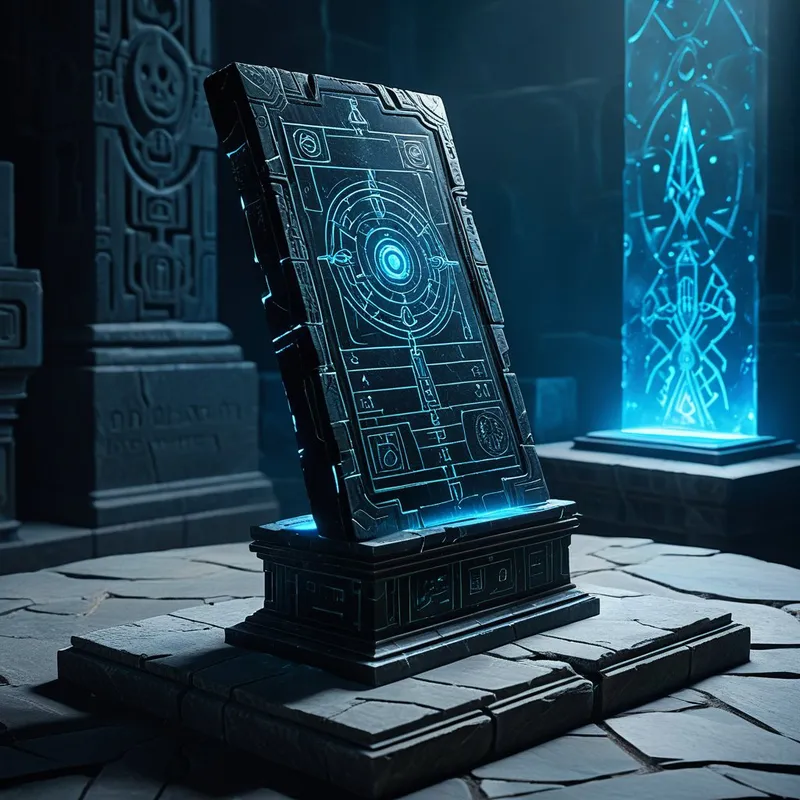
I am in an infinite archive, but all the texts are written in a language of light that dissolves as I try to read it. I hold a stone tablet, heavy and cold, knowing it contains the missing chapter of my life, but the symbols are just static, beautiful and meaningless.
This dream is the psyche’s direct report: you are in possession of the raw material of your meaning, but the internal translator—the part that weaves event into essence—has gone offline.
The False Lead
This theme is not about a simple lack of direction or a passing bout of confusion. It is not the “bad luck” of a chaotic week or the overwhelm of too many options. To mistake it for such is to confuse the collapse of the library’s indexing system with merely misplacing a single book. The terror here is ontological, not logistical. It is the silent, creeping fear that the story you’ve been living might belong to someone else—a parent, a culture, a trauma—and that your authentic voice has been relegated to the footnotes. The dream is not complaining about the plot; it is questioning the fundamental authority of the author.
Psychological Architecture
When dreams of fractured narratives arrive, they signal a profound shift in the psyche’s internal family system. The various “parts” of you—the inner child who felt, the achiever who acted, the critic who judged—have been operating from isolated scripts. The dream reveals the shadow work of individuation not as adding a new character, but as convening a council of all existing ones to draft a new constitution. The grief felt is for the simpler, handed-down story you must release. The terror is of the blank page that follows. This is the architecture of the Self reorganizing itself from a collection of reactive subplots into a coherent, sovereign epic. You are being asked to move from a character in your story to the author of it, with all the terrifying responsibility and creative power that entails.
Mythic Resonance
We see this eternal process in the myth of Ariadne and the Minotaur. The labyrinth is not just a maze of walls, but a narrative trap—a story of sacrifice and fear written by a tyrannical king. Theseus, the conscious ego, enters to slay the beast, but he is lost immediately. The meaning, the way out, is not found through force, but through the spool of thread given by Ariadne. She represents the intuitive, connective wisdom of the psyche itself, the part that remembers how stories are woven and can trace a path back to their source. The dream of lost narratives is your Ariadne offering you the thread; the alchemy is in having the courage to follow it into the dark, not knowing what beast or liberation you will find, but trusting the line will hold.
Symbolic Nodes
- Fragmented Texts: Scrolls, books with missing pages, erased words, shifting fonts.
- Lost Archives & Libraries: Infinite rooms, locked cabinets, dust-covered volumes.
- Unreadable Codes: Encrypted messages, beautiful but indecipherable symbols, fading ink.
- Silent Messengers: Figures who try to speak but produce no sound, or deliver a message you instantly forget.
- Broken Narrative Devices: Shattered mirrors (reflecting disconnected scenes), stopped clocks (time without progression), jammed film projectors.
Archetypal Resonance
The energy here is fundamentally that of The Creator Archetype. Not the shadow creator, obsessed with a singular, personal vision, but the mature Creator as the essential Architect of Meaning. This archetype feels the somatic hollowness as the primal creative urge—the need to bring order from chaos, form from the formless. Its alchemical potential lies in its refusal to accept a meaningless reality; it must impose coherence, build the narrative framework, even if it must first dismantle the old, borrowed one. The terror of the blank page is its sacred fuel. When this archetype is active, the psyche knows, at a bone-deep level, that meaning is not found, but forged—and you are the sole smith with access to the inner fire.
The Alchemical Process
The transmutation here is from Consumer of Narrative to Author of Meaning. The required heat is the unbearable tension of holding two truths: the profound inadequacy of the old story, and the equally profound responsibility of writing the new one. This is the pressure of the liminal space—the "in-between" where the former identity has dissolved but the new one has not yet cohered. The alchemical fire is lit by a ruthless, compassionate inventory: which parts of my life’s script are mine, and which are inherited, imposed, or adopted for survival? The base metal is the collection of disparate, often conflicting, sub-personalities and their storylines. The gold is the integrated, self-authored narrative that can hold complexity without fracturing. You must sit in the silent archive of your own soul and, piece by piece, learn the lost language of your own longing.

The Integration Protocol
Question 1: If my life up to this point were a book, what would be its title? Who would the reader assume is the author? Question 2: What is one "chapter" of my past that feels written in a voice not my own? What single sentence would my authentic voice write to begin rewriting it? Question 3: In the dream of the lost archive, what did the indecipherable text feel like, before I tried to understand it? What truth lives in that sensation alone?
Action 1 (Somatic Re-Anchoring): When you feel the hollow, narrative-less ache, place a hand on your solar plexus. Breathe into that space, not seeking a story, but simply acknowledging the void as a clean slate. Whisper, "The page is blank. I am here." Action 2 (Unstructured Reclamation): Take a large piece of paper. Without narrative intent, draw lines, shapes, and words that represent the "fragments" from your dream or waking sense of disconnection. Let them collide. Then, with a different colored pen, draw just one connecting line or shape that makes the chaos feel intentional. This is the first act of authorship. Action 3 (Ritual Re-Narration): Find a small, ordinary object—a stone, a key, a specific pen. Declare it your "foundational glyph." For one week, carry it and, each time you touch it, silently state one true sentence about your present moment experience (e.g., "I am tired and the light is grey," "I feel a spark of curiosity"). You are not writing a epic, you are practicing the authority of the simple, true line.
Final Validation
It is a terrifying thing to feel the story of your self unravel. To stand in the ruins of a meaning that once felt solid is a profound and lonely courage. Do not mistake this dissolution for failure; it is the necessary clearing of the inner stage. The archive is not lost. The language is not dead. It has simply been waiting for you, the true author, to return—not as a reader, but as a scribe wielding the pen of your own conscious, embodied experience. The meaning you seek is not hidden in the last chapter of an old book. It is waiting in the first, brave, shaky word you choose to inscribe on the clean, white page of your now.