
The Architecture of Becoming: Dreams of Movement & Transition
The Somatic Echo
Before the mind can articulate a change, the body registers it as a tectonic hum. This is the somatic echo of transition: a low-grade vibration in the marrow, a subtle vertigo when you are perfectly still. It is the feeling of the ground being both solid and not-solid, like standing on a platform you know is about to begin its journey. The breath catches, not in fear, but in anticipation of a different rhythm. The muscles hold a latent readiness, a coiled potential for a direction not yet chosen. This is the visceral pre-language of the psyche preparing to migrate. It is the internal weather shifting, a pressure change in the soul’s atmosphere that announces a coming storm of reconfiguration.
The Dreamer's Log
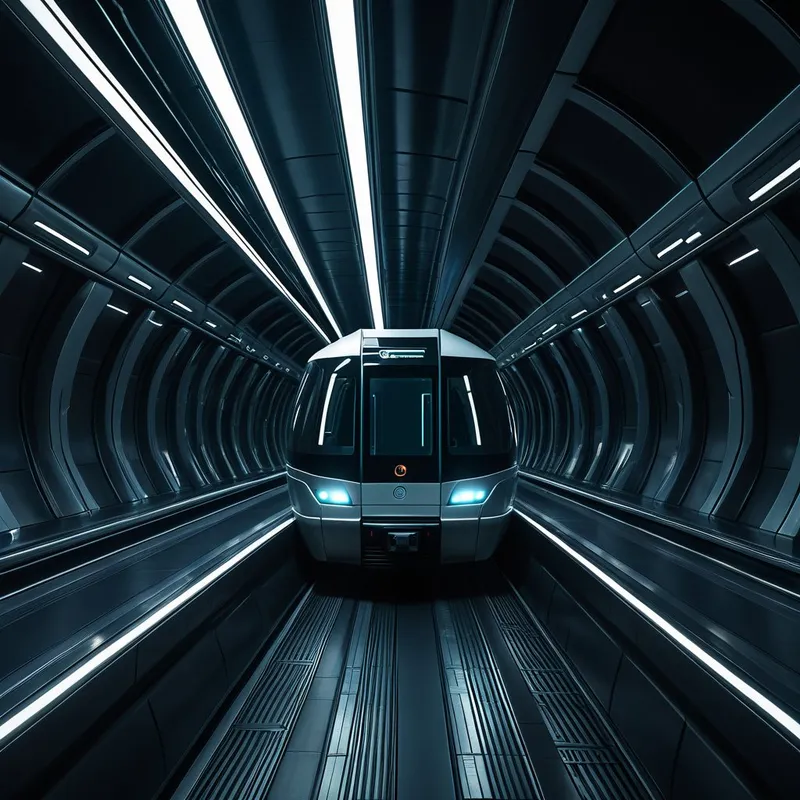
The dream is always the same: I am on a sleek, automated monorail, gliding soundlessly through a tunnel of polished black stone. There are no stations, no maps, only the certainty of motion. I am the only passenger. The destination is unknown, but the movement itself feels like a purpose.
Here, the alchemical process is the dissolution of the need for a known destination; the vehicle itself is the transformed state.
The False Lead
This theme is not about mere physical relocation, a change of job, or a streak of circumstantial luck or misfortune. To mistake the symbol for the circumstance is to stand outside the cathedral and comment on the weather. The movement in these dreams is of a different order—it is structural, foundational. It is not the furniture being rearranged in the house of the self; it is the house itself being quietly, irrevocably rebuilt on a new plot of land within you. A dream of missing a train is not a prophecy of failure; it is the psyche’s stark report on your ambivalence, your unconscious refusal to board the vehicle of your own becoming.
Psychological Architecture
The deep work here is the shadow work of release. To move forward is to consent to leaving a version of yourself behind. This is the grief of the orphaned self—the part of you that was forged in a previous season, that learned to survive in an old landscape. That self must be acknowledged, honored, and then released like a leaf into a river. The individuation process demands this migration. You are not fleeing; you are outgrowing. The terror is not of the new, but of the dissolution of the familiar container. The psyche, in its infinite wisdom, uses the metaphor of movement to force a confrontation with your own attachments to stagnant forms. Will you cling to the crumbling shore, or learn to breathe in the medium of the journey itself?
Mythic Resonance
Consider the story of Inanna, the Sumerian goddess who descends through the seven gates of the underworld. At each gate, she is stripped of a royal garment or symbol of her power—her crown, her lapis beads, her robe. This is not a defeat, but a necessary deconstruction. To reach the depths and return transformed, she must surrender the identity that defined her in the world above. Each relinquishment is a movement inward, a transition from one state of knowing to another. Her journey maps the universal firmware: true transition requires a willing divestment, a stripping down to the essential, naked self before the ascent into a new, integrated sovereignty can begin.
Symbolic Nodes
Common images in this lexicon include: vehicles of all kinds (trains, cars, ships, especially if driverless or on a fixed track); bridges, tunnels, and portals; elevators and escalators; being carried by a current (river, wind, crowd); hallways that stretch or change; staircases that appear or disappear; and the potent, often unsettling image of flying or falling without control. Each is a cipher for the mechanism of change—imposed, chosen, assisted, or terrifyingly free.
Archetypal Resonance
The energy here resonates most powerfully with The Explorer Archetype. The core impulse of the Explorer is to seek, to venture beyond the known map in search of a more authentic self or a truer home. This archetype does not move for movement’s sake, but from a deep, somatic discontent with the confines of the familiar. Its energy is that restless hum in the marrow, the conviction that there is more. The shadow of the Explorer—the Aimless or Alienated wanderer—emerges when the movement becomes an escape, a refusal to integrate any finding, perpetually seeking the next horizon to avoid the work of the present one. The alchemical potential lies in the Explorer’s courage to face the blank spaces on the map, understanding that the true territory being discovered is the uncharted landscape of the inner self.
The Alchemical Process
The transmutation here is from Passenger to Navigator. The raw, leaden matter is the feeling of being carried by forces unseen—fate, habit, the expectations of others, or the inertia of a life outgrown. The intense heat required is the crisis of agency. This is the pressure that asks, often brutally: “Are you moving, or are you being moved?” The grief is for the lost comfort of passivity; the terror is of choosing a direction and being responsible for its wilderness. The alchemical fire burns away the illusion of the external driver. In the crucible of this awareness, the vehicle of your life—the career, the relationship, the daily pattern—does not disappear. Instead, you discover the controls were always in your hands, merely shrouded in shadow. The gold forged is not a final destination, but sovereignty over the journey itself: the capacity to be in motion, fully conscious, and at peace with the unfolding path.

The Integration Protocol
To metabolize this dream material, engage with these inquiries and actions:
Question 1: In the dream, what is the quality of the movement? Is it smooth or jarring, chosen or imposed? What does that tell you about your relationship to the current transition in your waking life?
Question 2: What, specifically, are you being asked to leave behind in order to move forward? Name not just the circumstance, but the identity, the comfort, or the old story that is attached to it.
Question 3: If you imagined yourself as the vehicle in the dream—the train, the river, the elevator—what is your fuel or current? What power source have you been ignoring?
Action 1 (Somatic Cartography): For one week, pause three times daily. Feel your feet on the ground. Ask internally: “Where am I located in my own life right now—at the beginning, middle, or end of a cycle?” Don’t think it. Feel the answer in your body’s posture, tension, or ease.
Action 2 (Unstructured Passage): Set a timer for 15 minutes. With pen and paper, begin writing with the sentence: “The vehicle I am inside is…” Do not stop writing, do not edit, do not lift the pen. Let the description of the vehicle, its motion, and its interior flow uncensored. This is not to create a story, but to let the psyche sketch its own blueprint.
Action 3 (Ritual of Release & Welcome): Find two small stones. Hold the first, and name aloud the old state, identity, or pattern you are consciously releasing. Place it at the base of a tree or in a body of water. Hold the second, and name the quality you are inviting for the journey ahead (e.g., trust, curiosity, courage). Carry this stone in your pocket for a week as a tactile anchor to your new navigational role.
Final Validation
It is valid to feel unmoored. It is human to glance back at the receding shore with a pang of grief, even for a prison that kept you safe. This tension is not a sign you are doing it wrong; it is the signature of authentic metamorphosis. The dream of movement is not a sentence to perpetual wandering, but an invitation to become the author of your passage. You are not losing your way. You are learning, bone-deep, that the way is made by walking. The transition is not between points on a map, but between versions of your soul. And you, in your essential core, are both the journey and the destination coming into being.