
The Dream of the Unbending Law: Alchemy for a Rigid Soul
The Somatic Echo
Before the mind conjures a courtroom or a list of transgressions, the body knows moral rigidity. It is a sensation of cold density in the chest, a fossilization around the heart. The breath becomes shallow, held captive by an internal corset of should and must not. The jaw sets, the shoulders lock into a defensive rampart. It is the somatic signature of a psyche that has mistaken its scaffolding for its soul—a living system petrifying into a monument. You feel less like a flowing river and more like its frozen, treacherous banks, defined solely by what you contain and what you forbid from crossing.
The Dreamer's Log (Case Vignette)
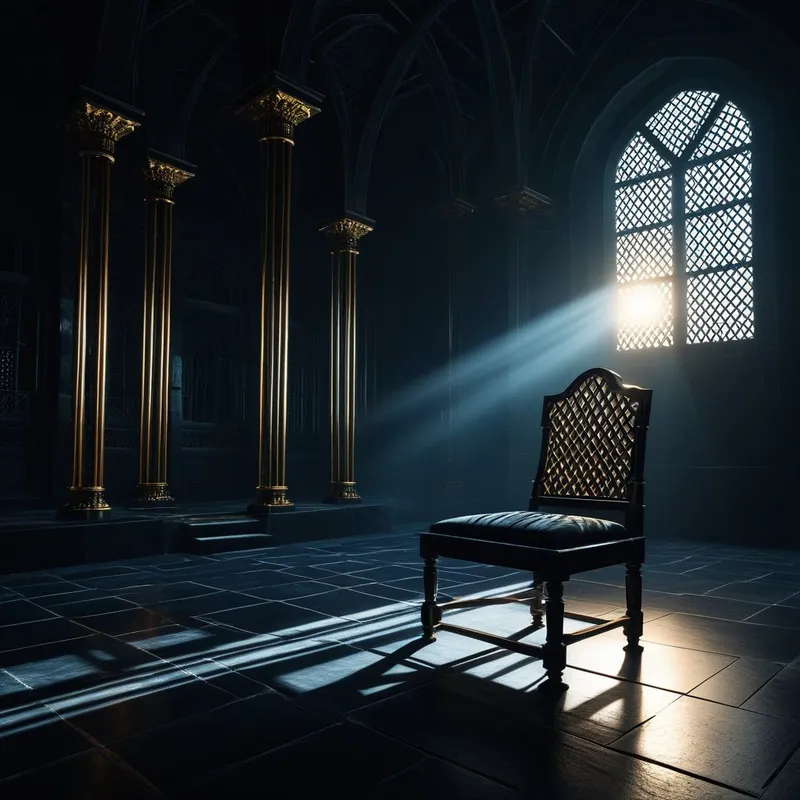
I am in a vast, empty hall of polished black stone. A single, ornate wooden chair sits in a shaft of cold light. A voice, neither mine nor another’s, simply present, begins to recite a list of my failures: the unkind thought I entertained on Tuesday, the minor promise forgotten last month, the secret envy I nursed. With each item, an invisible bar of golden light forms around the chair, until I am looking at a perfect, shimmering cage built from my own catalogued sins. The chair remains empty.
Alchemical Interpretation: The psyche presents the self not as a sinner in the dock, but as the absent judge, demonstrating how the internal judiciary has become so perfected it cages the very seat of being.
The False Lead
This is not a dream about being morally correct or receiving divine chastisement. That is its most seductive trap—the belief that the tightening, judgmental voice is a purifying force, a spiritual upgrade. It is not. Moral rigidity is the shadow of integrity, not its light. It is the conversion of ethical longing into psychological concrete. The dream is not highlighting your failures, but the failure of a system within you that can only relate to life through the brittle metrics of condemnation and acquittal. It signals a structural crisis in your inner governance, not a simple verdict on your behavior.
Psychological Architecture
Beneath the dream of the unbending rule lies a profound terror of the fluid, the ambiguous, the uncontrollably alive. The psyche, in parts, constructs this rigid internal legislature as a desperate defense against chaos—both the chaos of external life and the wild, unpoliced wilderness of the inner world. This is the domain of what we might call the Inner Magistrate, a subpersonality born from early experiences where love felt conditional, safety seemed predicated on perfect behavior, or belonging required the suppression of messy, complex emotions.
The Shadow work here is not to destroy the Magistrate, but to depose it from its tyrannical throne and invite it to a council. Individuation demands the reintegration of the very qualities the Magistrate exiled: compassion for error, curiosity about shadow, and the capacity for contextual grace. The process feels like a civil war within the soul’s parliament, where the loud, clear voice of law is challenged by the silent, profound presence of mercy. To become whole is to exchange a codex for a compass—a tool for navigation rather than a script for condemnation.
Mythic Resonance
We see this architecture perfected in the myth of Pharaoh from the Exodus story. Here, moral rigidity is not personal but systemic, enshrined in a civilization. Pharaoh’s heart is repeatedly hardened—a divine metaphor for a psychological state of absolute, calcified will. His rigidity is his identity; to soften is to admit the collapse of his entire world-order, his god-like self-conception. The plagues that follow are not merely punishments, but the erupting, ignored life-force of the repressed (the Israelites as symbolic of the suppressed, creative, instinctual self). The Red Sea’s parting is the ultimate alchemical image: the rigid path of control (the sea floor) is only revealed through a terrifying suspension of the natural order, a yielding to a force greater than one’s own will. The drowned army is the fate of the rigid structure when it finally, catastrophically, encounters the returning tide of life.
Symbolic Nodes
- Empty Thrones, Judgement Seats, or Courtrooms: The architecture of judgment without the presence of a compassionate judge.
- Cages, Bars, or Lattices of Light: Self-constructed prisons of perfectionism.
- Frozen Landscapes, Stone Tablets, or Brittle Objects: The emotional climate of the rigid psyche.
- Unwavering, Monotonous Voices or Lists: The internal prosecutor’s drone.
- Shattering Glass or Cracking Ice: The first signs of the structure’s inevitable failure under the pressure of lived experience.
Archetypal Resonance
The energy at the core of this theme is that of The Shadow Ruler. The Ruler archetype in its essence seeks to create order, structure, and a harmonious kingdom—in this case, the inner world. Its shadow, however, manifests as the Tyrant or Control-Freak, where order becomes oppression, structure becomes a prison, and harmony is demanded through total compliance. The somatic echo of clenched control and cold judgment is the Shadow Ruler’s bodyguard standing post. Its alchemical potential lies in its original, noble aim: sovereignty. The transmutation is from tyranny—imposed, fear-based control—to true sovereignty: a wise, compassionate, and flexible authority that can hold complexity without fracturing.
The Alchemical Process
The alchemy of moral rigidity is the Dissolution of the Monolith. The required heat is the unbearable warmth of self-confrontation—not with your sins, but with the profound grief and fear that necessitated this fortress of righteousness. The pressure is the weight of lived reality, which constantly, subtly, contradicts your inner dogma. The prima materia, the leaden state, is the cold, isolated certainty of being "right." The process begins when life delivers a situation your rigid code cannot parse, a human contradiction your laws cannot judge. This creates a fissure.
Through that crack seeps doubt, not as a enemy, but as the solvent. You must consciously hold the tension between your deep desire for clean, moral order and the messy, morally ambiguous truth of a human heart—your own and others'. This is the nigredo, the blackening, where the old structure feels like it is crumbling into a terrifying void. The transmutation occurs when you realize the fortress was not protecting something precious, but imprisoning it. The gold that emerges is Ethical Fluidity: the capacity to discern with wisdom rather than judge with law, to hold principles that are guiding stars rather than binding chains. Sovereignty is born when you govern from a center of compassion, not from a perimeter of fear.

The Integration Protocol
Question 1: Where in my waking life have I confused a defensive boundary (a "thou shalt not") for a core moral principle? Can I feel the difference in my body between the two?
Question 2: If the voice of my inner judge were a character in my inner family, what is it most afraid would happen if it stopped pronouncing verdicts? What chaos does it believe it is holding back?
Question 3: When have I received or witnessed an act of grace—unexpected, unearned kindness in the face of a mistake—and how did that feel compared to the satisfaction of being "right"?
Action 1 (The Grounding Crack): For one day, consciously practice suspending internal judgment on minor infractions—yours and others'. When you notice the critical voice arise about a spilled coffee or a curt reply, simply note: "There is the judge." Do not argue with it. Feel the physical space that opens up when the sentence is not passed.
Action 2 (Unstructured Mapping): Take a large piece of paper and draw the "Kingdom of Me." Map it not as you wish it were, but as it is governed. Where are the rigid walls? The locked dungeons? The barren, over-controlled fields? Where is the wild, untamed forest? Use symbols, not words. Let the map be messy. This externalizes the internal architecture.
Action 3 (The Ritual of Softening): Find a small, rigid natural object—a twig, a dry leaf, a stone. Hold it and acknowledge its current state: brittle, defined, hard. Then, with intention, place it in a bowl of water or bury it in soft soil, symbolically offering it to the elements of dissolution and transformation. Witness it over days as it changes, softens, or integrates. This is a physical metaphor for the process you are inviting within.
Final Validation
To dream of moral rigidity is to feel the profound ache of a soul that has armored its deepest tenderness in stone. It is a lonely and exhausting vigil. Honor the part of you that built this fortress; it was trying, with the tools it had, to create safety and meaning in a bewildering world. Its strategy has reached its limit. The integration is not a collapse into moral relativism, but a courageous expansion into moral maturity. You are not dismantling your conscience; you are liberating it from the prison of perfection, allowing it to become what it was always meant to be: a wise, gentle, and unshakeable source of inner guidance, fluent in the complex poetry of a human life. The sovereignty you seek awaits not in stricter laws, but in a deeper, more compassionate lawfulness that flows from your very core.