
The Alchemy of the Fractured Self: Dreaming of Moral Dissonance
The Somatic Echo
It begins not as a thought, but as a tremor in the foundation of the self. A cold, metallic taste at the back of the throat. A constriction in the chest, as if the ribs are a cage holding two warring creatures. The stomach knots, a visceral recoil from an action not yet taken. The hands feel foreign, clumsy, instruments awaiting a command they already dread. This is the somatic echo of moral dissonance—the body’s profound wisdom sounding the alarm long before the conscious mind can articulate the crime. It is the feeling of being a puppet whose strings are pulled by a hand you recognize as your own, yet whose motives have become utterly alien. The dream does not bring the conflict; it amplifies the silent, subterranean quake that is already happening.
The Dreamer's Log
You stand in a sterile, silent control room. A single, sleek black console holds a large, red button. A calm, authoritative voice—your own, yet filtered through a distant speaker—instructs you to press it. You know, with a certainty that bypasses logic, that this will detonate a charge in a distant, populated city. There is no threat to you, no gun to your head. Only the quiet expectation of the empty room and the voice of your own command. Your finger hovers, trembling, an inch from the surface.
In this dream, the alchemical process begins with the horrifying realization that the authority demanding the violation and the self being violated are one and the same, forcing a confrontation with an internalized tyrant.

The False Lead
This is not a dream of simple guilt over a remembered misdeed, nor is it a prophecy of future bad luck. Do not mistake the profound structural crisis of moral dissonance for the surface-level sting of a conscience poked. The latter is about an action that conflicts with a stable inner code. The former is far more terrifying: it is the code itself that has fractured. The dream reveals a schism in the very architecture of your values, where one part of your psyche—often born of survival, adaptation, or unintegrated shadow—has seized executive control and is issuing orders that the rest of you finds abhorrent. It is civil war within the kingdom of the self.
Psychological Architecture
To understand this dream is to enter the shadowlands of Individuation. Here, you are not integrating a single, repressed trait, but reconciling entire internal factions with opposing moral compasses. Perhaps the Orphan, who learned to survive by pleasing a tyrannical parent, now runs the show, advocating for compliance at any cost. It clashes violently with the nascent Sovereign, who knows true safety comes from integrity. Or the heroic Achiever, who equates worth with ruthless victory, silences the weeping Caregiver within. This is Shadow work of the highest order: recognizing that the "monster" forcing your dream-hand is not an external demon, but a wounded, frozen part of your own history, masquerading as the whole. It built a fortress of "shoulds" and "musts" for protection, and now that fortress has become your prison. Integration is not about destroying this warden, but hearing its desperate, outdated logic and offering it a new role in a more compassionate, unified inner council.
Mythic Resonance
We see this eternal struggle etched in myth. Consider the torment of Arjuna on the battlefield of Kurukshetra in the Bhagavad Gita. Paralyzed before the war, he is not afraid of death, but of the moral catastrophe of raising his sword against his own teachers, elders, and kin. His divine charioteer, Krishna, does not dismiss his dissonance; he reframes it, expanding Arjuna’s understanding of his duty (dharma) from a personal, relational code to a cosmic, sovereign imperative. The conflict is not resolved by choosing a side, but by undergoing a radical transformation of perspective that can hold the paradox. Similarly, the story of Sophie’s Choice is a modern, harrowing myth of moral dissonance engineered by an external evil, forcing the unbearable severing of the self’s most sacred bonds. The dream often places us in Sophie’s position, but the choice is being engineered from within.
Symbolic Nodes
- Being forced to sign a false confession or a contract you know is evil.
- Watching yourself, from a distance, commit a cruel or violent act.
- Trying to scream a warning but finding your voice is silent or only you can hear it.
- Operating complex machinery or a vehicle that is headed for catastrophe, with controls that don’t respond.
- Wearing a uniform or mask that feels like a violation of your identity.
- A cherished, beautiful object (a family heirloom, a work of art) that you are ordered to deface or destroy.
Archetypal Resonance
The Shadow Ruler is the archetypal energy most active in the heart of this theme. Its somatic echo is the cold, rigid control, the internal authoritarian decree that brooks no dissent from your own softer values. The Shadow Ruler does not seek harmony or true leadership; it demands absolute obedience to a fractured, fear-based law. In the dream, it is the unfeeling voice from the speaker, the immovable expectation of the empty room, the part of you that believes integrity is a luxury it cannot afford. Its alchemical potential, however, is immense. The intense heat of this dissonance is the very furnace required to melt the tyrant’s crown and forge it into the true scepter of the Sovereign—the integrated Ruler who governs the inner kingdom with wisdom, compassion, and authentic authority, where all internal voices are heard and honored within a cohesive, self-authored moral framework.
The Alchemical Process
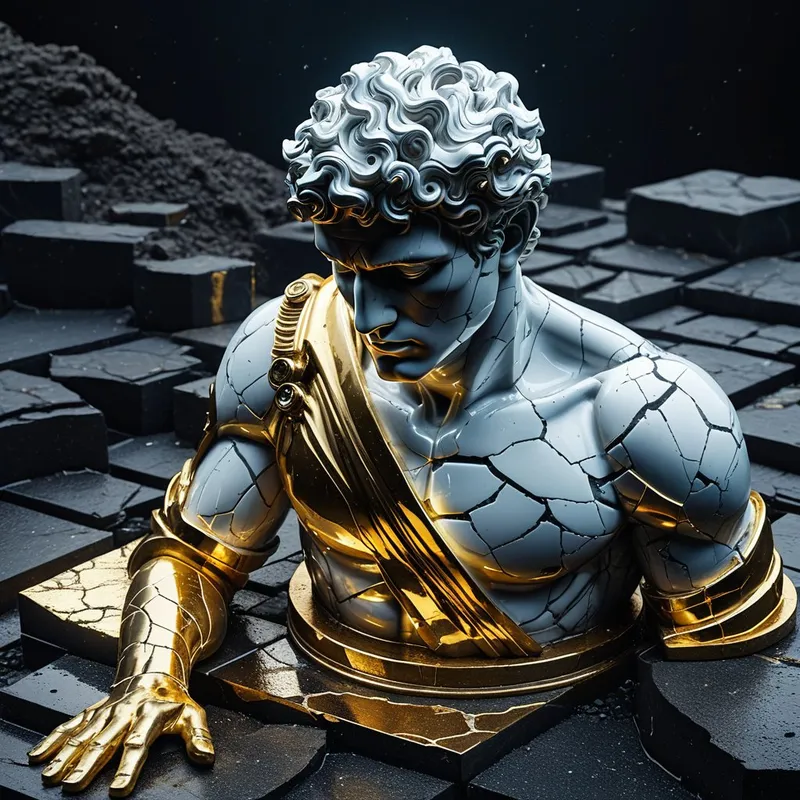
The transmutation of moral dissonance is the Nigredo of the soul—the blackening, the putrefaction, where all certainties dissolve. The required heat is the unbearable tension of holding two contradictory truths: “I am being forced to do this” and “The force is me.” This pressure cracks the ego’s shell. The alchemical fire is the raw, unmediated feeling of the somatic echo—the nausea, the tremor, the constriction. Do not numb it. Sit in its awful truth. This is the dissolution of an old, borrowed morality. From this blackened chaos, the Separatio occurs: you learn to distinguish the voice of the internalized tyrant (the Shadow Ruler) from the voice of your essential, ethical core. Then, through Coniunctio, you do not banish the tyrant, but engage it. You ask this frozen protector: What are you so afraid will happen if we disobey? What ancient law are you still enforcing? In answering, its rigid structure softens. Its fear is reintegrated as discernment, its control as conscious choice. The leaden guilt transmutes into the gold of profound self-authority.
The Integration Protocol
Question 1: In the dream, what part of me was issuing the command or creating the situation? Can I give that part a face, a voice, a posture? What does it believe its job is?
Question 2: What part of me was horrified, paralyzed, or resisting? What core value of mine was being directly threatened?
Question 3: In my waking life, where do I feel a faint echo of this same somatic tension—a tightness, a resentment, a sense of "having to" that clashes with my deeper desires?
Action 1 (The Internal Council): In a quiet moment, close your eyes and feel for the somatic echo in your body. Let the two "parts" from your dream reflection take seats in an inner space. Don't let them argue. Simply have each state its case, its fear, and its deepest intention to the other. Be the mediator who listens for the shared, buried concern beneath the conflict.
Action 2 (Unstructured Writing): Set a timer for 10 minutes. Without stopping, judgment, or concern for grammar, write from the perspective of the "tyrant" part. Let it speak its manifesto. Why are its harsh laws necessary? What chaos does it believe it is preventing? This is not an excuse, but an archaeology of your own psyche.
Action 3 (Ritual of Reclamation): Find a small, physical object that represents the "forced" action or the old, brittle morality (a stone, a scrap of paper with a word on it). In a private, intentional space, hold it. Acknowledge its former power over you. Then, through an act of your choosing—burying it, painting it a new color, placing it on an altar as a relic of a past era—perform a ritual that symbolizes you are no longer subject to its command. The power of choice is returned to your hands.
Final Validation
To dream of moral dissonance is to walk a razor's edge within yourself. It is excruciating because it matters so deeply; it is a sign of a conscience that is alive, complex, and struggling to grow beyond simplistic right-and-wrong into the nuanced terrain of true integrity. The pain is not a sign of failure, but of fermentation—the necessary chaos before a higher synthesis. You are not breaking. You are outgrowing. The very fact that you feel this fracture so acutely is the proof that you possess the wholeness required to heal it. This dream is not your condemnation; it is your soul’s most urgent invitation to build a sovereign self, from the inside out, capable of holding its own profound contradictions and governing with a hard-won, unshakable grace.