The Crucible of Choice: When Dreams Present Moral Dilemmas
The Somatic Echo
It begins not as a thought, but as a weight. A dense, cold stone settling in the pit of the stomach, or a sharp, metallic tension cinching the chest. The breath becomes shallow, held hostage by an invisible vise. There is a feeling of being pulled in two directions at once, a somatic tearing that precedes any conscious understanding of the choice to be made. The body knows the truth before the mind can articulate it: you are standing at a crossroads where every path forward seems to demand a sacrifice of some essential part of yourself. This is the visceral signature of a moral dilemma entering the dreamspace—a deep, systemic conflict being forced to the surface, where it can no longer be ignored.
The Dreamer's Log (Case Vignette)
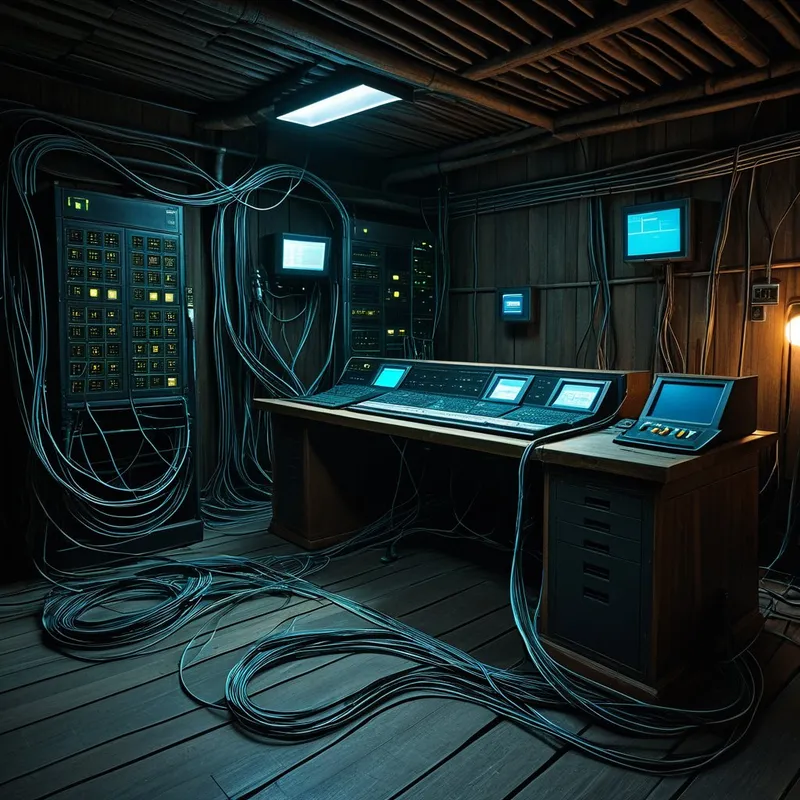
I am standing before a vast, humming terminal in a silent, cavernous room. The screen displays a simple, stark command: “PRESS ONE BUTTON TO CONTINUE.” Before me are two: one labeled “SAVE THE ONE YOU LOVE,” the other, “SAVE THE MANY YOU DO NOT KNOW.” My hand hovers, trembling, over the console. I know that to choose is to damn, and to not choose is to damn everything.
This dream is not a test of logic, but an alchemical ignition sequence: the psyche is forcing the dreamer to confront the unbearable tension between the personal heart and the impersonal conscience, to feel the full cost of sovereignty.
The False Lead
This theme is not about simple guilt over a bad decision, nor is it a premonition of external misfortune. A dream of a moral dilemma is distinct from a nightmare of persecution or bad luck. The terror does not come from an external monster, but from an internal fork in the road of the soul. It is not a warning of what will happen, but a revelation of what is already happening within you—a clash of values, loyalties, or identities that your waking life has been quietly suppressing. Misinterpreting this as a prophecy of doom is to miss its profound, if painful, gift: the call to conscious integration.
Psychological Architecture
To encounter a moral dilemma in a dream is to be ushered into the deepest chamber of Shadow work. Here, the neat compartments of your identity—the good parent, the loyal friend, the ethical professional—dissolve. You are faced not with a choice between right and wrong, but between two competing versions of right, each championed by a different exiled part of your internal family. Perhaps the Caregiver within screams to protect a loved one at any cost, while the Ruler argues for the greater good. The dream does not solve this. It holds it. It makes you dwell in the unbearable heat of contradiction until a third, more conscious position can be forged. This is the essence of Individuation: not becoming a perfectly consistent being, but becoming a sovereign one capable of containing multitudes and making conscious choices from that complex center.
Mythic Resonance
We see this eternal firmware in the story of King Solomon, faced with two women claiming the same child. His proposed solution—to cut the baby in half—was not a genuine suggestion, but a psychological detonation. It was designed to bypass the intellectual dilemma and trigger the raw, somatic truth of authentic motherhood. The one who would rather surrender her claim than see the child harmed revealed the deeper, non-negotiable value. The dilemma was the crucible; the visceral reaction was the gold. Similarly, the Bodhisattva vow in Buddhism embodies the ultimate moral tension: postponing one’s own final enlightenment until all beings are liberated. It is a conscious, eternal dwelling in the dilemma between personal peace and universal responsibility, making the tension itself the path.
Symbolic Nodes
Common images that signal this deep processing include: standing at a fork in a road where both paths vanish into fog; holding scales that will not balance; being forced to choose between two people or objects that are somehow fused; a door that requires you to leave something precious behind to pass through; a judge or council awaiting a verdict only you can give; a weapon you must use against someone you protect.
Archetypal Resonance
The energy most active in the heart of a moral dilemma is that of The Ruler Archetype. Not the Shadow Ruler who demands control out of fear, but the essential Ruler in its moment of ultimate crisis and potential. This archetype carries the burden of sovereignty, the awful responsibility of choice that determines fates. The somatic echo—the weight in the chest, the tightening—is the Ruler’s mantle being placed upon shoulders that do not yet feel ready to bear it. Its alchemical potential lies precisely in this pressure: to move from the childish wish for a perfect, painless option to the mature capacity to choose consciously, ethically, and compassionately from a place of integrated authority, even—especially—when no choice is clean.
The Alchemical Process
The transmutation here is from fragmentation to sovereign containment. The base metal is the shattered self, each shard holding a partial truth that conflicts with another. The heat is applied by the dream itself, which refuses to offer an easy escape and forces you to feel the contradiction fully. This is the nigredo, the blackening—the despair of having no “right” answer. The pressure is the sustained attention you bring to it upon waking, refusing to dismiss it as “just a bad dream.” The alchemical fire burns away the fantasy of a perfect, conflict-free self. What remains, and what begins to coalesce in the albedo (whitening), is not a solution to the dilemma, but a stronger, more resilient vessel—your conscious awareness—that can hold the tension without breaking. The gold (rubedo) is the earned sovereignty to act, not from a single, rigid rule, but from a centered, complex wisdom that acknowledges the cost.
The Integration Protocol
Question 1: In the dream, which choice felt like a betrayal of my deepest values? Which felt like a betrayal of my deepest connections?
Question 2: If I imagine each option in the dream as a distinct voice within me, who or what does each voice represent? (e.g., The Protector, The Idealist, The Realist, The Child)?
Question 3: What third, unseen option might exist that would honor the core truth behind both of the conflicting choices presented?
Action 1 (Somatic Anchoring): When you feel the echo of the dilemma's tension in your body, place one hand on your heart and the other on your solar plexus. Breathe into the space between your hands, not to solve the tension, but to acknowledge it as a sign of your depth and capacity to care. Simply say, "This weight is my care."
Action 2 (Unstructured Writing): Set a timer for 10 minutes. Write from the perspective of the object or person you had to choose between in the dream. Let it speak. What does it feel? What does it want you to know? Do not edit or judge the writing.
Action 3 (Ritual of Acknowledgment): Find two small stones. Hold one in each hand, naming them for the two conflicting values or loyalties from your dream. Then, find a bowl of water (representing the container of your consciousness). Gently submerge both stones together in the water, and let them rest there side-by-side. The ritual is not to choose one, but to practice holding both in your field of care.
Final Validation
To dream of moral dilemmas is to be entrusted with a profound and difficult grace. It means your psyche is no longer satisfied with easy answers or fragmented living. It is forging a you that can stand in the storm of contradiction and not be swept away—a you that can choose, not because it is easy, but because you have become strong enough to bear the responsibility and the grief that true choice often entails. This is the hard-won ground of a soul coming into its own sovereign authority.