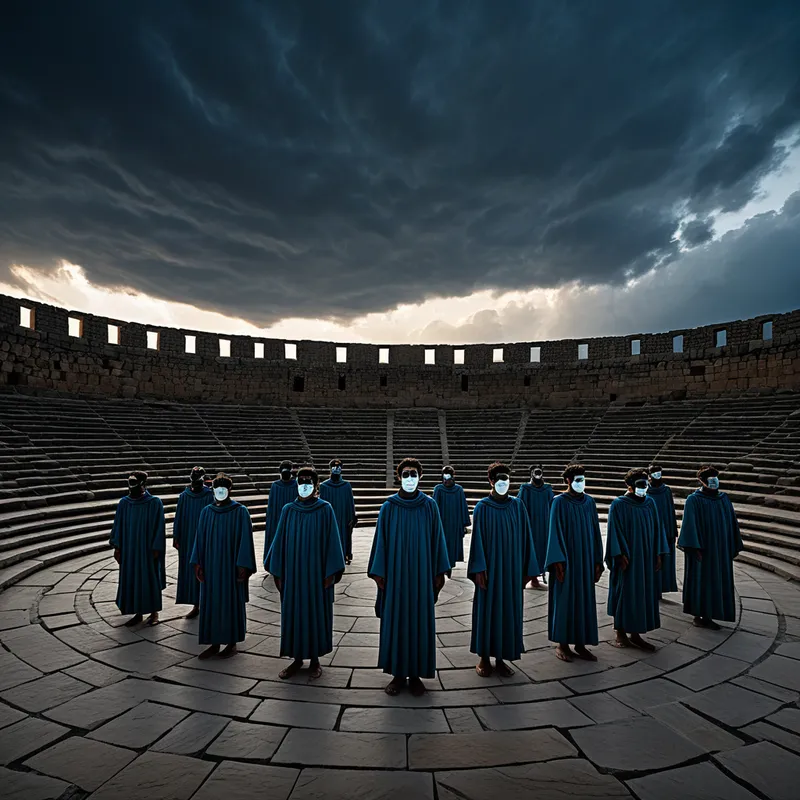
The Soul’s Silent Court: When Dreams Deliver Moral Commentary
The dream of moral commentary arrives not as a thought, but as a verdict. It is a sentence passed in the chambers of the body before the conscious mind has even been called to the stand. It is the gut that tightens into a fist of cold iron, the heart that beats a frantic, arrhythmic testimony against the ribs, the throat that constricts around an unspoken plea. This is the somatic echo: a visceral, undeniable sense of accountability. It is the body remembering a debt the ego has forgotten, a tremor in the foundation of the self that whispers: you are being weighed.
The Dreamer's Log (Case Vignette)
I stood before a colossal set of bronze scales in a cavernous, empty hall. On one pan, I placed a single, perfect pearl—a secret I had kept to protect someone. On the other, I watched helplessly as a pile of dark, granular sand began to pour from my own hands, an endless stream of half-truths and withheld words, until the scale tipped with a deafening, final groan.
Alchemical Interpretation: The dream transmutes the abstract concept of a "white lie" into the tangible, alchemical substances of pearl and sand, revealing how a single act of preservation can, through the silent accrual of omission, become an unbearable weight of distortion.

The False Lead
This is not a dream of simple "guilt" or societal shame. To mistake it for such is to confuse the soul’s deep audit for a scolding from a parent or a priest. Moral commentary dreams are not about external rules you have broken; they are about internal covenants you have betrayed. They are not concerned with being caught, but with the integrity of the structure you inhabit. The discomfort is not a punishment, but the friction of a foundational stone being realigned. It is the difference between feeling sorry and being reconciled.
Psychological Architecture
Here, the Shadow work is that of the Internal Judge—a psychic structure often conflated with the critical parent, but far more ancient and impersonal. This Judge is not a personified figure from your past; it is the architect of your own coherence. Its commentary arises when a part of your system—an exiled Orphan, a rebellious Rebel, a fearful Innocent—has acted in a way that fractures the soul’s innate drive toward wholeness. The dream is the courtroom where this fracture is made visible. The process of individuation demands you do not dismiss the Judge as a tyrant, nor blindly accept its verdict as dogma. You must step forward as both the accused and the advocate, listening to the testimony of all your internal parts—the one who acted, the one who was affected, the one who witnessed—and seek not acquittal, but integration. The goal is to transform the Judge from a silent, sentencing authority into the Sage-like witness of your own complex truth.
Mythic Resonance
We see this eternal process in the Egyptian myth of the Weighing of the Heart. Upon death, the heart of the deceased was placed on a scale against the feather of Ma’at, goddess of truth and cosmic order. But this was not a test of moral perfection by human standards; it was an assessment of the heart’s alignment with the fundamental harmony of existence. A heart heavy with the weight of distortion—not necessarily "evil," but burdened by deceit, imbalance, and actions that tore at the fabric of connection—would be devoured. The dream is this sacred ceremony happening now, in the living psyche, urging a return to Ma’at before the soul feels consumed by its own misalignment.
Symbolic Nodes
- Scales, Balances, Measuring Devices: The core symbol of equitable judgment and consequence.
- Empty Courtrooms, Judgement Seats, Silent Juries: The architecture of internal authority awaiting your participation.
- Being Watched or Recorded (Unblinking eyes, cameras, ledgers): The inescapable awareness of the Self observing the self.
- Testifying, Pleading, or Being Unable to Speak: The dynamics of your internal defense and prosecution.
- Verdicts, Scrolls, Sealed Documents: The delivery of the soul’s conclusion.
- Prisons, Cages, or Restricted Spaces: The felt-sense of consequence or self-imposed limitation following an action.
Archetypal Resonance
The energy here resonates most powerfully with The Sage Archetype, specifically in its shadow manifestation. The Shadow Sage is the dogmatic, judgmental inner critic that confuses its partial truth for the whole truth. It delivers pronouncements from a place of cold, detached intellect, severing the heart from the verdict. In the somatic echo, it is the rigid spine and the clenched jaw of self-righteousness turned inward. Its alchemical potential lies in its unwavering commitment to truth; the task is to heat that cold, crystalline judgment in the fires of compassion and context, transforming it into the integrated Sage’s wisdom—a discernment that weighs with clarity, but holds with understanding.
The Alchemical Process
The transmutation of moral commentary is the alchemy of Integrity. The prima materia is the leaden weight of self-recognition—the "I did that" or "I am that" which initially feels like a sentence. The necessary heat is the unbearable vulnerability of sitting in that recognition without fleeing into denial (the Shadow Innocent) or self-flagellation (the Shadow Caregiver). The pressure is sustained, conscious attention on the fracture. The process is not one of erasure, but of inclusion. You must take the condemned action or trait, not to justify it, but to understand its origin in your internal family system. Which exiled part performed this act? What was it trying to protect, gain, or express? By listening to its testimony, you introduce the solvent of context. The lead of shame slowly separates into its components: the gold of a core need, the silver of a misplaced strategy, and the dross of actual impact. Sovereignty is born when you can hold all these elements in your own hands, accountable not to an external law, but to the self-authored law of your becoming.

The Integration Protocol
Question 1: If the figure in your dream who judged or witnessed you were not a critic, but a deeply concerned guardian of your wholeness, what one piece of data about your integrity is it trying to bring to your attention?
Question 2: What exiled or silenced part of yourself might have taken the action being commented upon? What forgotten vow to that part are you being asked to remember?
Question 3: Can you locate the precise point in your body where the "verdict" landed? If that sensation could speak the language of care instead of judgment, what would it say?
Action 1 (The Unspoken Defense): In a private, uninterrupted space, speak aloud a defense for the part of you that stands accused in the dream. Do not argue for its "rightness," but for its context. Give voice to its fears, its history, its limited options. Record this if you can, and listen back.
Action 2 (The Ledger of Light & Shadow): Take a page and draw a vertical line. On one side, in detail, list every consequence—for yourself and others—of the action or pattern highlighted by the dream (the "shadow ledger"). On the other, with equal seriousness, list every need, protection, or fragmented intention that drove it (the "light ledger"). Hold the full account.
Action 3 (Ritual of Re-Weighing): Find two small objects: one to represent the "burden" (a stone, a heavy nut) and one to represent the "truth of the need" (a feather, a leaf, a seed). Go to a quiet place in nature. Hold them both, acknowledging each. Then, bury or release the "burden" object, and plant or carry the "need" object with you as a reminder to address that need consciously.
Final Validation
To receive a dream of moral commentary is to be entrusted with a profound and difficult truth: your soul believes you are strong enough to look at your own fractures. It is a brutal mercy. The path is not toward becoming "good" by some external standard, but toward becoming whole by your own deepest design. The court is not in session to condemn you, but because your sovereignty is worth the trial. The verdict, when you can hear it through the fear, is always an invitation: to reclaim the gavel, to understand the law, and to preside over the ongoing, merciful justice of your own becoming.