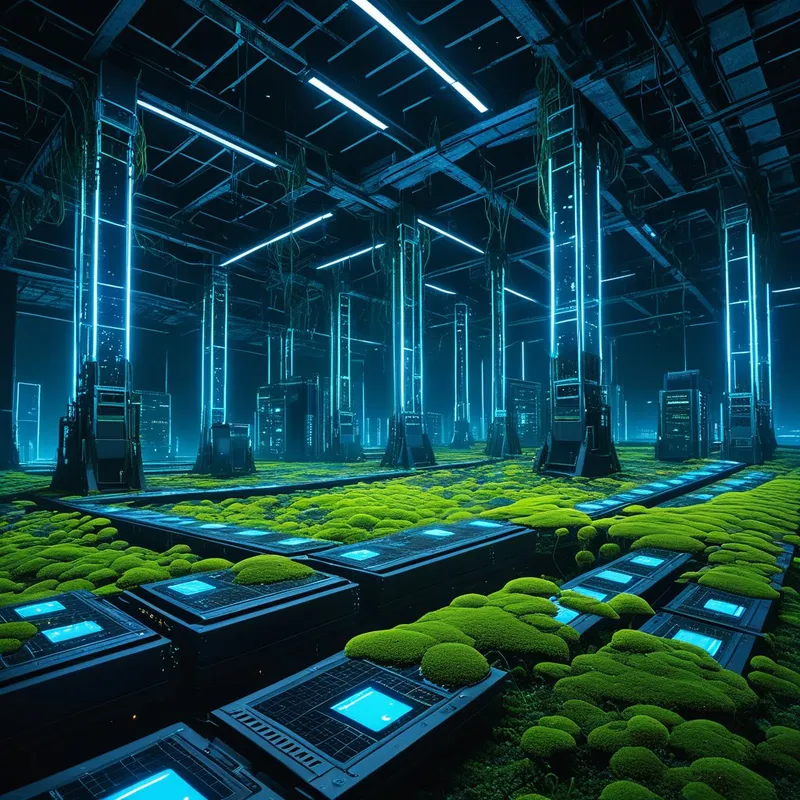
The Somatic Echo of Modern Burnout
It begins not as a thought, but as a texture. A specific gravity in the limbs, a leaden viscosity in the blood. The body becomes a silent alarm, a system broadcasting its distress in a language older than words. There is a hollowness behind the sternum, not of sadness, but of depletion—a vacuum where motivation once hummed. The mind, that frantic manager, continues to issue commands, but the signals fray and dissipate before reaching the muscles. You move through your world like a ghost in your own machinery, hearing the clicks and whirs of obligation but feeling none of the torque. Sleep offers no reprieve; it becomes another domain to be optimized, another inbox filling with the fragmented symbols of a life running on corrupted code. This is the somatic echo: the body’s profound, poetic logic declaring that the current operating system cannot be patched. It must be entirely rewritten.
The Dreamer's Log
I am in my apartment, but it is also a control room. My laptop is open, its screen a mosaic of a hundred fractured windows, each playing a different urgent, silent video. I try to close them, but my fingers pass through the keys like smoke. A single, perfect drop of mercury forms on the spacebar, trembling, holding the reflection of the entire city before it falls and vanishes into the machinery below.
This dream is an alchemical image of the self liquefying under pressure, its solid structures dissolving to reveal a core of pure, unstable potential.

The False Lead
This is not mere fatigue, a deficit that a long weekend can replenish. Do not mistake it for simple overwhelm, the temporary flood of a busy season. Modern burnout is a structural failure. It is the collapse of the internal governance that allocates your energy, attention, and care. It is not about having too many tasks, but about the silent, catastrophic erosion of the why that once animated those tasks. The psyche isn't complaining about the workload; it is indicting the entire premise of the enterprise. To interpret these dreams as mere stress is to hear a fire alarm and decide to rearrange the furniture.
Psychological Architecture: The Shadow Council's Mutiny
Beneath the conscious ego, a council of inner parts—what some call the Internal Family System—has been running the show. The Manager, ambitious and tireless, has been promoted to tyrant. The Laborer, the diligent executor, has been worked to the bone. The Caregiver has been giving from an empty well, and the Innocent, who knows only play and rest, has been locked in a soundproof room. Burnout is the moment this shadow council stages a mutiny. The Laborer goes on strike. The Manager’s memos are ignored. The system grinds to a halt not out of malice, but as the only possible intervention. This is a forced initiation into Individuation: you are being compelled, by your own deepest intelligence, to depose the autocratic, one-dimensional ruler of your psyche and reconvene a true democracy of the soul. The sovereign Self must return from exile to listen to the reports from all its neglected territories.
Mythic Resonance
We see this not in the hero’s glorious battle, but in his aftermath. Think of Achilles in his tent after his rage has cooled, refusing to fight. The Greeks are losing, his comrades are dying, but he sits, sullen and depleted. This is not cowardice; it is a profound systemic shutdown. The very identity of "the greatest warrior" has become a prison, and his burnout is a refusal to perform that self-destruction one more time. Or consider the Fisher King from the Grail legends, ruler of a barren land that mirrors his own inner wound. His kingdom is a wasteland not because of an enemy’s attack, but because of his own enduring, untreated paralysis—a perfect myth for the burnout of leadership, where the ruler’s inner depletion renders the entire realm infertile.
Symbolic Nodes
- Malfunctioning or Unresponsive Technology: Phones that won’t dial, cars without engines, computers that melt or display static.
- Barren or Toxic Landscapes: Cracked earth, dead gardens, offices filled with dust or creeping vines.
- Broken or Clogged Conduits: Pipes spewing black sludge, electrical wires sputtering uselessly, tunnels that collapse.
- Empty Containers: Hollowed-out buildings, cups with holes, bank vaults filled with ash.
- Being Late for a Critical, Unknown Event: A perpetual state of frantic irrelevance.
Archetypal Resonance
The Shadow Ruler is the dominant archetype in the drama of modern burnout. This is the energy of control, order, and sovereignty turned inward and corrupted into a brutal, unsustainable tyranny. The Shadow Ruler does not lead; it micromanages. It does not steward resources; it hoards them and then berates the system for being inefficient. The somatic echo of leaden exhaustion is the body’s rebellion against this inner dictator’s relentless production quotas. The alchemical potential here is immense: the heat of the burnout crisis is precisely what can melt the rigid, isolating throne of the Shadow Ruler, allowing for the reintegration of the exiled parts—the Jester’s levity, the Caregiver’s compassion, the Explorer’s curiosity—to form a true, resilient, and flexible sovereignty.
The Alchemical Process: From Ash to Essential Salt
The alchemy of burnout is a calcinatio—a burning down to a white ash. The intense psychological heat is the friction between who you thought you had to be and who you actually are. The pressure is the weight of a life built on a false premise. This process is not gentle. It incinerates the flammable identities of the relentless worker, the perfect provider, the always-available friend. What remains in the ash is not nothing, but the essential salt: your non-negotiable core, the irreducible elements of your being that cannot be burned away. This salt is bitter with the taste of lost time and grief, but it is also the seed crystal around which a new, authentic structure can slowly form. The transmutation occurs when you stop trying to re-animate the ashes and instead learn to listen to the quiet, potent truth of this essential residue.

The Integration Protocol
Question 1: If your exhaustion had a voice beyond "I can't," what one sentence would it whisper about what it is truly protecting you from?
Question 2: What small, forgotten part of yourself did you first relegate to "when I have time," and what has its long silence cost your inner ecosystem?
Question 3: Imagine your energy as a sovereign currency. Which activities or relationships in your life are extracting value without depositing anything, and what would happen if you declared a moratorium?
Action 1 (The Grounding Audit): For one day, do not ask yourself "What should I do?" Instead, before any action, place a hand on your body and ask, "Do I have the resource for this?" If the answer is anything but a clear, somatic "yes," do not proceed. Record the difference in the texture of the day.
Action 2 (The Unstructured Page): Set a timer for seven minutes. With a pen and paper, engage in "cognitive vomiting." Write without pause, structure, or goal. Let it be messy, repetitive, illogical. The moment the timer stops, destroy the page—burn it, shred it, wash it off in the sink. This is not for keeping; it is for clearing the psychic cache.
Action 3 (The Ritual of Broken Tools): Find one physical object that represents an instrument of your burnout—a dead pen, a worn-out mouse, a specific key on your keyboard. In a private moment, deliberately break or decommission it with intention. Bury it, place it in a box wrapped in cloth, or set it adrift in water. Acknowledge it as a tool of an old regime that is now formally, ceremonially retired.
Final Validation
The depth of your burnout is a measure not of your weakness, but of the profound strength it took to sustain an impossible fiction for as long as you did. This crushing gravity is the necessary condition for a new kind of orbit. You are not breaking down. You are being broken open. The silence that follows the noise is not emptiness, but the fertile void from which a self-authored life, built on the bedrock of your essential salt, can finally begin to grow.