
The Watcher in the Mirror: Metacognition and the Dream of Dreams
The Somatic Echo
It begins not with a thought, but with a feeling—a subtle, unsettling doubling of presence. There is a pressure behind the eyes, a cool detachment in the chest, as if a part of you has stepped back to lean against the inner wall of your own skull. The body feels both intensely real and curiously distant, like a vessel you are piloting from a remote station. This is the somatic signature of metacognition: the visceral sensation of consciousness folding back upon itself. It is the quiet hum of a system observing its own processes, a ghost in the machine feeling the gears turn. Before any image forms, there is this echo—the profound and lonely weight of being both the dreamer and the dreamed.
The Dreamer's Log
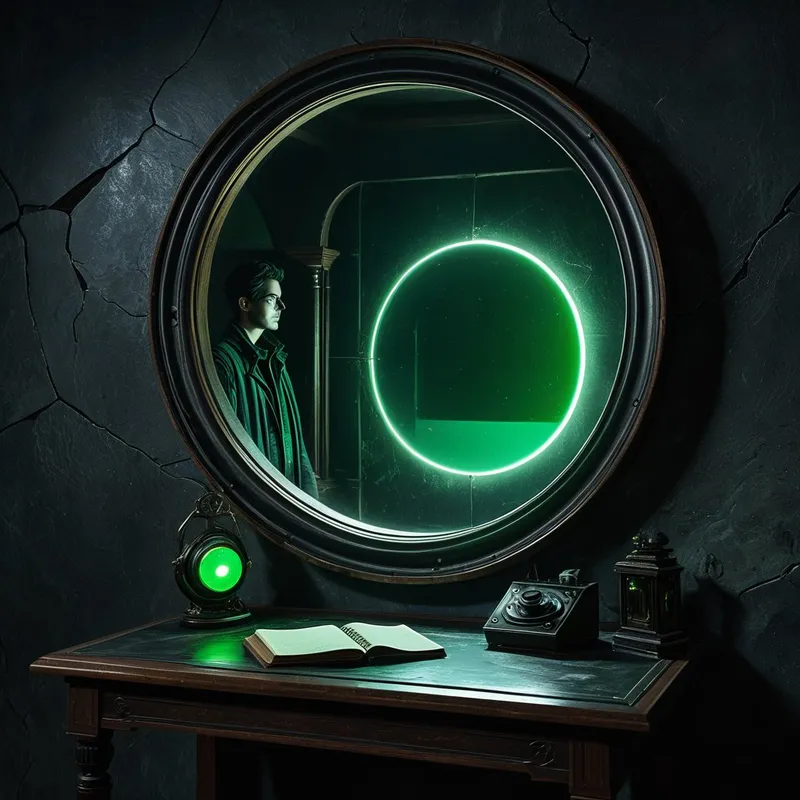
I am in a circular, windowless room with walls of dark glass. I see myself from across the room, standing before a large, cracked mirror. The "me" in the reflection is not mimicking my movements; it is writing in a large, leather-bound book. I feel a wave of panic—not fear of the double, but a terror that I have forgotten something vital, that the reflection is recording what the "I" here in the room has already lost. The reflection looks up, meets my eyes, and shakes its head slowly.
Alchemical Interpretation: The dream ego, lost in the chamber of its own making, witnesses the reflective Self documenting the forgotten narrative, a silent rebuke to the sleeping author.
The False Lead
This is not mere "lucid dreaming," though lucidity may be its fleeting symptom. The common misinterpretation is to believe the goal is control—to seize the dream's steering wheel and fly. That is a fantasy of the ego, not the work of the soul. Metacognitive dreams are not about dominating the landscape, but about witnessing the architect. The terror is not of the dream's content, but of the staggering responsibility of seeing the machinery behind the scenery. It is the difference between being a passenger who suddenly notices the driver is also asleep, and believing you must now perform stunts with the vehicle. The theme is structural, not situational; it concerns the foundation of perception itself, not the furniture arranged upon it.
Psychological Architecture
To dream of watching yourself dream is to encounter the central paradox of individuation: the self must become an object to itself to become a subject. This is the deepest Shadow work, where the parts of you that manage the narrative—the inner director, the critic, the silent scribe—step out from the wings and reveal themselves. You meet the sub-personality that believes it is you, the one that constructs your daily identity, and you see it as a contingent figure in a larger psyche. The grief here is for the simple, naive "I" that is lost forever. The terror is the existential vertigo of having no solid center, only layers of witnessing. Yet in this dissolution of the primary ego lies the potential for true sovereignty. You are not dismantling the self; you are mapping the internal family system of consciousness, meeting the orphaned witnesses and exiled observers, and inviting them back into a council where no single voice has to pretend to be the king.
Mythic Resonance
This is the moment in the myth of Narcissus that is rarely told: not when he falls in love with the image, but the infinitesimal pause after he realizes the image is his own reflection. In that gap—between the perception of "other" and the recognition of "self"—lies the spark of metacognition. It is the universe observing itself. Similarly, in the Hindu concept of Maya, the divine play of illusion, the seeker's ultimate realization is not that the world is false, but that they are the witness of the illusion, the consciousness in which the play appears. The dreamer who watches the dream is performing this ancient, interior rite, confronting the veils of personal Maya to touch the watcher behind all scenes.
Symbolic Nodes
- Mirrors that show a different action or a vacant self.
- Observing yourself from a corner of the room or from above.
- Finding and reading a book or log that details your own life or current dream.
- Operating a control panel or console that seems to govern the dream environment.
- A guide or figure who explicitly tells you, "You are in a dream."
- Cameras, monitors, or recording devices focused on you.
- Transparent walls, floors, or ceilings, revealing the structure of the space.
Archetypal Resonance
The energy here is pure The Sage Archetype, specifically in its nascent, observing mode. Not the Sage as a dispenser of wisdom, but the Sage as the silent, perpetual witness. Its core drive is not to judge or even to understand immediately, but simply to see the truth of the pattern. The somatic echo of cool detachment is the Sage’s neutral ground, the necessary distance for observation. The alchemical potential lies in the Sage’s journey from passive witness to integrated knower—the one who, by seeing the architecture of their own mind without flinching, gains the profound authority that comes from self-recognition. The shadow that must be faced is the Shadow Sage—the dogmatic inner voice that claims the watcher's perspective is the only reality, severing connection to the body and the heart in a cold calculus of observation.
The Alchemical Process
The transmutation here is of consciousness into conscience. The raw, leaden ore is the paralyzing shock of self-observation—the "heat" is the sustained, uncomfortable pressure of holding that double vision without fleeing into action or denial. You must endure the feeling of being a ghost in your own machine. The "pressure" is the refusal to let the witnessing self collapse back into the dreamed ego. In this crucible, a separation occurs: the part of you that experiences (the dream ego) is gently distinguished from the part that observes (the witnessing Self). The gold that emerges is not omniscience, but authorship. You gain the capacity to edit the relationship between these parts. The grief of lost simplicity is alchemized into the profound sovereignty of informed participation. You are no longer just a character in the psyche’s story; you become its editor, its compassionate archivist.

The Integration Protocol
Question 1: In the dream, what was the primary emotion of the "you" that was being watched? Was it different from the emotion of the "you" that was watching?
Question 2: If the dreaming "you" is a character, and the watching "you" is the author, what forgotten plot point or character motivation might the author be trying to show the character?
Question 3: In your waking life, when do you most feel that same somatic echo of detachment—of watching yourself go through the motions? What is that distant watcher trying to show you?
Action 1 (The Observer's Log): Keep a small notebook by your bed. Upon waking, before trying to interpret, simply write a third-person, factual report of the dream. "She found herself in a room. She observed herself from the corner." This practice grounds the metacognitive energy in language.
Action 2 (The Mirror Dialogue): Stand before a mirror in a quiet moment. Look into your own eyes and state, aloud, a simple observation about your current inner state, but phrase it as if reporting on another. For example, "He is feeling anxious about the meeting today." Notice the subtle shift in perspective and the feelings it evokes.
Action 3 (Mapping the Chamber): Create an abstract drawing or diagram of the dream's metacognitive space. Don't draw figures. Instead, map the relationship: Where was the watcher? Where was the watched? What was between them? Use shapes, lines, and colors to represent the energy, distance, and connection (or lack thereof). Let the map reveal the architecture of your inner relationship.
Final Validation
To have this dream is to be called to a frontier that feels like a precipice. It is deeply, inherently unsettling because it challenges the most basic assumption of being: that you are a unified "I." The disorientation is not a sign of breaking, but of a profound expansion beginning. It is the psyche's own immune response to the sleep of unconscious identity. The path is not to "solve" the doubling, but to befriend it—to thank the watcher for its vigilance, and to listen to what the dreamed self, now seen with such clarity, has been trying to live, or forget. In that sacred space between observer and observed, you are not falling apart. You are learning, for the first time, how you were put together. And in that knowing, you gain the ultimate creative power: the right to reassemble.