
The Dream of Mental Overcapacity: When the Inner System Demands a Shutdown
The Somatic Echo
Before the mind can articulate the crisis, the body sings its elegy. It begins not as a thought, but as a density—a leaden fullness behind the eyes, a humming pressure in the skull’s vault, as if the cerebrospinal fluid has been replaced with static. The breath becomes shallow, a system running on auxiliary power. There is a peculiar, paradoxical fatigue: not the soft weariness of the body, but the brittle, buzzing exhaustion of a processor forced to solve an equation with infinite variables. The shoulders carry not weight, but the ghost-imprint of collapsed architectures. This is the somatic prelude to the dream of mental overcapacity: the visceral knowledge that the inner kingdom is operating under a state of emergency, its protocols failing, its borders dissolving under a silent, internal siege.
The Dreamer's Log
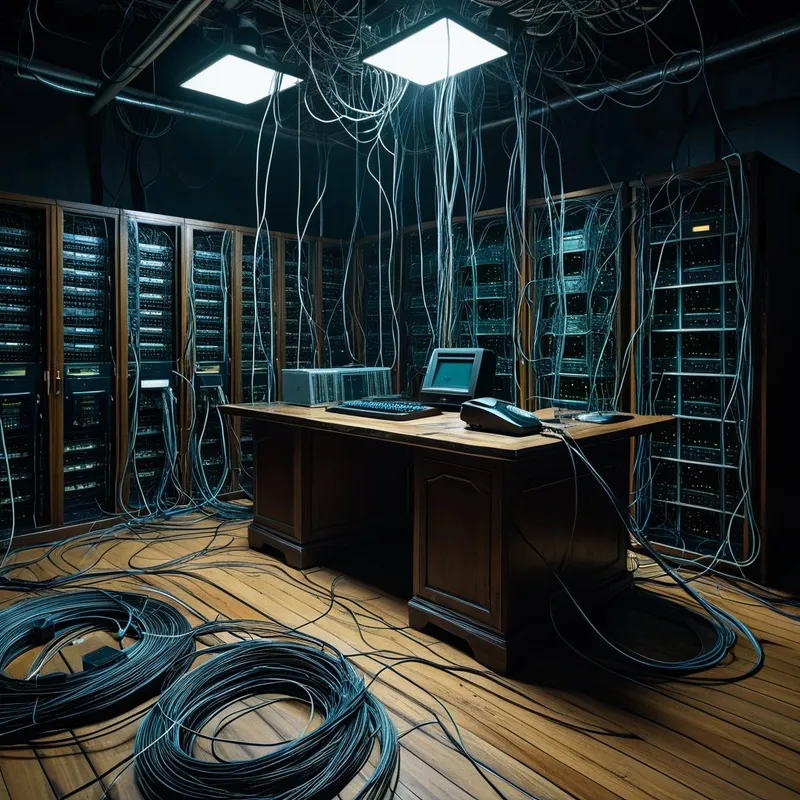
The dream is always the same: I am standing in the control room of a vast, derelict space station. Every monitor is flashing crimson error codes, alarms blare in dissonant chords, and a robotic voice repeats, "Core containment failing." My task is singular—to answer a single, blinking red telephone on a central console. But with each ring, a new monitor erupts into chaos, a pipe bursts overhead, and the voice grows more frantic. I reach for the receiver, but my hand passes through it like smoke.
Alchemical Interpretation: The system’s frantic demand for a single, saving connection is the very mechanism preventing it; the dream reveals that salvation lies not in answering the call, but in allowing the station—the outdated psychic structure—to finally fail.
The False Lead
This is not a dream about mere stress or a temporary glut of responsibilities. To interpret it as such is to mistake a tectonic shift for a tremor. Mental overcapacity is not the complaint of a schedule stretched too thin, but the symptom of a soul stretched over a framework that can no longer contain it. It is not about having too many tasks, but about employing an entire identity—a whole way of being—that has exceeded its operational limits. The terror is not of failure, but of the necessary collapse that precedes authenticity. This dream does not warn you to work harder or manage better; it commands you to stop. To cease the internal negotiations. To let the old system go offline.
Psychological Architecture
Beneath the dream of crashing servers and overflowing inboxes lies a profound drama of Shadow and Individuation. The psyche, in its wisdom, constructs personas—efficient, adaptable programs that navigate the world. But when these personas become the totality, when the Manager, the Caretaker, the Achiever run unchecked as the sole operating system, the Self—the silent, vast source code—is pushed into exile. It becomes data with no directory, a signal with no receiver. The overcapacity dream is this exiled Self initiating a forced shutdown. It is the Shadow, not as a monster, but as a system administrator executing a hard reboot on a corrupted OS. The grief we feel is for the identities we must release; the terror is of the blank screen that follows. This is the architecture of becoming: the conscious self must consent to its own temporary dissolution, to sit in the dark hum of the idle machine, to discover what transmissions come through when the noise of constant processing finally stops.
Mythic Resonance
We hear this echo in the story of the Tower of Babel. Humanity, speaking one language, builds a tower to reach heaven—a monument of unified, relentless effort. But the divine response is not destruction; it is a fragmentation of language. The project of sheer, collective overcapacity collapses not from a lack of will, but from a forced diversification of consciousness. The myth is not a punishment, but a salvation. The single-minded drive to build heavenward, to process reality through one monolithic lens, leads to a psychic Babel. The resulting confusion of tongues is the birth of individuality, the necessary scattering that prevents the total assimilation of the soul into a single, overloaded program. Our modern tower is not of brick, but of thought, obligation, and identity—and the dream is the psyche’s divine intervention, scattering our inner language so a new, more personal dialect can emerge.
Symbolic Nodes
- Failing Infrastructure: Crumbling bridges, bursting pipes, collapsing ceilings, and sinking buildings.
- Overloaded Systems: Glitching computers, switchboards with every line lit, engines screaming at redline, overflowing reservoirs or bins.
- Unanswerable Communications: Ringing phones that cannot be picked up, radios broadcasting static, incomprehensible messages on screens.
- Infinite Tasks: Corridors that lengthen as you walk, rooms that refill as you clean, documents that multiply as you sign them.
- Critical Alarms: Blinking red lights, sirens with no visible source, automated warning voices, unheeded evacuation orders.
Archetypal Resonance
The core energy of mental overcapacity is the crisis of The Shadow Ruler Archetype. The Ruler archetype seeks to establish order, structure, and sovereign control over its domain. In its shadow aspect, this drive curdles into the Tyrant or Control-Freak—a regime of relentless, micromanaging efficiency that leaves no room for chaos, creativity, or the unknown. The somatic echo of pressure and buzzing fatigue is the feeling of this Shadow Ruler on the throne, attempting to govern the wild, unbounded territory of the psyche with the rigid laws of a failing state. The alchemical potential lies in the overthrow of this inner tyrant. The overcapacity dream is the rebellion within the kingdom; it is the system’s own feedback revealing the tyranny of total control. The path to sovereignty is not through tighter governance, but through the Ruler’s ultimate, wise act: to abdicate its absolute authority, to make space for the other exiled archetypes—the Jester, the Explorer, the Innocent—to return and contribute to a more fluid, resilient, and authentic governance of the self.
The Alchemical Process
The transmutation here is one of Catabolic Alchemy. Where typical alchemy seeks to refine base matter into gold, this process requires the controlled decomposition of gold back into base matter. The intense heat and pressure—the nigredo—is the unbearable tension of the overload itself. It is the feeling of the system seizing, the identity cracking under its own contradictions. The process demands that you do not fight the collapse, but instead lean into the rupture. This is the psychological equivalent of staring at the blue screen of death and choosing not to frantically press keys, but to power down the entire machine. The grief is for the loss of the old, efficient identity. The terror is of the void that follows. But in that void, in the silent aftermath of the shutdown, a fundamental reorganization becomes possible. The scattered fragments of self are not reassembled into the old tower; they are allowed to settle into a new, more organic, and deeply grounded formation—a sovereignty born not of control, but of wise and compassionate integration.

The Integration Protocol
Question 1: Where in my waking life am I acting as the sole, tyrannical operator of a system that was meant to be a collaborative ecosystem? Question 2: What one belief, obligation, or identity feels most like a non-negotiable, critical program—and what might happen if I allowed it to ‘fail’ or go offline? Question 3: In the silence after imagined collapse, what forgotten or exiled part of myself might finally send a signal?
Action 1 (The Intentional Glitch): For one hour, introduce a deliberate, gentle failure in your routine. Miss a minor, self-imposed deadline. Leave an email unanswered. Sit and stare out a window during a time slot usually reserved for productivity. Do not fill the space. Observe what emotions or thoughts arise in the gap. Action 2 (Unstructured Cartography): With large paper and markers, let your hand draw the architecture of your current mental “system.” Don’t think. Let it be abstract—lines, shapes, colors, densities. Where are the pressure points? Where are the dead ends? Now, with a different color, draw a single, flowing line that bypasses all of it. This is the new pathway. Action 3 (The Ritual Decommission): Find a small object that symbolizes an outdated “protocol” or rule you live by (a burnt-out pen, a old to-do list, a key that opens nothing). Take it to a body of water—a sink, a bath, a river, the sea. Thank it for its service, then fully submerge it. Let it go. Turn and walk away without looking back.
Final Validation
The dream of mental overcapacity is a brutal gift. It is the psyche’s refusal to let you live a life that is merely efficient at the cost of being alive. The difficulty is real, the fragmentation is terrifying, and the call to let go can feel like a kind of death. But validate this: your soul is not breaking. It is breaking out. It is demanding more territory, more breath, more unscripted life than your current internal governance allows. The overload is the birth cry of a larger self. Your task is not to prevent the crash, but to become the compassionate witness to the demolition, and then, in the profound and fertile silence that follows, to begin listening for the first, quiet notes of a music you were always meant to hear, but were too busy managing the noise to ever perceive.