
The Masculine Principle: Architect of the Inner World
The Somatic Echo
Before it is a thought, it is a sensation. It begins not in the mind, but in the marrow. A low hum of potential, a gathering pressure in the solar plexus—not anxiety, but a coiled, waiting tension. It is the feeling of a spine wanting to straighten against a weight it has carried for years. It is the dry-mouthed clarity before a necessary word is spoken, the gravitational pull toward a decision that has been orbiting you, unseen. In the body, the Masculine Principle announces itself as a call to structure: a deep, somatic yearning for boundaries that are firm yet permeable, for a center that can hold. It is the silent, electric charge between stillness and action.
The Dreamer's Log
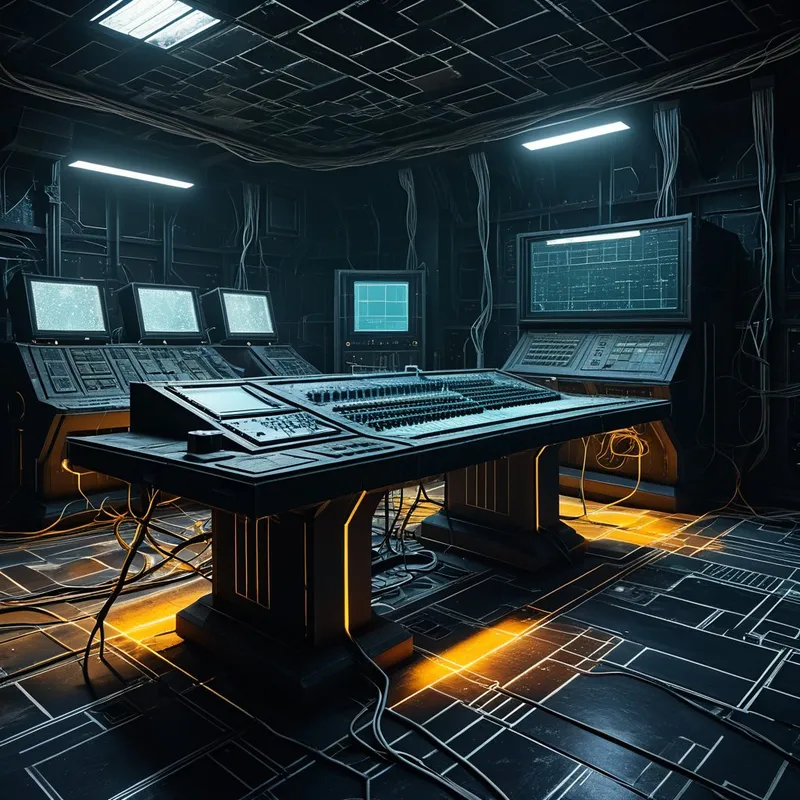
The dreamer stands in the heart of a derelict control center, a cathedral of dead technology. Banks of monitors show static snow, and a thick layer of dust silences the world. In the center, a single console of polished obsidian remains, its surface alive with a faint, amber pulse. A voice, neither male nor female but resonant with absolute clarity, issues from the empty air: "Initiate the sequence. The coordinates are within you." The dreamer’s hand hovers over a smooth, cold panel, trembling not with fear, but with the terrifying weight of agency.
This dream is an alchemical summons: the dormant command center of the psyche is powering on, demanding the dreamer’s conscious hand to input the code of their own destiny.
The False Lead
This is not a call to domineering force, to the brittle caricature of authority that shouts to hide its vacancy. The dream of the Masculine Principle is often mistaken for a mandate to become harder, more rigid, more imposing upon the world. That is its shadow, a fortress built from fear. The true theme is not about power over, but power within—the capacity to consciously direct energy, to give form to chaos, to say "this, and not that" from a place of inner sovereignty. It is not the crushing fist, but the guiding hand; not the unbending sword, but the plumb line.
Psychological Architecture
To engage this principle is to enter the silent workshop where the self is forged. The Shadow work here involves confronting the internalized tyrant—the critical, punitive voice that masquerades as discipline—and the equally potent ghost of the abdicated king: the passive, directionless part that refuses to choose, to act, to take responsibility for its own existence. Individuation in this realm is the reclamation of your own inner executive function. It is the slow, patient process of differentiating your true will from the cacophony of shoulds, fears, and inherited scripts. You are not building a wall to keep the world out; you are constructing a spine so you can meet it.
Mythic Resonance
Consider the myth of Theseus entering the Labyrinth. The maze itself is the chaotic, unformed psyche—the twisting, recursive patterns of confusion and unconscious impulse. The Minotaur at its center is the raw, untamed, and fearsome aspect of instinctual power. But the core of the myth is not the monster; it is the clew, the ball of thread given by Ariadne. This thread is the active, discerning, linear intelligence of the Masculine Principle. It is conscious intention. Theseus does not bulldoze the maze; he navigates it with a directed, purposeful line, confronts the beast, and retraces his steps to freedom, having transformed the chaos into a mapped territory. The principle is the thread, the pathfinder, the one who brings order to the inner wilderness.
Symbolic Nodes
Common images that speak this symbolic language include: Towers, obelisks, and skyscrapers (aspiration and structure); Bridges, roads, and straight paths (direction and connection); Swords, keys, and tools (discernment, access, and agency); Mountains and cliffs (challenges requiring ascent and perspective); Fathers, kings, wise old men, or anonymous authorities (externalized representations of inner authority); Empty thrones, dormant control panels, silent engines (the potential for command awaiting activation).
Archetypal Resonance
The energy of the Masculine Principle finds its purest expression in The Ruler Archetype. This is not the Ruler as a distant monarch, but as the innate, organizing intelligence within your own psyche—the part capable of establishing inner law, setting boundaries, and allocating resources (energy, time, attention) with wisdom. Its somatic echo is that deep-seated posture of sovereignty, the feeling of being centered in your own authority. Its alchemical potential lies in its capacity to transform the chaotic, competing "family" of internal parts into a coherent, collaborative kingdom, where each aspect is governed not by tyranny, but by the conscious, benevolent order of the integrated self.
The Alchemical Process
The transmutation of the Masculine Principle requires the heat of conscious choice and the pressure of consequence. The prima materia—the raw, leaden state—is a life lived by default, where will is diluted by doubt and agency is outsourced. The alchemical fire is lit the moment you say, "I choose this," and fully feel the weight of what is thereby not chosen. This is the nigredo, the blackening: the grief for abandoned paths, the terror of being wrong, the loneliness of self-authority. The albedo, the whitening, occurs as you consistently align action with this clarified will, polishing your intent through practice. The final rubedo, the reddening, is not a burst of power, but the steady, golden warmth of sovereignty—the knowledge that your inner throne is occupied by your authentic self, capable of both firm decree and compassionate rule.
The Integration Protocol
Question 1: Where in my life right now is there a silent console, a dormant control panel, awaiting my conscious command? What sequence am I afraid to initiate?
Question 2: If my inner kingdom were a landscape, what borders are porous and bleeding energy, and what walls are so thick they are starving the realm of light and exchange?
Question 3: What one, clear, linear action—a single thread through my current labyrinth—would most embody self-governance today?
Action 1 (The Somatic Anchor): For three minutes, stand with your feet firmly planted. Feel the line of your spine. Place one hand on your solar plexus. Breathe into that space, and with each exhale, mentally speak a short, clear statement of a personal boundary or a chosen direction. No justification, no apology. Just the clean, clear line of the statement.
Action 2 (The Cartographer's Journal): Take a blank page. Without narrative, draw the "map" of a current challenge or confusion. Use only straight lines, angles, and geometric shapes. Where is the blocked path? Where is the missing bridge? The act of imposing this geometric order on emotional chaos is the practice of the principle itself.
Action 3 (The Ritual of the Keystone): Find a small, solid stone. Hold it, and imbue it with the quality of a single, decisive choice you have made or need to make. Place it intentionally on a windowsill or desk—a tangible monument to your active will. Let it be a physical anchor for your inner authority.
Final Validation
To feel the tremor of this awakening is to feel the profound solitude of the architect who must first dismantle the unstable foundations. It is arduous, for you are learning to command forces within you that have long been either rebellious or asleep. This difficulty is the measure of the transformation's depth. But within that tremor lies the most profound promise: you are not subject to the chaos of your inner world. You are being called to its helm. The authority you seek does not reside in any external throne; it is waiting, silent and potent, in the quiet center of your own being, ready for you to take your seat.