The Summons of the Ancestral Vault
The Somatic Echo
It begins not as a thought, but as a weight. A density in the marrow, a gravity in the gut that pulls you toward the earth. It’s the feeling of carrying a chest you cannot see, its contents shifting with every step—sometimes a comforting anchor, other times a leaden burden. There is a pressure in the chest cavity, a subtle ache in the shoulders, as if generations have rested their hands there, whispering their unfinished business into your posture. This is the somatic signature of legacy: the body as a living archive, a vessel for psychic material that is not yet yours, but for which you are now the custodian. Before the mind can parse a single dream image, the nervous system is already humming with the echoes of what came before, a low-frequency signal from the depths of time.
The Dreamer's Log
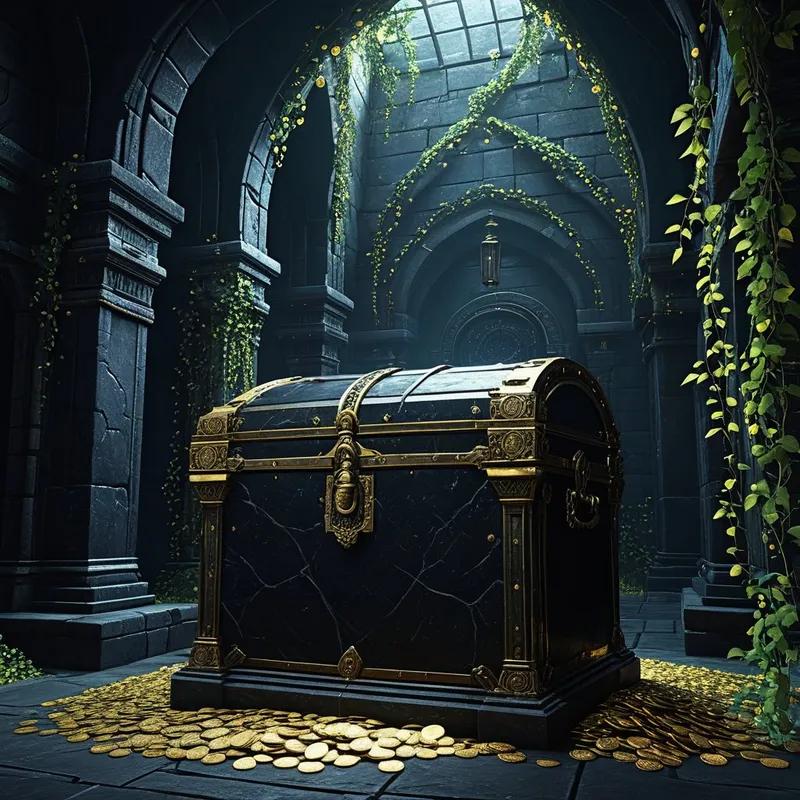
The dreamer stands in a vast, silent vault. Before them rests an ornate chest, unlocked. Inside, they find not coins or jewels, but a tangled mass of their father’s old, frayed neckties, interwoven with sharp, beautiful thorns and the faint, glowing seeds of unknown plants. A voice, neither kind nor cruel, simply states: “Sort it. What you keep, you become.”
This is the alchemical mandate: to consciously sift the inherited psychic material, separating the binding constraints (the frayed ties) from the protective wisdom (the thorns) and the latent potential (the seeds) waiting for your soil.
The False Lead
This theme is not a literal premonition about wills, estates, or material wealth. To interpret it as such is to mistake the map for the territory, the symbol for the substance. It is not about what you will receive, but what you already carry—the psychological, emotional, and spiritual DNA passed down through family systems, culture, and trauma. A dream of a crumbling family home is not a prophecy of real estate loss; it is an image of an outmoded internal structure, a psyche built on foundations that can no longer bear the weight of your becoming. The work here is structural, not situational.
Psychological Architecture
To engage with dreams of legacy is to enter the shadowlands of your own lineage. It is deep Shadow work of the most intimate kind: you are not just facing your personal repressed self, but the accumulated, unprocessed grief, rage, unfulfilled ambitions, and silenced joys of those who came before you. This is the Individuation process writ large. You are tasked with differentiating your authentic self from the conglomerate self—the amalgam of parental expectations, ancestral fears, and cultural scripts. It feels like a gentle, relentless excavation. You must hold each artifact of your inheritance—a tendency toward silence, a flare of temper, a particular brand of resilience—and ask: “Is this mine? Or is this a debt I am carrying for another?” The goal is not to reject the past, but to metabolize it. To transform blind inheritance into conscious authorship.
Mythic Resonance
We see this eternal process in the Greek myth of Atreus, where a curse of vengeance and feast of betrayal is passed down like a poisoned heirloom from generation to generation, from Agamemnon to Orestes. The legacy is a bloody chain of reaction. The cycle only breaks when Orestes, guided by the new wisdom of Athena, chooses a path of trial and reconciliation over blind repetition. His inheritance was the curse; his legacy became the establishment of a court of justice. Similarly, in the Arthurian cycle, the sword in the stone is not merely a test of strength, but a test of rightful inheritance. It asks: who has the inner sovereignty, the integrated psyche, to wield the power of the lineage without being corrupted by it? The myth tells us that true legacy is not claimed by birthright alone, but forged through inner alignment.
Symbolic Nodes
- Ancient Houses, Mansions, or Vaults: The architecture of the inherited psyche, with locked rooms (repressed memories), crumbling wings (neglected potentials), and hidden basements (family secrets).
- Heirlooms, Chests, Lockboxes: Concentrated packets of psychic inheritance. Their condition and content—tarnished, glowing, heavy, alive—reveal the nature of what has been passed down.
- Family Members as Symbolic Figures: Ancestors appearing not as themselves, but as carriers of a specific energy (the Critical Judge, the Silent Martyr, the Wild Artist).
- Documents, Wills, Maps, or Blueprints: The perceived “rules” of the lineage, the script you are expected to follow.
- Seeds, Bulbs, or Dormant Plants: Latent potentials and innate gifts that are your true, non-material inheritance, waiting for the right conditions to grow.
- Buried Objects or Exhumations: Aspects of self or family history that are demanding to be acknowledged and integrated.
Archetypal Resonance
The psychological core of the Legacy & Inheritance theme resonates most powerfully with The Ruler Archetype. This is not about the Shadow Ruler’s tyranny or control, but the Ruler’s sacred mandate: to establish order, assume responsibility, and create a legacy of stability and value. The somatic echo—the weight of responsibility—is the Ruler feeling the mantle of sovereignty being offered, often before they feel ready to wear it. The entire process is an alchemical journey toward inner kingship and queenship; it is about moving from being a subject of your inheritance (governed by its unseen rules) to becoming the sovereign of your own psyche, consciously authoring the quality of the realm you inhabit and will one day pass on. The terror is the fear of this responsibility; the grief is for the simpler life of blind obedience; the sovereignty is the earned right to say, “This ends with me,” or “This beauty begins with me.”
The Alchemical Process
The transmutation here is the conversion of psychic debt into soul equity. The prima materia is the heavy, undifferentiated mass of “how we’ve always been.” The heat is applied through conscious questioning, the unbearable tension of feeling gratitude for your lineage while simultaneously acknowledging its limitations and wounds. The pressure is the weight of choice: the realization that you are the pivotal generation, the one who can choose to stop passing on the unprocessed pain. In the alchemical vessel of your awareness, the inherited traits—the anxiety, the stoicism, the artistic flair—are broken down. Through the fire of honest reflection, you separate the essential gold (the core strength, the unique gift) from the dross (the fear-based adaptation, the limiting belief). You do not discard the dross; you witness it with compassion, letting its energy dissolve. The gold you reclaim is no longer merely “Grandmother’s resilience,” it is now your resilience, consciously understood and wielded. The legacy you then leave is not a repetition, but a revelation.
The Integration Protocol
Question 1: When you feel the “weight” of your family name, history, or expectations, what is the specific sensation in your body? Where is it located, and what texture, temperature, or image does it bring to mind?
Question 2: If your lineage were a house, what one room feels most like “you”? What room is permanently locked, and what do you instinctively feel is behind that door?
Question 3: What is one beautiful, non-material gift (a capacity for joy, a way with words, a connection to nature) that you can trace through your lineage? How is it trying to express itself uniquely through you, in this time?
Action 1 (Somatic Mapping): When you feel the somatic echo of legacy, stop. Place a hand on the area of weight or pressure. Breathe into it. Instead of trying to make it go away, ask it: “What are you here to tell me?” Listen not for words, but for shifts in sensation, for fleeting images or memories. Journal the impressions without judgment.
Action 2 (Creative Exhumation): Create a “Soul Will.” Using any medium—collage, painting, unstructured writing, a voice memo—document the non-material inheritance you wish to leave behind. What qualities of being, what understandings, what flavors of love do you want to bequeath to the future (your own future self, loved ones, the world)? This is not a list of assets, but a map of a state of being.
Action 3 (Ritual of Release & Claiming): Find two small objects: one to represent a burden of inheritance you are ready to release (a stone, a rusted bolt), and one to represent a gift you are ready to fully claim as your own (a seed, a beautiful stone, a ring). In a quiet moment, hold the first object, thank it for its service, and consciously state you are no longer carrying it. Bury it, toss it into moving water, or simply place it aside. Then, take the second object, charge it with your intention, and place it on an altar or in a pocket you touch often, a tactile reminder of your sovereign claim.
Final Validation
This work is not for the faint of heart. To sort the contents of the ancestral vault is to handle artifacts of love and loss, triumph and failure that are dusted with the fingerprints of a hundred souls. It is lonely, profound, and often heartbreaking labor. Yet, within that very heartbreak lies your emancipation. For in choosing what to keep, what to transform, and what to bless and release, you do something revolutionary: you cease to be a footnote in someone else’s story and become the author of your own. The weight you feel is not a chain; it is the mantle of sovereignty waiting for your shoulders to grow strong enough to wear it. The inheritance was never the chest. It is the key you forged by daring to look inside.