
The Inner Court: Alchemizing Judgment into Sovereign Discernment
The Somatic Echo
It begins not as a thought, but as a weight. A cold, metallic pressure in the solar plexus, a tightening in the throat as if words are being held back, judged before they are even born. The shoulders hunch, preparing for a blow that has not yet landed. There is a hollow, echoing quality in the chest, a courtroom where the verdict has been read but you were not present to hear it. This is the body’s pre-language, the somatic architecture of judgment. It is the ghost of a gavel’s strike, resonating in the marrow. Before the mind conjures the accusing figure, the failing grade, or the critical eye, the body already knows the territory: you stand in a field of evaluation, and the ground feels perilously thin.
The Dreamer's Log
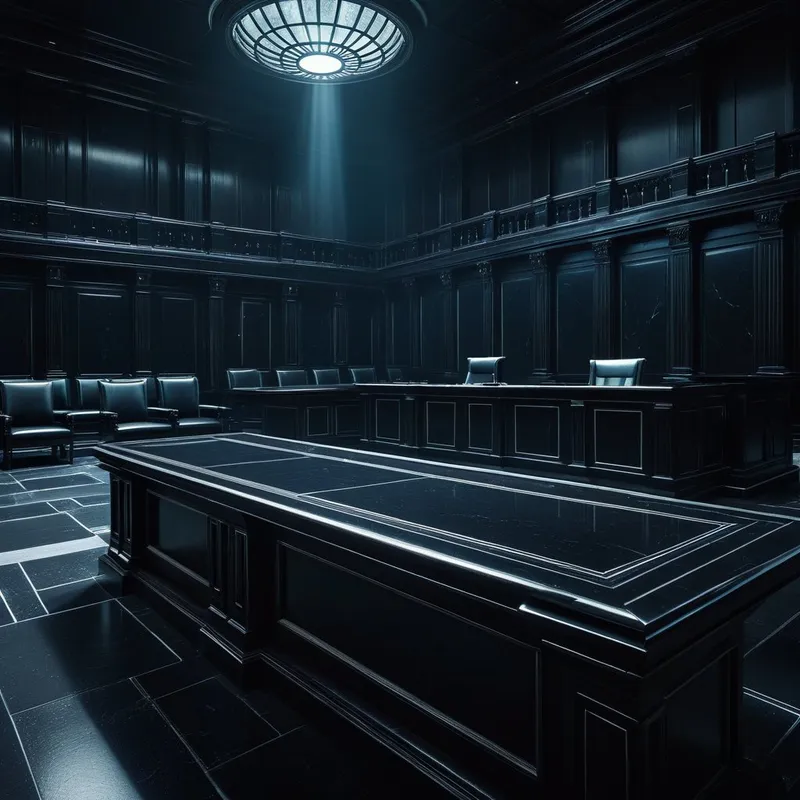
The dreamer stands in a cavernous, silent courtroom of polished obsidian. A single document glows with indecipherable script upon the judge's bench, which is empty. From the shadowed gallery, a chorus of whispers begins to coalesce into a single, deafening verdict they can almost, but not quite, understand. They wake with their heart as the gavel, pounding the sentence into their ribs.
This is the psyche presenting the verdict before the trial, forcing the dreamer to become both the accused and the architect of their own law.
The False Lead
This theme is not about being found guilty by the world. That is its most superficial costume, a decoy of shame. Nor is it merely about "bad luck" or external criticism. To mistake this dream for a simple replay of daily anxiety is to miss its profound invitation. The terror of judgment dreams is not the fear of punishment from an external authority. It is the terror of confronting the internal, fragmented jury you have unconsciously assembled—the inherited voices, the outdated rules, the exiled parts of yourself you have deemed unworthy. The dream is not highlighting your failure; it is highlighting the courtroom itself, and asking: who built this? Who is the judge? And what law is being served?
Psychological Architecture
Here, Shadow work is not a battle against a monster in the dark, but the meticulous, courageous audit of an internal legal system. Individuation in this realm is the process of moving from a subject of the law to its sovereign. You begin by identifying the "voices" on the internal bench. One may speak in the tone of a critical parent (the internalized rule-enforcer). Another may whimper with the fear of the orphaned part that believes safety lies in conformity. A third may shout with the rebel’s rage against any law at all, creating chaos to avoid true discernment.
This is the deep architecture: a fragmented Internal Family, each part holding a piece of the gavel, trying to maintain order through criticism or collapse. The process is to approach the bench not to plead your case, but to gently, firmly, ask each voice to step down. To thank it for its service—for the parent’s attempt to protect through rules, for the orphan’s attempt to belong through obedience—and to reclaim its power. You integrate these fragments not by obeying or destroying them, but by hearing their testimony and then dissolving the court that set them against each other. The goal is not a better verdict, but to become the silent, spacious hall in which all voices can be heard, and from that listening, a new knowing—discernment—can arise.
Mythic Resonance
We see this eternal process in the myth of Psyche and her tasks. Aphrodite’s judgment upon her is severe and seemingly impossible: sort a massive pile of mixed grains into perfect, separate mounds before dawn. This is the essence of the judgment dream—the overwhelming, minute, and endless task of discernment set by a capricious external authority (the internalized critic). Psyche does not succeed through force, but by surrendering her isolated struggle. She allows help (the ants) to come, symbolizing the activation of instinctual, collective, and humble parts of the psyche. The judgment is not overcome by meeting its brutal logic, but by changing the very nature of the game from solitary ordeal to collaborative, natural intelligence.
Symbolic Nodes
- Scales, balances, or measuring devices: The call for evaluation, often imbalanced.
- Empty thrones, benches, or judge's chairs: The projection of authority outward, awaiting your own occupancy.
- Documents, lists, or report cards with blurred or damning text: The unreadable law of the superego, the verdict felt but not understood.
- Being watched by faceless crowds or silent panels: The sensation of being perpetually assessed by the internalized "other."
- Failing a test you didn't know you were taking: The core experience of judgment without conscious criteria.
Archetypal Resonance
The energy here is most potently that of The Shadow Sage.
The Sage archetype in its essence seeks truth and wisdom. Its shadow, the Dogmatic or Judgmental Sage, is what presides over these dreams. It is the internalized professor who cares more for the letter of the law than the spirit of the student, the critic who mistakes categorization for understanding. Its somatic echo is that cold, analytical pressure in the gut—the reduction of a living experience to a binary pass/fail. This shadow does not seek to enlighten, but to conclude. The alchemical potential lies in recognizing this voice not as truth itself, but as a fractured part that holds a piece of the puzzle. By engaging it with curiosity rather than fear, by asking "What are you trying to protect me from with these strict rules?", you begin the transmutation. The Shadow Sage’s rigid judgments can, under the heat of conscious compassion, be refined into the true Sage’s gift: discernment—the wise, compassionate, and nuanced application of insight that considers the whole, not just the rule.
The Alchemical Process
The alchemy of judgment is the transmutation of criticism into criteria. The prima materia is the raw, toxic shame of the verdict—the feeling of being essentially wrong. The heat required is the unbearable tension of suspending the verdict. You must hold yourself in the fire of not knowing, of refusing to collapse into "I am bad" or defiantly into "They are all wrong." This is the solve: dissolving the old, internal courtroom and all its actors.
The pressure is applied through relentless, gentle questioning of every "should" and "must." As the old structures dissolve, the coagula begins—the precipitation of your own sovereign standard. This is not a new, harsher law, but a living, internal compass. It is forged from the melted-down artifacts of the old court: the parent's concern becomes your value for integrity; the orphan's fear becomes your compassion for vulnerability. The gavel is recast into a tuning fork, resonating with the frequency of your own truth. The transmutation is complete when the external event that once would have triggered a cascade of internal prosecution now simply gets measured against your own crystalline criteria and is found either relevant or irrelevant to your sovereignty.

The Integration Protocol
Question 1: The next time you feel the somatic echo of judgment (the tightness, the weight), pause and ask: "If this feeling were a person speaking a sentence, what would that sentence be? Who does the voice sound like?"
Question 2: In the dream, who or what was issuing the judgment? Now, imagine turning to that figure and asking it: "What are you afraid will happen if I do not obey your verdict?"
Question 3: What is one ancient, unexamined "law" you have been living by (e.g., "I must be perfect to be safe," "Pleasure must be earned")? Where did this law truly originate?
Action 1 (The Silent Bench): For five minutes, sit in meditation. Visualize your internal courtroom. See the judge's bench, the witness stand, the gallery. One by one, gently escort every figure out of the room. Sit in the empty silence of the hall. Feel the architecture that remains—this is the space of your own awareness, before any judgment fills it.
Action 2 (Rewriting the Codex): Take a notebook. On one page, write a list of "Received Laws" (judgments, criticisms, "shoulds" you've internalized). On the facing page, for each item, write a "Sovereign Principle." Transform the external rule into an internal value. For example, "You are too much" becomes "I value my full, expressive capacity."
Action 3 (The Unsent Defense): Write a letter to your dream's judging figure. Do not defend or explain yourself. Instead, write from the perspective of the most compassionate, wise being you can imagine—your future, integrated self. Describe what you see happening in the courtroom. Offer understanding to the judge for its fears. Then, declare the court adjourned, in a tone of final, gentle authority. Do not send it; burn or bury it as a ritual of dissolution.
Final Validation
To dream of judgment is to carry a profound and wearying weight. It can feel like the universe itself has you under review. Please understand: this weight is the sign of a psyche laboring to give birth to its own authority. The exhaustion is real. The fear of the verdict is valid. You are not wrong for feeling it. But you are being invited to a staggering act of reclamation: to take that weight, that cold gavel, that echoing hall of judgment, and to realize, molecule by molecule, that it is all built inside you. And what is built can be unmade. What is internal can be rearranged. The power that once terrified you as an external sentence is the very same power that awaits your claim—the power to discern, from a place of unassailable inner ground, what is truly yours to carry, and what is simply the echo of an old, empty courtroom you are now free to leave.