
The Cartography of Becoming: Dreams of Journey & Progress
We do not dream of journeys because we are lost. We dream of them because we are in motion. Before the mind can plot a course or name a destination, the body knows the voyage has already begun. This is the somatic echo of the journey dream: a low hum in the solar plexus, a subtle tension in the hamstrings as if already braced for a step, a breath that catches not in fear, but in the anticipatory stillness before departure. It is the visceral sense of potential energy—a coiled spring in the psyche, a tectonic pressure building along the fault lines of the self. The journey is not an event on the horizon; it is the ground trembling beneath your feet.
The Dreamer's Log
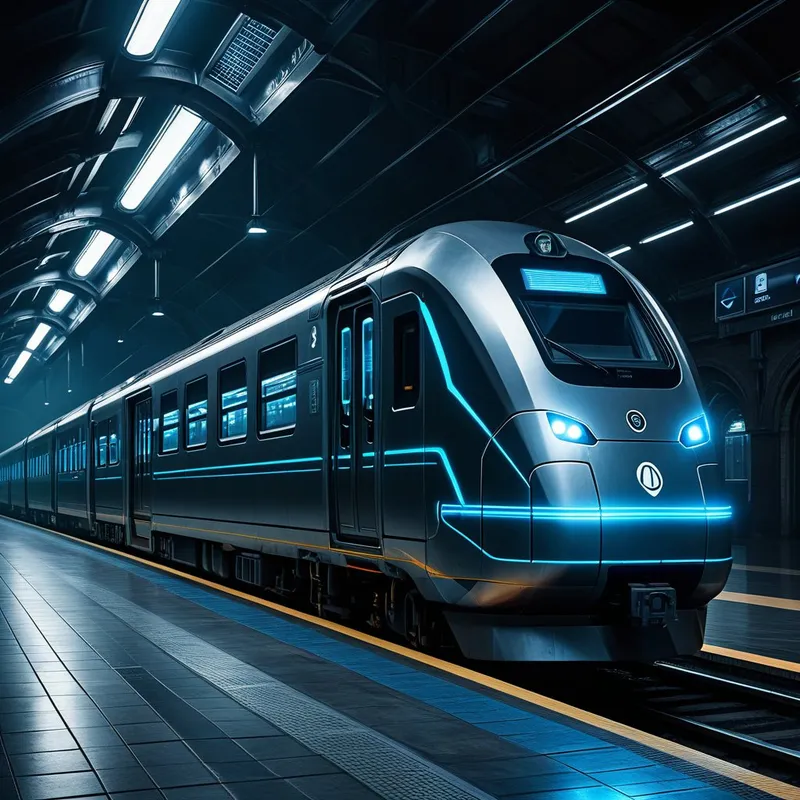
The dream is always the same: I am in a vast, underground train station, all polished stone and cold, electric light. A silver train waits, its doors open, humming. I know I must board it. I have a ticket, but I cannot read the destination. Every time I move toward the door, my feet become heavy, as if the platform itself is holding me back. The train does not leave. It just waits, humming, for me to choose the weight of my own inertia or the terror of the unknown track.
This is the soul’s alchemical equation: the immutable vehicle of change awaits, but the catalyst is the conscious choice to move against the gravity of the familiar.
The False Lead
This theme is not a simple narrative of travel from point A to point B, nor is it a mere allegory for "life's path." To interpret it as such is to mistake the map for the territory. A dream of a blocked road is not a prophecy of bad luck; it is an x-ray of an internal checkpoint. A dream of a missed flight is not a warning of failure in your plans, but a profound reflection of a part of you that refuses to depart from a known, if painful, psychic airport. The journey in the dreamscape is never about the external logistics of progress. It is about the structural integrity—or lack thereof—of the will that attempts to enact it.
Psychological Architecture
The true architecture of a journey dream is built in the shadowlands. Here, progress is not linear advancement but a process of individuation—the difficult, non-negotiable work of differentiating the authentic self from the internal chorus of inherited expectations, trauma responses, and adopted personas. This is the shadow work: to meet the internal gatekeepers on every metaphorical bridge. One part of you, the loyal Orphan, may cling to the known shores of victimhood, fearing the open sea where it cannot blame the coastline for its confines. Another, the Shadow Ruler, may sabotage the engine, terrified that true sovereignty means losing control over the kingdom of your familiar suffering.
The journey forces a confrontation with these exiled parts. The road asks you to carry them or be pulled apart by them. The vehicle—be it car, train, or ship—is the temporary, fragile vessel of the conscious ego, trying to navigate a landscape populated by its own unconscious inhabitants. Progress is measured not in miles, but in the increasing capacity of that vessel to contain its own contradictions without cracking apart.
Mythic Resonance
Consider the Sumerian goddess Inanna’s descent into the underworld. Her journey was not a lateral quest but a vertical, ritualized unmoving. At each of the seven gates, she was stripped of a royal garment, a title, a piece of her worldly identity, until she arrived naked and dead at the core. This is the mythic firmware of true progress: it is not an accumulation, but a necessary, brutal divestment. The journey inward, toward the shadow, requires surrendering the very armaments you believed were necessary for the trip. Likewise, the Odyssey is not the story of a hero getting home; it is the story of a man being unmade and remade by the journey itself, until the "home" he returns to is unrecognizable because he is unrecognizable. The destination changes because the traveler is alchemized by the road.
Symbolic Nodes
- Roads, Paths, Tunnels: The perceived trajectory of the psyche. A fork signifies a decision point in values, not just options. A blocked tunnel is repressed material.
- Vehicles (Cars, Trains, Ships): The means of conscious agency. A broken-down car is a depleted will. A speeding, out-of-control vehicle is untamed impulse masquerading as progress.
- Maps & Compasses: The search for external guidance or internal intuition. An unreadable map suggests a disconnect from inner wisdom.
- Bridges & Crossings: Transitions between psychological states. A rickety bridge indicates anxiety about the stability of a new phase.
- Stations, Airports, Ports: Liminal spaces of potential departure or arrival. Being stuck here is the paralysis of potential, the purgatory of choice.
- Luggage/Baggage: The burdens, memories, and identities you carry. An overstuffed bag is the weight of an unlived life.
Archetypal Resonance
The Explorer Archetype is the primal engine of this dream theme. Its energy is not mere wanderlust, but the sacred discontent that makes the familiar prison unbearable. Its somatic echo is that restlessness in the bones, the itch in the feet—the body’s innate knowledge that stagnation is a slow death. The Explorer does not seek a pre-existing paradise; it seeks the frontier where the self ends and the unknown begins, for it is only at that precipice that new aspects of the soul can be discovered and forged. Its alchemical potential lies in its willingness to trade the false security of the map for the terrifying, liberating truth of the territory. However, when this energy is repressed or feared, it manifests as its Shadow Explorer—the aimless wanderer, the perpetual tourist who confuses motion for progress, accumulating miles but never depth, forever alienated from both home and horizon.
The Alchemical Process
The transmutation here is of Inertia into Momentum. The base material is the leaden weight of the familiar, the gravitational pull of the unlived life. The prima materia is that moment in the dream—and in waking life—where you feel the profound, exhausting cost of staying put. The alchemical heat is applied through conscious friction: the deliberate act of moving when every internal system advises caution, of taking the step onto the unreadable track. This is the nigredo, the blackening—the dissolution of the old identity that was built for the old landscape.
The pressure is the sustained tension between the comfort of the known suffering and the terror of the unknown growth. In this crucible, the grief for the self you must leave behind meets the terror of the self you have not yet become. The alchemical secret is that the vehicle is not separate from the road; you do not board the train, you become it. The momentum generated by the first conscious choice begins to transmute the heavy, resistant lead of inertia into the flowing, mercurial silver of directed will. The destination emerges not as a place on a map, but as a quality of being forged by the journey itself.

The Integration Protocol
Question 1: In your waking life, where do you feel the most potent somatic echo of this dream—the specific tension, ache, or pull that signals you are at a personal frontier, resisting a necessary departure?
Question 2: If the vehicle in your dream (or the lack of one) represents your current sense of agency, what is its condition? What part of you is the mechanic, and what part is the saboteur?
Question 3: What one piece of "luggage" are you carrying that, if you set it down on the side of the road, would most increase your speed and freedom of movement? Name it not as a concept ("fear"), but as a specific story, identity, or obligation.
Action 1 (Somatic Anchoring): For one week, practice this upon waking: Before getting out of bed, feel your feet. Imagine the specific texture and temperature of the ground of your dream journey beneath them—cold stone, soft earth, metallic grating. Breathe into that sensation for three cycles, anchoring the dreamscape in your body before you rise to meet the day's road.
Action 2 (Unstructured Cartography): Take a large sheet of paper. Without planning, draw your internal landscape as it feels right now. Not a literal map, but an expressive representation of your psychic territory. Where are the blocked passes? The flowing rivers? The crumbling bridges? Let the drawing be messy, symbolic, and non-linear. This externalizes the architecture of your progress.
Action 3 (Ritual of the Threshold): Identify one small, tangible threshold in your home—a doorway, a gate, a specific step. For seven days, as you cross it, pause. Consciously state, "I cross this threshold with intention. I leave behind [name the energy you wish to release] and carry forward [name the quality you are cultivating]." This ritualizes the micro-journeys, training the psyche to recognize and honor its own progress.
Final Validation
The road is hard because it is real. The resistance you feel is not a sign you are on the wrong path, but a confirmation that you are on a true one—one that leads through, not around, the heart of your own becoming. The exhaustion, the doubt, the longing for a simpler map are all valid currencies in this economy of the soul. Honor them. Then, remember: you are not just walking the path. You are the path, the walker, and the destination being dreamed into existence with every heavy, holy, forward-falling step. The journey is the only proof that you are alive, and progress is the silent, relentless song of the soul remembering itself.