
The Intellectual Trial: When Your Mind Summons Its Own Inquisition
The dream of the Intellectual Trial does not begin with a thought. It begins in the gut. It is a cold, metallic weight settling low in the abdomen, a sudden hollowness behind the sternum as if the scaffolding of your self has been removed. The breath becomes shallow, held captive by an invisible vise of anticipation. This is the body’s ancient alarm, older than language, sensing a threat to its very map of reality. Before the mind conjures the courtroom, the examination hall, or the panel of silent judges, the nervous system already knows: you are about to be measured against a standard you cannot see, by a logic you do not fully own. The somatic echo is one of profound exposure, the visceral feeling of being an equation about to be solved and found wanting.
The Dreamer's Log
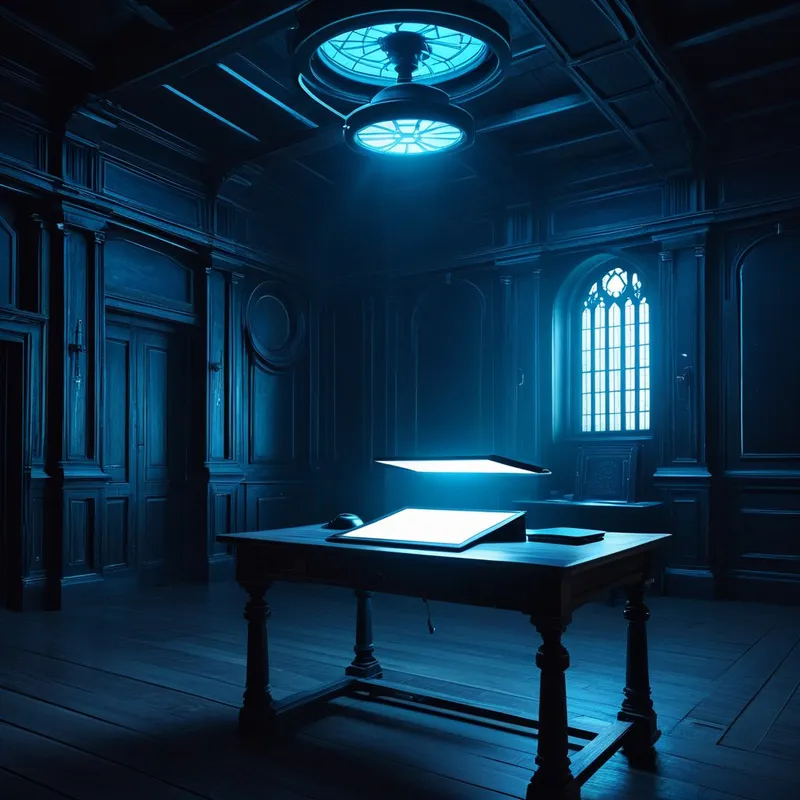
She stands in a vast, silent examination hall. The desk before her is polished obsidian, holding only a blank tablet that emits a faint, sterile light. A faceless, hovering drone is her only proctor. She knows the test is on "Everything You Claim to Understand," but the questions, when they appear, are in a shifting glyph-language that dissolves as she tries to read it. Her pen writes only water.
This is not a dream about failing a real-world test. It is the psyche’s alchemical crucible, where the very substance of "knowing" is being heated to the point of dissolution, so a more fluid, embodied intelligence can begin to coalesce.
The False Lead
Do not mistake this for a simple anxiety dream about work or school performance. That is its mundane costume. The Intellectual Trial is not about the fear of external judgment over a specific skill. It is about an internal, structural crisis of epistemology—how you know what you know. It is the Self, through the divine paradox of the unconscious, putting its own cherished intellectual frameworks on trial. It is not about being wrong about a fact; it is about the terrifying, liberating possibility that your entire way of being right has become a cage.
Psychological Architecture
Here, Shadow work is not about confronting a hidden monster, but about confronting a hidden judge. This is the part of you that absorbed the world’s metrics—the shoulds, the paradigms, the "correct" ways of thinking—and installed them as the sovereign ruler of your inner realm. The trial dream is the rebellion of your deeper, more chaotic, and creative intelligence against this internal tyranny. The individuation process at play is the dethroning of the cognitive ego as the sole authority. You are being asked, often brutally, to differentiate between knowledge (accumulated, static, defensive) and wisdom (emergent, fluid, connective). The pressure you feel is the friction between a personality built on a foundation of "knowing" and the soul's demand to rebuild on the ground of "inquiring."
Mythic Resonance
We see this eternal process in the story of the Buddha under the Bodhi tree. Before his enlightenment, he was assailed by the demon Mara, who manifested not as a beast, but as a barrage of arguments, doubts, and intellectual temptations—a final, ultimate examination of everything the prince-turned-ascetic believed to be true. His victory was not through superior debate, but through a profound, somatic grounding, touching the earth itself, moving beyond the mind’s battlefield. Similarly, in the Greek tradition, Socrates’ entire life was an intellectual trial, his wisdom residing in the admission of his own ignorance, transmuting the jury’s death sentence into a philosophical cornerstone. The trial is not the end; it is the initiatory fire.
Symbolic Nodes
- Empty Examination Halls, Silent Courtrooms: The sterile theater of the mind's self-interrogation.
- Unreadable Test Papers, Glitching Screens: The failure of old cognitive languages to capture emerging truth.
- Faceless Judges, Silent Panels: The internalized, anonymous authority of cultural and parental expectations.
- Writing Utensils That Fail (dry pens, watery ink): The impotence of the ego's narrative in the face of the numinous.
- Being Asked to Defend a Thesis You Don't Believe: The acute dissonance between lived experience and adopted belief systems.
- A Library That Collapses or Re-orders Itself: The deconstruction of a once-stable internal canon.
Archetypal Resonance
The energy at the core of the Intellectual Trial is that of The Shadow Sage. The Sage archetype in its fullness seeks truth and understanding. Its shadow, however, is dogmatic, judgmental, and rigidly certain. The trial dream is often staged by this Shadow Sage—the inner critic that mistakes its limited map for the entire territory and puts the rest of the psyche on trial for heresy. The somatic echo of cold dread is the body’s response to this inner tyranny of "should-know." Yet, within this very confrontation lies the alchemical potential: to engage the trial is to begin the process of converting the Shadow Sage’s harsh judgment into the true Sage’s discerning wisdom, transforming condemnation into compassionate inquiry.
The Alchemical Process
The alchemy of the Intellectual Trial is the Transmutation of Certainty into Curiosity. The prima materia—the base lead—is your rigid identification with your intellect as your primary identity and defense. The heat is applied via the intense, shame-laden pressure of the dream trial itself, the feeling of being fundamentally found out. This heat serves a precise purpose: to crack the hermetic seal of your cognitive certainty. The old, crystalline structures of "I know" must soften, melt, and enter a state of solve (dissolution). This is the grief—the terror of the blank page, the silent judge. The coagula (re-coagulation) occurs not when you find new, better answers, but when you consciously step into the role of the eternal questioner. The sovereign Self that emerges is not the one who aced the test, but the one who realizes it authored the exam in the first place, and can now change the questions.

The Integration Protocol
To work with this dream is to move from the dock to the bench, from the examined to the conscious architect of your own knowing.
Question 1: Where in my waking life do I feel like an imposter, not due to a lack of skill, but because I am using a framework of understanding that feels alien to my lived experience?
Question 2: What cherished belief or piece of "knowledge" about myself, others, or the world would be the most terrifying to be proven wrong about? What is protected by that belief?
Question 3: If my intelligence were a landscape, not a library, what would it look like right now? A fortified city? A barren desert? A tangled forest? A flowing river?
Action 1 (Somatic Reclamation): When you feel the cold, metallic dread of the trial arise in waking life, place a hand on your lower abdomen. Breathe deeply into that space for three cycles. Do not try to think your way out. Simply acknowledge, "This is the feeling of the old mind trying to defend its fort. I am more than this fortress."
Action 2 (Unstructured Glyph-Making): Take a large sheet of paper and inks, charcoal, or mud. Without any intention to create an image, let your hand make marks, smudges, and symbols that feel like the "unreadable questions" from the dream. Let it be messy, chaotic, and non-representational. This externalizes and alchemizes the glitching language.
Action 3 (Ritual of Dethronement): Find a small stone or object to represent your "Internal Proctor/Judge." In a private space, speak to it aloud. Thank it for its (misguided) attempt to protect you through rigid certainty. Then, deliberately move it from a central, high place (like an altar or shelf) to a lower, peripheral one—a drawer, a windowsill. Physically enact the relocation of this energy from sovereign to advisor.
Final Validation
The terror of the Intellectual Trial is real and profound, for it strikes at the very core of how we have learned to navigate reality. To feel this dismantling is not a sign of weakness, but a testament to the courage of a psyche that will no longer tolerate the confinement of a borrowed mind. You are not being broken. You are being unbound. The examination is not a verdict from an external god, but a labor pain from the sovereign Self struggling to be born from the chrysalis of mere intellect. The dream is the invitation to lay down the heavy armor of knowing, and to pick up the lighter, more potent tool of wonder.