The Somatic Echo
It begins not as a thought, but as a weight. A specific, hollow density in the solar plexus, as if you’ve swallowed a cold, polished stone. The shoulders carry an invisible mantle, stiff and ill-fitting. The jaw is subtly clenched, holding a smile that isn’t yours. There is a low-grade hum of dissonance, a vibration between the skin and the self, like wearing a costume woven from static. This is the body’s pre-verbal testimony to a life lived on a stage you never agreed to build. Before the mind can articulate the problem of “who am I supposed to be?” the nervous system is already broadcasting the strain of the performance.
The Dreamer's Log
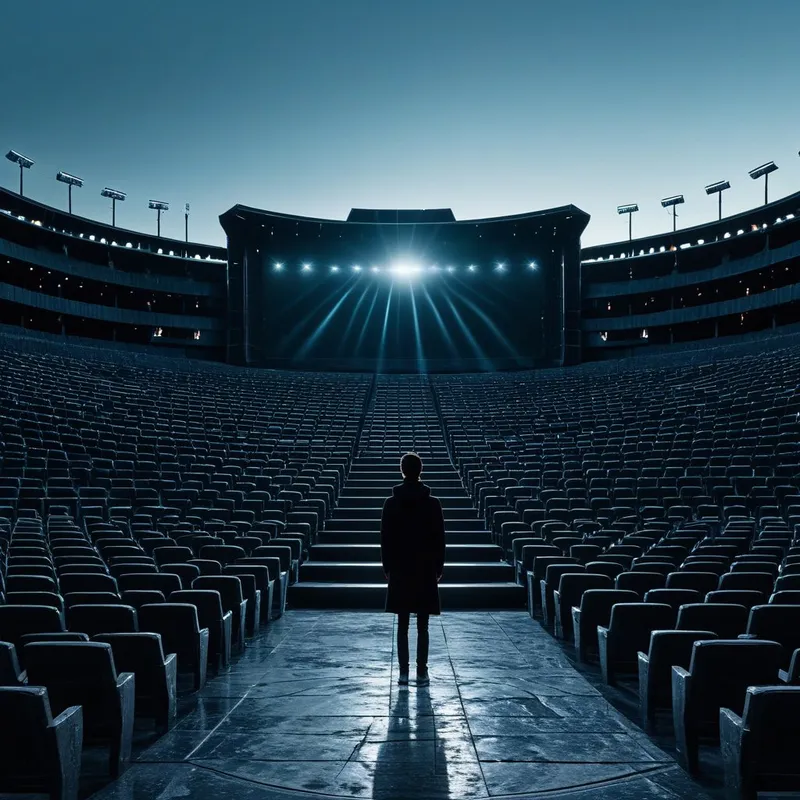
You are backstage in a cavernous, unnamed theater. A voice, neither kind nor cruel, announces your cue. You look at the script in your hands, but the pages are blank. Panic is a cold wire in your throat. You reach for a mask on the rack, but your fingers pass through it like smoke. The curtain is rising on a silent, expectant audience you cannot see.
The alchemy here is the dissolution of the script, forcing the dreamer to meet the audience not with a prepared role, but with the terrifying raw material of their own being.

The False Lead
This is not a dream about social anxiety or mere stage fright. Those are surface tremors. The theme of Identity Performance points to a far deeper structural fault: the unconscious, habitual enactment of a self that was constructed for survival, for love, for safety, but which has now become a sarcophagus. It is not about the fear of failing a task, but the soul’s grief at succeeding too well at being someone else. To mistake this for a simple dream of embarrassment is to confuse the cracking of the ego’s shell for a minor social bruise.
Psychological Architecture
Beneath the performance lies the Shadow work of reclamation. We are born whole, a parliament of potential selves. But early in life, parts of us are exiled—the too-loud child, the too-needy infant, the too-angry rebel—deemed unacceptable to the world we depend on. What remains learns to perform. The Good Child, The Reliable Partner, The Unflappable Professional: these are not lies, but life-saving adaptations. They are sub-personalities, internal family members who took the spotlight so the exiled ones could survive in the dark.
Individuation, in this context, is not about building a better performance. It is the slow, courageous process of turning the lights backstage. It is sitting with the exiled ones in their silence, listening to their grief without letting them take over the stage. It is the recognition that you are not the performer, nor the exiled part, but the space in which both exist. The stage itself must transform from a proscenium of judgment into a sanctuary of witness.
Mythic Resonance
We see this eternal drama in the myth of Narcissus. He is not vain in the simple sense; he is trapped in a performance for an audience of one—his own idealized reflection. The pool’s surface is the ultimate stage, offering a perfect, static image that requires no messy authenticity. He starves gazing at a performance of himself, unable to turn toward the nourishing, real-world echo of Echo, who can only repeat the last words of others—another poignant metaphor for the performed self. Both are locked in a hall of mirrors, one of image, the other of sound, until the life force is spent.
Symbolic Nodes
- Empty Stages & Silent Audiences: The architecture of expectation without content.
- Masks That Melt or Shatter: The failure of the persona as a reliable tool.
- Mirrors Showing a Stranger or Nothing: A rupture in self-recognition.
- Forgotten Lines or Blank Scripts: The internal scriptwriter has gone silent.
- Malfunctioning Microphones or Stuck Zippers: The tools of performance betraying you.
- Being in the Wrong Play or Costume: A deep sense of existential incongruity.
Archetypal Resonance
The Shadow Ruler is the archetypal engine of this theme. Its core energy is the desperate, rigid control of all external perception to maintain a façade of order and authority. The somatic echo—the clenched jaw, the stiff mantle—is the body bearing the tyranny of this inner regime, enforcing a single, "correct" version of the self upon the diverse internal kingdom. Its alchemical potential lies in its collapse; when the Shadow Ruler’s stagecraft fails, the chaos it sought to suppress becomes the fertile ground from which true, flexible sovereignty—the integrated Ruler—can eventually emerge, governing not through control, but through compassionate inclusion of all inner citizens.
The Alchemical Process
The transmutation of Identity Performance is the Solve et Coagula—the dissolution and reconstitution—of the self. The intense heat is applied by life itself: a failure that your persona cannot explain, a loss that your role cannot soothe, a desire that your script does not contain. This heat cracks the polished veneer.
The first phase, Solve, is terrifying. It feels like coming undone. The old masks lose their adhesive. The familiar lines evaporate. This is not destruction, but deconstruction—the separating of the you from the costume. The pressure is the grief of realizing how much of your life-energy has been spent on upkeep for a ghost. The alchemical fire burns away the allegiance to the performance, leaving only the raw, authentic ash of what is truly felt.
Then, Coagula. From this ash, without blueprint or script, a new form begins to cohere. It is not manufactured; it precipitates. It is a sovereignty born of vulnerability, an authority that comes not from playing a king, but from honestly inhabiting your own domain, shadows and all. The performer dies, and the citizen of the self is born.

The Integration Protocol
Question 1: In the quietest moment of your day, when no one is watching, what is the one feeling you most consistently edit out or perform over?
Question 2: What forgotten part of yourself did the performance you give the world originally protect? Can you thank that protector, even as you gently tell it its intense service is no longer required?
Question 3: If your life were a stage, who built the set, who writes the scripts, and who is the audience you are truly trying to please? Are they the same entity?
Action 1 (The Unwritten Monologue): Sit with a notebook. Set a timer for five minutes. Write in the voice of one of your "exiled" parts—the part that is never allowed on your internal stage. Do not edit, do not perform. Let it be messy, angry, sad, or childish. Then, without analysis, burn or shred the page. The act is in the expression, not the preservation.
Action 2 (Somatic De-rolement): Stand comfortably. Imagine slowly, physically, unzipping and stepping out of the "costume" of your most habitual role (The Professional, The Caretaker, etc.). Feel it pool at your feet. Shake out your limbs. For one minute, simply inhabit your body without that weight. Breathe into the space where the costume was.
Action 3 (Ritual of the Empty Chair): Place an empty chair across from you. Imagine sitting in it is the Shadow Ruler, the inner director demanding your performance. Speak to it aloud. Tell it what its control has cost you. Then, move to sit in its chair. Answer as it. Hear its fears—likely of chaos, of unlovability, of annihilation. End by moving back to your original seat and stating one boundary: "I acknowledge your fear, but I am the sovereign here now."
Final Validation
The exhaustion is real. The hollow feeling after the applause fades is a true signal, not a flaw. To dream of the failing performance is a brutal kindness—it is the psyche’s last-ditch effort to wake you up from the sleepwalk of a borrowed life. The stage is crumbling because you were meant to walk on the earth. The mask is melting because your true face, however unfamiliar, needs the air. This is not a crisis of identity, but the long-awaited and deeply frightening birth of it. The performance must fail so that the person can finally, messily, and magnificently begin.