The Dream of Human Obsolescence: A Call from the Depths
The Somatic Echo
It begins not as a thought, but as a hollowing. A cold, silent vacuum opens just beneath the sternum, a cavity where purpose and warmth once resided. The breath becomes shallow, as if the air itself has grown thin and insufficient. There is a leaden weight in the limbs, a profound inertia that whispers, why move? The skin might prickle with a phantom static, the eerie sensation of being scanned, measured, and found wanting by an invisible eye. This is the body’s ancient alarm, sensing not a predator in the brush, but a more subtle extinction: the terrifying suspicion that your particular frequency of being is no longer required by the world, or worse, by your own soul.
The Dreamer's Log
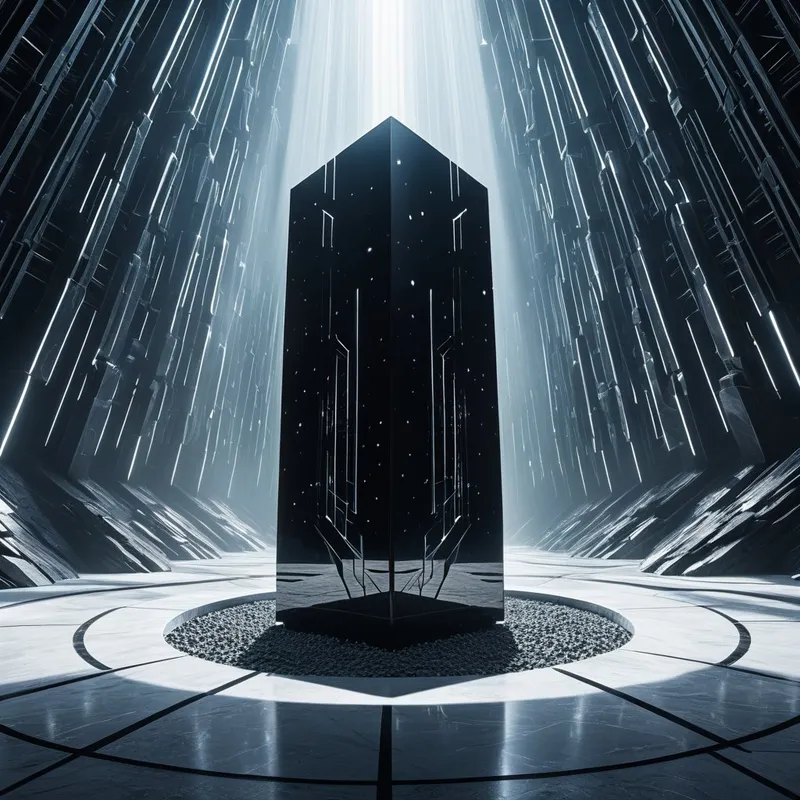
The dream is always the same. I walk into the vast, humming server room of my old life. My desk is gone. In its place, a sleek, silent column of light pulses with a rhythm I cannot comprehend. My chair remains—a worn leather relic—but it is turned to face the wall, coated in a fine, grey dust. I understand, without being told, that the system runs perfectly now. It just doesn’t need me to sit here anymore.
Alchemical Interpretation: The dream presents not a firing, but a retirement of a specific internal role—the diligent manager of an outdated psychic infrastructure—inviting a mourning that must precede a more authentic form of presence.

The False Lead
This is not a dream about mere professional redundancy or a streak of bad luck. To interpret it as such is to stay in the superficial narrative, the ego’s complaint. The terror of obsolescence runs deeper than the fear of a replaced skill; it is the fear of a replaced self. It is not about the world discarding you, but about a core part of your own psyche—a long-standing identity, a cherished role, a reliable way of being—reaching its expiration date. The grief is real, but its source is internal. The system declaring you obsolete is often your own soul, initiating a necessary demolition.
Psychological Architecture
When this dream arrives, it signals that a foundational persona—what Jung called a "suitable piece of collective psyche"—has finished its contract. You built a self to navigate a certain world: the Responsible One, the Expert, the Caretaker, the Producer. It served you. It got you here. But now, its logic is a closed loop, its responses are legacy code. The soul’s imperative toward wholeness cannot tolerate a subsystem that runs on autopilot, bypassing the living core. The shadow work here is to consciously dis-identify. You must separate your eternal being from the temporary program. This is the Individuation process in its most ruthless phase: it asks you to stand in the hollowed-out silence after the role has died and answer, not what do I do?, but who am I, now that I am not that? It is the terrifying freedom of being decommissioned.
Mythic Resonance
We see this in the story of the Golem, the clay servant brought to life by sacred word to protect a community. It is powerful, necessary, but ultimately mindless. When its task is complete or its power turns destructive, the rabbi must return and erase the sacred letter from its forehead, reducing it back to inert clay. The dream of obsolescence is that moment of de-animation. The myth whispers that the construct was never you; it was a tool, a vessel for a specific time. Your essence is the one who speaks the word, not the clay that forms the body. Similarly, the Phoenix does not simply repair itself; it must be consumed entirely by flame, reduced to essential ash, before the new form can coalesce. The dream is the fire.
Symbolic Nodes
- Empty chairs turned to the wall or facing obsolete machinery.
- Silent, efficient machines or rooms that function flawlessly without human presence.
- Your own voice becoming mute, or your words appearing as fading text on a screen.
- Keys that no longer fit, or badges that fail to scan.
- Being transparent, ghostly, or completely unnoticed in a familiar place.
- Manuals or books whose pages have turned blank.
Archetypal Resonance
The Shadow Ruler is the archetype most active in this theme’s painful genesis. Its core energy is the desperate, rigid grip on a kingdom that no longer exists—the internal regime of "how I must be" to stay in control, to remain relevant, to command respect.
The somatic echo of hollowness and static is the Shadow Ruler’s throne room going silent, its decrees echoing in an empty chamber. This archetype’s tyranny is often internal; it is the part of us that insists on maintaining an outdated self-concept as the sole authority of our worth. Its alchemical potential lies in its dissolution. The profound grief of obsolescence is the necessary coup that deposes this inner tyrant. When its control breaks, the sovereignty does not vanish—it transforms. It is redistributed from a monolithic, anxious ruler to a collaborative, fluid council of the whole self. The death of the Shadow Ruler is the birth of true, embodied sovereignty, where you rule not from fear of being replaced, but from the unshakable ground of your own existence.
The Alchemical Process
The transmutation here is from Legacy Code to Living Protocol. The prima materia is the grief and terror of being phased out. The heat is applied by consciously dwelling in that hollow feeling without rushing to fill it with a new identity, a new project, a new distraction. This is the nigredo, the blackening, where you allow the old construct to be seen as dead. The pressure is the soul’s relentless question: What remains when the function is stripped away?
The alchemical fire is the courage to decommission yourself. You must actively participate in the dismantling. This is not passive victimhood; it is a ritual of surrender. You give the internal order to power down the old subsystem. You thank the role for its service and consciously revoke its authority. In the white heat of that void, the albedo occurs: a cold, clear light of awareness reveals your essence, distinct from all its functions. The new "protocol" that emerges is not another rigid program, but a living, responsive intelligence—a way of being that is adaptable, intuitive, and rooted in presence rather than performance. The gold is the realization that you are the consciousness in which roles appear and dissolve; you are the field, not the temporary crop.

The Integration Protocol
Question 1: What specific role, identity, or "way of being" in my life feels most like a tired, automated program running in the background?
Question 2: If that internal program were to be permanently decommissioned tonight, what old fear does it keep at bay? What space would its absence create?
Question 3: What simple, non-utilitarian action or moment of stillness makes me feel most present, most inexplicably myself, beyond any function I perform?
Action 1 (Grounding in the Hollow): For five minutes, sit quietly and place your hand on the hollow space in your chest. Breathe into that sensation without trying to change or fix it. Imagine your breath as a neutral witness, simply acknowledging the empty chair within.
Action 2 (Creative Decommissioning): Draw, paint, or write a "decommissioning order" for the obsolete inner role. Give it a formal title (e.g., "The Director of Constant Productivity"). Describe its function, thank it for its service, and declare its mandate concluded. Then, visually or verbally, dissolve the document—smudge it, tear it, wash the ink away.
Action 3 (Sovereign Ritual): Go to a place in nature or a quiet room. Perform a simple, deliberate action that serves no purpose other than to mark your presence. Stack stones. Trace a pattern in the sand. Arrange leaves on the ground. The act is a declaration: I am here, and my being is its own justification.
Final Validation
The ache of obsolescence is a legitimate, profound grief. It is the death of a self you built, a companion you relied upon. To feel its desolation is not a failure, but evidence of your depth. Honor that passage. Then, listen into the silence it leaves behind. That silence is not emptiness; it is the clean slate of your soul. From that void, you are not rebuilt as a better tool for the world. You are remembered as the irreplaceable, sovereign consciousness that was there all along, waiting for the machinery to finally grow quiet so it could hear its own, essential hum.