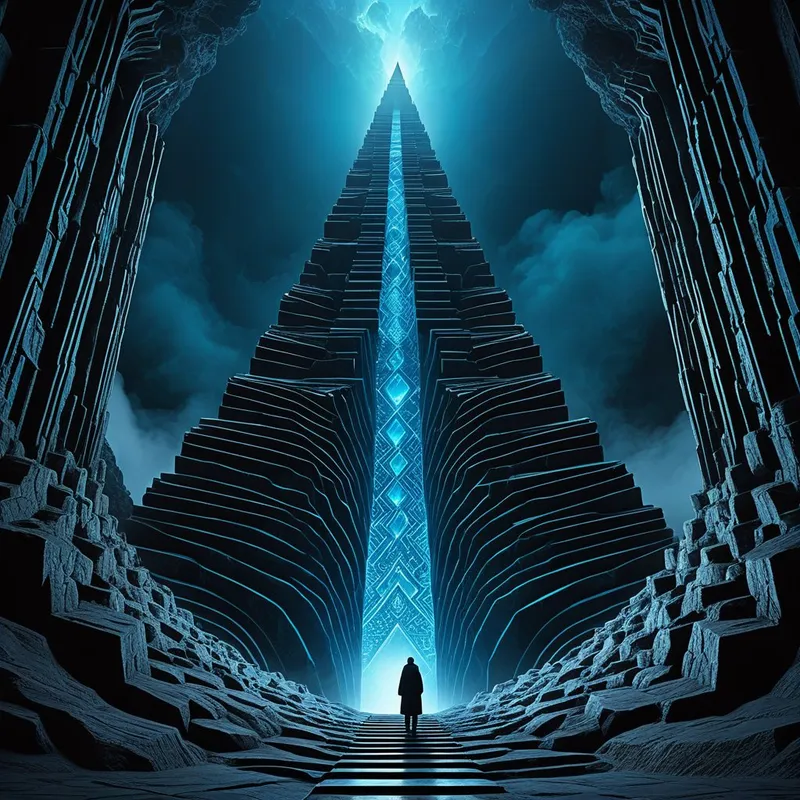
The Architecture of the Self: Dreams of Hierarchy & Power
The Somatic Echo
Before the mind conjures a throne room, a corporate ladder, or a towering citadel, the body knows. It registers as a specific gravity—a weight in the solar plexus that feels like a stone orb, dense and cold. It is the clench of the jaw, a silent bracing against an unseen command. It is a rigidity in the spine, a posture held not in pride, but in anticipation of judgment from above or below. This is the somatic echo of hierarchy, the ancient, pre-verbal knowing of one’s place in a structure. It whispers of pressure from above, of responsibility for what is below, and of the silent, screaming question at the center: Where do I stand? The breath becomes shallow, held in the upper chest, afraid to descend into the belly where true authority resides. This is not an idea. It is a lived geometry in the flesh.
The Dreamer's Log
In the dream, I am in a vast, silent library that is also a data center. Racks of servers hum where books should be. I know I must find a specific log file, a record of a critical error, but the system’s directory is a labyrinth of permissions. I have clearance for the outer halls, but the core archives are locked behind doors that require a key I do not possess. The air grows colder the deeper I wander.
This is the dream of the internal audit. The search for the "critical error" is the soul’s demand to locate the original fracture in one’s sense of personal authority. The locked archives are the aspects of the self deemed too powerful, too traumatic, or too true to be accessed by the conscious ego.

The False Lead
This theme is not about social climbing, office politics, or a simple desire for control. To mistake it for such is to remain in the literal hallway, reading the corporate newsletter instead of seeking the core archive. A dream of being powerless before a boss is rarely about the boss. A dream of sitting on a crumbling throne is not a prophecy of lost status. These are the mind’s brilliant, metaphorical staging of an internal condition. The terror here is not of external failure, but of the disintegration of an inner governing system that has, until now, defined the borders of the self. The grief is for the parts of us we exiled to maintain that old order.
Psychological Architecture
Here lies the deep Shadow work. Every internal hierarchy is a governance model, a psychic bureaucracy erected for a reason: to survive. The inner critic holds the gavel, the pleaser manages foreign relations, the achiever mines for validation, the orphan stands guard at the gates of vulnerability. This council runs the kingdom of you. Dreams of power expose this cabinet. They show you its chain of command, its secret alliances, and its imprisoned dissidents—the wild artist, the furious rebel, the sobbing child locked in the dungeon for disrupting proceedings.
Individuation, in this realm, is not a coup d'état. It is a constitutional convention. It is the agonizing, glorious process of dissolving the autocracy and establishing a sovereign republic of the self. The shadow is not a monster in the basement; it is the legitimate president-in-exile of a disowned territory of your being. To integrate power is to grant that exile amnesty, to listen to its manifesto, and to find a place for its energy in the new governance. The pressure you feel is the strain of the old structure, built for a smaller, older version of you, trying to contain the expanding nation of your soul.
Mythic Resonance
We see this in the story of Theseus and the Minotaur. The labyrinth is not just a maze; it is the imposed, insane hierarchy of King Minos, a structure of sacrifice and terror. Theseus does not simply slay the monster. He must first navigate the oppressive, illogical architecture of another’s power. His thread, a gift from Ariadne (the connective, intuitive principle), is not a weapon, but a tool of orientation. It allows him to penetrate the center of the oppressive system, confront the beastly shadow (the Minotaur, born of a broken hierarchy), and retrace his steps to integrate the journey. The power gained is not kingship over others, but sovereignty over one’s own path through the psychological labyrinths we inherit.
Symbolic Nodes
- Ladders, Stairs, Elevators: The felt experience of ascent, descent, or being stuck between levels of the self.
- Thrones, Desks, Judge's Benches: Seats of internal judgment and authority.
- Crowns, Keys, Badges, Uniforms: Symbols of legitimized (or illegitimate) roles.
- Towers, Pyramids, Skyscrapers: The architecture of isolation and overview.
- Dungeons, Basements, Service Tunnels: The repressed, foundational, or "lower" aspects of the psyche.
- Being Micromanaged or Ignored by a Machine/System: The experience of the psyche's own automated, impersonal governance.
- Finding a Hidden Room or a Secret Document: Discovering disowned power or truth.
Archetypal Resonance
The energy at the core of this theme is that of The Ruler Archetype. Its shadow manifestation—the Tyrant and the Control-Freak—is often the first to appear in these dreams, representing the internalized critic, the rigid inner system, or the fear of chaos that seeks order through domination. The somatic echo of the clenched jaw and rigid spine is the body hosting the Shadow Ruler’s council of war. Yet, the archetype’s highest expression holds the alchemical potential. The true Ruler does not dominate the kingdom; they steward it. They establish order not from fear, but from a vision of harmony and prosperous function for all parts of the realm. The journey from Shadow Ruler to Sovereign is the essence of this dream work: transforming the need to control into the capacity to govern the self with wisdom, responsibility, and benevolent authority.
The Alchemical Process
The transmutation here is from structure to sovereignty. The base metal is the leaden, oppressive inner hierarchy—a frozen, fear-based governance. The heat required is the unbearable tension of holding two truths: the deep grief for the parts of yourself crushed under the old regime, and the terrifying thrill of the chaos that comes when that regime falters. This is the nigredo, the blackening.
The pressure is the conscious commitment to sit in the throne room of your own psyche during this civil war, to feel the petitions of every exiled part—the orphan’s grief, the rebel’s fury, the lover’s longing—without immediately reinstating the old tyrant to silence them. As you listen, a miraculous shift occurs. The rigid, vertical hierarchy begins to dissolve. It does not vanish into anarchy, but reconfigures. It becomes a network, a council, a neural web. The gold produced is not dominance, but integrated authority: the power that comes from a self that is in dialogue with itself, where command is replaced by coordination, and control by conscious choice.

The Integration Protocol
Question 1: In the dream’s hierarchy, where was I positioned? Was I above, below, beside, or outside the structure? What did that position feel like in my body?
Question 2: If the power structure in the dream were a governing system inside me, what is its primary law? What part of me does it most seek to control or silence?
Question 3: What one piece of intelligence, energy, or truth is locked in the "lower" or "restricted" area of my dream? What might it need to say to the part of me that holds the "keys"?
Action 1 (Somatic Re-mapping): For one day, track the somatic echo. Each time you feel that jaw clench, that shoulder tighten, or that stomach drop in response to an external demand or internal criticism, pause. Place a hand on that body part and breathe into it. Don’t change it. Just acknowledge its presence as a signal from your inner governance.
Action 2 (Council of Parts): Engage in unstructured writing. Let your hand move without censorship. First, let the voice of your inner "Authority Figure" (the boss, the judge, the king/queen) speak. What does it want? What is it afraid of? Then, let a voice from the "Dungeon" or "Basement" of your dream respond. Facilitate a dialogue, not a debate.
Action 3 (Ritual of Decentralization): Create a simple, physical map of your inner kingdom. Use stones, drawings, or objects on a table. Place them in the old, hierarchical structure from your dream. Then, slowly, deliberately, rearrange them. Move the "exiled" object to the center. Place the "ruler" object off to the side. Create a circle, a web, a new geography. Witness the new arrangement without judgment.
Final Validation
It is profoundly difficult to feel the foundations of your own psyche shudder. To dream of power is to be summoned to the most intimate and daunting reconstruction project imaginable: the rebuilding of your own governance. The fear is real. The grief for the simpler, if smaller, self you must leave behind is valid. But this is not a curse; it is a coronation—not over others, but over the vast and waiting territories of your own soul. The authority you seek has always been yours. The dream is not showing you a ladder to climb, but the blueprint of the throne you have been afraid to occupy. Sit. The kingdom awaits its sovereign.