
The Alchemy of the Accused: Guilt, Punishment, and the Dream of Forgiveness
The Somatic Echo
It begins not as a thought, but as a gravity. A cold, dense stone settles in the pit of the stomach, a leaden anchor dropped into the sea of the self. The shoulders curl forward, as if expecting a blow. The breath becomes shallow, held in the chest like a prisoner in a cell. This is the body’s memory of a crime it cannot name, a verdict passed in a court the waking mind has never seen. It is the somatic echo of a fracture within—a part of the self standing in judgment of another. Before the dream images form, this is the territory: a visceral landscape of condemnation, where the flesh itself confesses to a transgression against the soul’s own, often unconscious, laws.
The Dreamer's Log
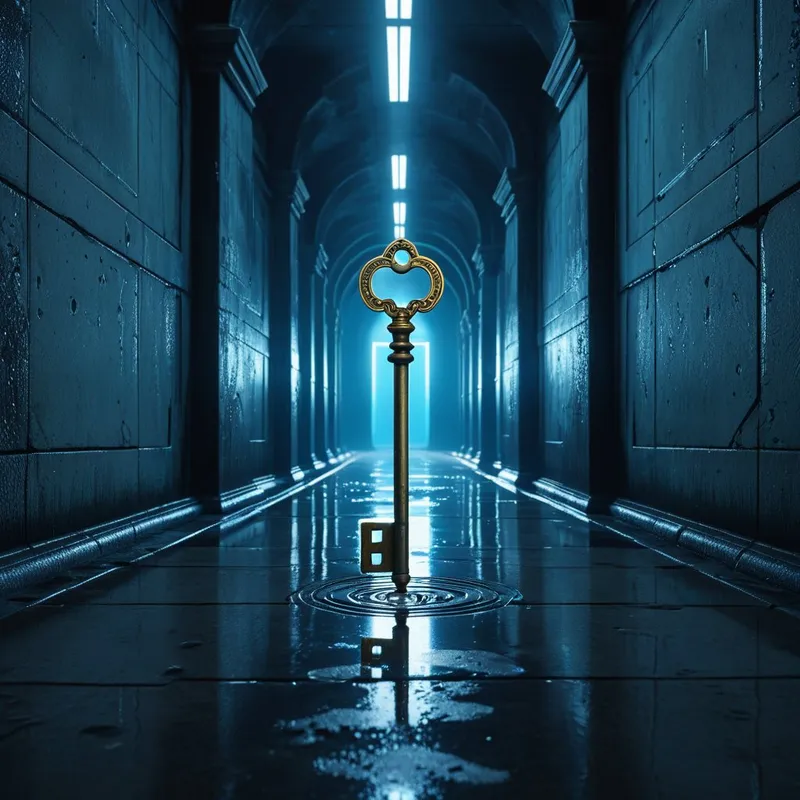
The dreamer walks down an endless, institutional corridor of damp concrete. They know, with absolute certainty, they have misplaced a vital key—a key that was not theirs to lose. From the ceiling, a single, stark lightbulb flickers, and with each sputter, the walls seem to inch closer. There is no pursuer, only the crushing certainty of their own failure and the architecture itself closing in as punishment.
This is not a dream of external threat, but of internal jurisdiction. The lost key represents a forgotten responsibility to an exiled part of the self, and the shrinking corridor is the psyche’s enforcement of a sentence passed by a hidden, inner magistrate.
The False Lead
This theme is not a prophecy of karmic retribution or a sign of impending, real-world misfortune. To interpret it as such is to mistake the map for the territory. The courtroom of the dream is not a preview of life’s events, but a reflection of an ongoing, internal trial. It is not about what you will suffer, but about the suffering you are already inflicting upon yourself in the shadows of your awareness. The punishment dreamed is not a future to be feared, but a present condition to be acknowledged—a symptom of a self divided against itself.
Psychological Architecture
Beneath the dream of punishment lies the ancient, psychic structure of the Shadow. Guilt, in its profound sense, is the emotional signal that we have violated our own integrity. It marks the place where an action, a desire, or even a capacity has been deemed unacceptable by our conscious identity and cast into the inner darkness. But the exiled part does not disappear; it accrues energy. It becomes a plaintiff in the court of the unconscious, and its evidence is our own discomfort. The dream of punishment is this court in session. The judge is often a rigid, internalized moral code—a fusion of parental voices, cultural expectations, and childhood survival strategies. The sentence—be it confinement, pursuit, or humiliation—is the psyche’s dramatic portrayal of the inner confinement we already experience. This is the architecture of self-estrangement. The work of individuation here is not to overthrow the court, but to transform it from a penal colony into a council chamber. It requires standing as both the accused and the witness, listening to the testimony of the exiled fragment, and understanding the original, often protective, intent behind the law that banished it.
Mythic Resonance
We see this eternal process in the story of the Scapegoat, an archetype woven into cultures worldwide. A creature, often laden with the symbolic sins of the community, is cast out into the wilderness, carrying the burden of guilt away from the tribe. The dreamer experiencing punishment is often both the community casting out and the goat being driven away. The myth reveals the brutal, ancient logic: to preserve the perceived purity of the whole, a part must be sacrificed. Our personal psyche operates on this same mythic firmware. The modern, alchemical task is to venture into that wilderness, find the exiled goat, and bring it—and the burden it carries—back home, not as sin, but as lost energy waiting for reintegration.
Symbolic Nodes
- Prisons, Cages, Traps: The structure of the confined self.
- Being Chased or Hunted: The pressure of repressed content seeking acknowledgment.
- Lost or Broken Vital Objects (Keys, Documents, Tools): A severed connection to personal agency or responsibility.
- Failing a Test You Didn't Study For: Being held accountable to an unconscious or internalized standard.
- Public Humiliation or Exposure: The fear of the hidden flaw being seen, often by the self.
- Judges, Guards, Faceless Authorities: The internalized law, the superego in its punitive form.
Archetypal Resonance
The energy at the core of the Guilt & Punishment dream is that of The Shadow Ruler Archetype. This is the internal magistrate gone tyrannical, the part of the psyche that confuses sovereignty with absolute control, and order with punishment. Its somatic echo is the stiffened spine of judgment and the clenched jaw of decree. It resonates with this theme because it represents the psyche’s attempt to govern through fear and exile, maintaining a brittle, perfect kingdom by silencing any dissenting or “unruly” part of the self. Its alchemical potential lies in its transformation back into the true Ruler—the one who integrates, governs with compassion, and establishes inner sovereignty not through domination, but through wise inclusion of all its subjects.
The Alchemical Process
The transmutation of guilt requires the most intense heat of all: the fire of self-compassion applied directly to the wound of self-condemnation. The prima materia here is the leaden weight of the sentence. The process begins in the nigredo, the blackening: you must consciously enter the felt sense of the punishment, the cold corridor, the shrinking room. Do not flee the sensation. This is the pressure. Then, in the albedo, the whitening, you ask, not “What did I do wrong?” but “Which part of me feels accused, and which part is doing the accusing?” Separate the plaintiff from the judge. Listen to the exiled one’s story. Finally, the rubedo, the reddening: you facilitate a dialogue. You allow the judge to state its fear (chaos, rejection, annihilation), and you allow the accused to state its truth (its need, its desire, its original impulse). The transmutation is the moment the rigid sentence dissolves into a new, internal agreement—a law based on integration rather than exile. The gold produced is profound self-trust and inner sovereignty.

The Integration Protocol
Question 1: If the punishment in the dream (the cage, the chase, the exposure) is not a future event but a current, inner condition, what part of my waking life already feels like this sentence being served?
Question 2: What ancient, unspoken law—perhaps from childhood, family, or culture—did I break to deserve this inner verdict? Is that law still in alignment with my soul’s true code?
Question 3: If the figure punishing me in the dream (or the force behind it) could speak, what is it most afraid would happen if it stopped enforcing this sentence?
Action 1 (Somatic Amnesty): For one minute, place your hand where you feel the “gravity” of guilt—the stomach, the chest, the throat. Breathe into that space. With each exhale, imagine the breath is not justifying or arguing, but simply creating a tiny chamber of space around the dense feeling. You are not dissolving the guilt yet; you are ceasing to crowd it.
Action 2 (The Exile’s Testament): Take a blank page. Let the “exiled” part—the one being punished in the dream—write or draw its testimony. Not an apology, but its story. What did it want? What was it trying to do or feel? Use your non-dominant hand if it helps bypass the inner censor. This is creative evidence for the internal court.
Action 3 (Ritual of Nullification): Find a small stone. Hold it, imbuing it with the felt sense of the old, punishing sentence. Go to a body of moving water—a river, the sea, even a sink. Speak aloud: “The sentence is served. The law is updated.” Throw the stone into the water, or let the tap wash it away. The action is a physical signal to the unconscious that the old contract is complete.
Final Validation
To dream of guilt and punishment is to walk the most demanding corridor of the self. It feels like a life sentence passed by a merciless judge. Please understand: the very pain of it is proof of your wholeness straining to be realized. The psyche only prosecutes what it longs to reconcile. This dream is not your condemnation; it is your soul’s most severe and loving summons to its own highest court—not for a trial, but for a long-awaited amnesty. The key you dream you lost is already in your hand. It fits the lock of your own heart.