Grounding & Stability: The Dream of Becoming Your Own Bedrock
The Somatic Echo
Before the image forms, before the story begins, the body knows. It is a specific kind of gravity, a pull that feels less like descent and more like a desperate, silent plea for contact. It is the hollow echo in the solar plexus, a cavity where certainty should live. It is the tremor in the hands that seeks a railing that isn’t there, the subtle, constant hum of low-grade panic that the floor might dissolve beneath your feet. This is not fear of falling from a height; it is the terror that the height itself—the very structure of your life, your identity, your reality—was an illusion. The ground has not vanished; you have discovered, in the dark theater of sleep, that you were never truly standing on it. The somatic echo is the body’s memory of a foundation it has yet to build, a deep, cellular homesickness for a center you must now forge from within.
The Dreamer's Log (Case Vignette)
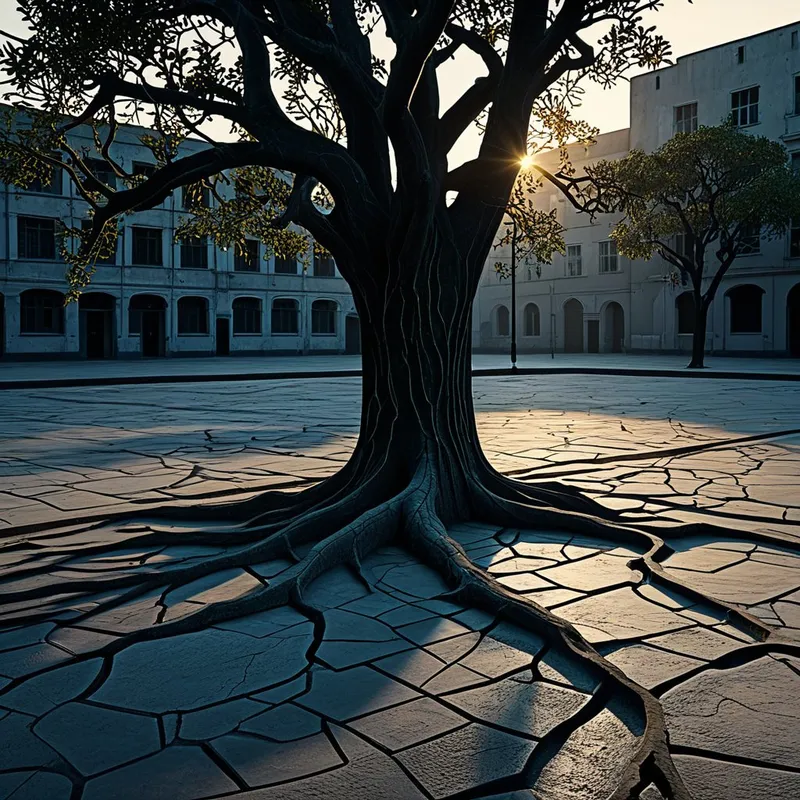
I am standing in the center of a vast, empty concrete plaza. The sky is a featureless gray. With each step I take, the concrete beneath my feet cracks like thin ice, spider-webbing out in all directions. I am not falling through, but I can feel the immense, hollow space below. I am afraid to move, yet standing still feels like a slow sink. In the distance, I see a single, gnarled tree root breaking through the pavement, solid and ancient.
The dream alchemizes the terror of a fragile persona (the cracking plaza) by revealing the enduring, subterranean Self (the ancient root) already at work, pushing through to be recognized.
The False Lead
This theme is not about a run of bad luck, a temporary lack of confidence, or the desire for a predictable routine. To mistake it for such is to confuse the symptom for the disease. A craving for external stability—a secure job, a solid relationship, a fixed schedule—is often the ego’s frantic attempt to plaster over the foundational crack. The dream of grounding is not asking for a better floor to stand on; it is initiating the profound, often terrifying process of becoming the floor. It is the difference between seeking shelter in a house and discovering you must become the mountain upon which the house is built. The instability you feel is not circumstantial; it is structural. The dream does not report on a shaky world, but on a psyche that has outgrown its old foundations and is now suspended in the alchemical solve—the dissolution—before the coagula, the re-forming, can begin.
Psychological Architecture
The work here is the silent, patient labor of the root system. In the language of internal family systems, it is the work of unburdening the Exiles who carry the primal memories of free-fall, of abandonment, of having no container. These are the young parts that learned the world was not safe to stand upon. Managers frantically pour concrete—perfect personas, relentless achievement, rigid control—to create a stable surface, while Firefighters numb the sensation of the hollow below with distraction or intoxication. The individuation process demands we descend, not into the hollow, but into the very substance that borders it. We must dialogue with the earth of our own being: the repressed instincts, the denied emotions, the inherited traumas that we have treated as unstable ground. To ground is not to solidify into rigidity, but to develop a dynamic, living connection to the dark, fertile soil of the unconscious. It is to exchange the brittle, man-made plaza for the complex, messy, and resilient ecology of the forest floor. Stability is then redefined not as immobility, but as a resilient capacity to bend, to sway, to lose leaves in the storm, while the deep taproot holds firm.
Mythic Resonance
Consider the Greek Titan, Atlas, condemned to hold the celestial heavens upon his shoulders for eternity. His is the ultimate burden of false grounding—bearing a weight that is not his own, mistaking the sky for his foundation, his strength perpetually spent preventing a collapse that was never his responsibility. The true myth of grounding is found in Antaeus, the giant son of Gaia, the Earth. His strength was invincible so long as he remained in contact with his mother, the ground. Hercules, understanding this, did not meet him with greater force, but with the intelligence of separation. He lifted Antaeus away from his source, and in that separation, the giant’s power evaporated. The dream of grounding is the Antaeus myth playing out in reverse: we have been lifted, by circumstance, by trauma, by modernity, from our psychic earth, and we are dying of weakness. The task is not to fight the Hercules who holds us aloft, but to remember the touch of Gaia and, with immense gravitational will, demand to be put down.
Symbolic Nodes
- Fracturing Ground: Cracks in floors, earthquakes, sinking sand, breaking ice.
- Deep Roots & Foundations: Ancient trees, bedrock, mountain bases, pylons driven deep into earth, cellars, basements.
- Failed Architecture: Crumbling buildings, collapsing bridges, unstable ladders, wobbly furniture.
- Gravitational Anomalies: Floating away, inability to run or walk effectively, heavy weights, magnets, dense metals.
- Connective Tissue: Bridges (especially stone), tunnels, anchors, chains, mycelial networks, taproots.
Archetypal Resonance
The Ruler Archetype is the sovereign energy most active in this theme, though often in its disowned, shadow form. The Shadow Ruler manifests as the internal tyrant or control-freak, the part that attempts to impose a brittle, fear-based order on a psyche perceived as chaotic and rebellious. It mistakes domination for stability, rigidity for strength. The somatic echo of hollowness is the Shadow Ruler’s kingdom—a realm with a grand facade but no central pillar. The alchemical potential lies in inviting this archetype out of its shadow. The true Ruler does not tyrannize the inner landscape from a place of fear; it embodies the center. It provides the unshakable law of self-respect, the clear boundaries of the sovereign self, and the calm authority that comes from being in right relationship with all parts of the internal kingdom. Grounding is the Ruler claiming its legitimate throne, not through force, but through the inherent, gravitational authority of being the core.
The Alchemical Process
The transmutation here is from the lead of existential anxiety—the free-floating terror of dissolution—into the gold of unassailable inner sovereignty. The required heat is the intense, sustained pressure of conscious descent. It is the nigredo, the blackening, where you must willingly stay with the feeling of having no ground, of the hollow panic, without rushing to fill it with old concrete. This is the alchemical crucible: to feel utterly unsupported and not flee into distraction or false stability. The pressure is the weight of your own awareness applied directly to the wound of rootlessness. In this heat, the false, brittle structures of the persona crack and fall away (calcinatio). Then, in the darkness, a new element begins to precipitate: not a thing you build, but a quality you discover. It is the coagula—the living earth of the Self rising to meet you. The grief of lost false foundations is distilled into the profound, silent knowing that you are, yourself, the foundational principle. The terror of the fall is alchemized into the law of gravity that now works for you, pulling you always back to your own center.

The Integration Protocol
Question 1: In your waking life, where do you feel the most "hollow" or unsupported? Is it in a role, a relationship, or a realm of your inner world? Describe the physical sensation of that hollowness without analyzing its cause.
Question 2: If your current sense of self were a structure, what is it built upon? Is it the approval of others, a title, a memory, an ideal? How deep do those pilings go into the soil of your authentic experience?
Question 3: What one, small, "unimportant" part of yourself have you been treating as unstable ground—an emotion, a memory, a need—that might actually be a nutrient for a deeper root?
Action 1 (Somatic Reclamation): For five minutes each day, stand barefoot. Do not just stand. Feel the exact points of contact. Imagine roots, not of wood, but of light or awareness, descending from your feet, through floors, into the earth. Don't visualize generically; feel the resistance of soil, stone, and clay. Your task is not to draw energy up, but to send your awareness down, like an anchor.
Action 2 (Creative Excavation): Take a large sheet of paper. In the center, draw a simple shape representing your body. Without planning, let your hand draw lines, shapes, and textures outward from the center to represent the "ground" you currently stand on. Is it scribbled, sparse, geometric, chaotic? Then, on a separate part of the page, draw the ground you wish to stand on. Don't draw a scene; draw a texture, a substance, a foundation.
Action 3 (Ritual of the Cornerstone): Find a small, ordinary stone. Hold it and imbue it with a single, simple quality you need in your foundation (e.g., "patience," "presence," "resilience"). Take it to a place that feels significant—your home, a garden, a park. Bury it. This is not a symbolic gesture; it is a contract. You are placing a piece of your conscious intent into the physical world, creating a literal anchor point between your inner and outer reality.
Final Validation
It is a terrifying and lonely thing to feel the world slip away, to discover the ground was not what you believed. This terror is not a sign of failure, but of profound awakening. The psyche only dissolves a foundation that can no longer bear the weight of who you are becoming. The instability is the gift—the brutal, necessary clearing of the site. You are not being abandoned by the earth. You are being asked, with the utmost urgency, to become it. To integrate this dream is to cease looking for a place to stand and to begin the solemn, glorious work of being the place. The mountain does not seek stability; it defines it by its very presence. You are that mountain in the making.