Fate & Destiny: The Soul's Blueprint and the Weight of Authorship
The Somatic Echo
It begins not as a thought, but as a gravity. A deep, tectonic pressure in the chest, a density behind the sternum that feels like a lodestone has been sewn into the flesh. The breath becomes shallow, as if the air itself is thick with implication. There is a pull, a magnetic north in the psyche that tugs at the viscera—a sensation of being oriented toward something vast and inescapable. This is the body’s knowing of destiny: not a glittering promise, but a solemn, physical weight. It is the echo of a pattern not yet fully born, a signature written in the marrow. Alongside it often runs a cold filament of dread, the chill of a door closing somewhere in the labyrinth of possibility. This is the somatic signature of fate: the visceral recognition of a boundary, a limit, a story that seems already inscribed. Together, they create a profound tension—the ache of a path calling you forward, and the terror of a script you did not write.
The Dreamer's Log
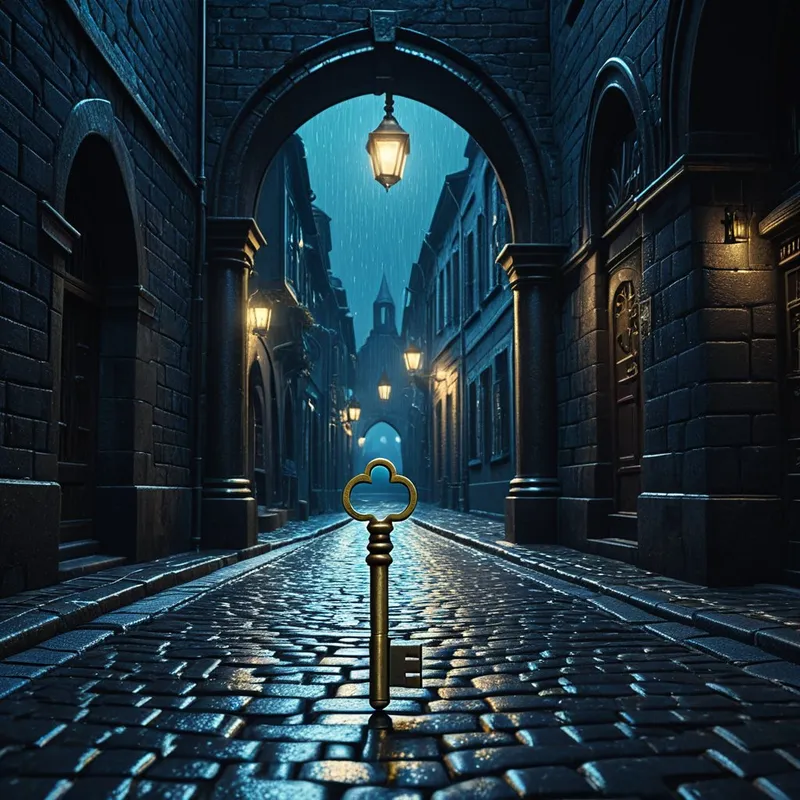
I am walking a familiar city street at night, but the buildings are made of shifting, dark glass. In my hand, I hold a key of intricate, impossible design. I know it opens a specific door that will change everything, but I cannot remember which archway, which alley. The key grows warm, then cold, a pulse against my palm. I am both the seeker and the sought.
This dream is an alchemical map: the key is the innate potential, the prima materia of the Self, and the forgotten door is the moment of conscious recognition where potential must become committed action.
The False Lead
This theme is not about passive fortune-telling or the cheap solace of a pre-written life script. It is the polar opposite of “everything happens for a reason,” a phrase that often sterilizes grief and absolves us of our creative terror. A dream of fate is not a notification of “bad luck” or a cosmic verdict; it is an encounter with the deep, structural patterns of the psyche—the familial legacies, the cultural scripts, the core wounds that shape our choices before we even know we are choosing. Destiny is not a glittering prize at the end of a linear path. It is the relentless, often uncomfortable, call to become the author of a story that only you, in your totality, can tell. To mistake this for mere fortune or misfortune is to remain a character in someone else’s myth.
Psychological Architecture
To engage with this theme is to enter the most profound chamber of Shadow work: the confrontation with your own foundational myths. It asks: What story was written onto your soul before you had language? What destinies were handed to you as inheritance—the unspoken family prophecy to be the caretaker, the rebel, the peacemaker, the success? This is the architecture of the psyche, the load-bearing walls of identity. The dream of fate emerges when this architecture is stressed, when the soul’s own blueprint strains against the inherited design. The process of individuation here is a sacred demolition and redesign. It requires feeling the full weight of the “fated” pattern—the grief of the path not taken, the anger at the presumed script—not to be crushed by it, but to gather its substance. You must metabolize the limestone of expectation to build the cathedral of your own authority.
Mythic Resonance
Consider the Greek Moirai, the Three Fates: Clotho who spins the thread of life, Lachesis who measures its length, and Atropos who cuts it. This is not a myth about helplessness, but about the triune nature of creative power within the self. We are all three sisters: we spin with our thoughts and intentions, we measure with our choices and values, and we cut with our decisions and boundaries. The terror of the myth is the externalization of this profound, internal responsibility. In the Norse web of Wyrd, woven by the Norns, every action is a new thread added to an ever-complexifying tapestry. You are not trapped in a finished web; you hold the shuttle. Your every choice—the uttered word, the withheld action, the courageous no—weaves the pattern anew. These myths are not stories of predestination, but ancient maps of profound, participatory authorship.
Symbolic Nodes
- Keys, Maps, & Compasses: Tools of navigation that imply a specific destination or a code to be deciphered.
- Threads, Webs, & Tapestries: The connective tissue of life, often being woven, measured, or cut.
- Crossroads, Portals, & Thresholds: Points of decisive, irreversible choice.
- Inscribed Objects (Books, Tablets, Scrolls): The “script” or law that appears already written.
- Celestial Bodies (Falling Stars, Aligned Planets): Forces larger than the individual, suggesting a cosmic order or timing.
- Unchangeable Environments (Stone Halls, Infinite Corridors): Landscapes that represent the perceived rigid structure of one’s life.
Archetypal Resonance
The energy of Fate & Destiny resonates most powerfully with The Ruler Archetype in its shadow and sovereign forms. The Shadow Ruler is the internal tyrant who believes in a fixed, hierarchical universe where you are a subject to a cruel or indifferent fate—it manifests as either helpless submission or a desperate, controlling rigidity against the currents of life. The somatic echo of density and dread is the body’s rebellion under this internal tyranny. The alchemical potential lies in the transmutation of this shadow into sovereignty. The true Ruler does not control external events, but establishes benevolent, unshakeable order within the inner kingdom. Claiming your destiny is the ultimate act of rulership: you stop being a subject to a story and become the sovereign author, the one who decrees meaning, establishes inner law, and takes responsibility for the realm of your own existence.
The Alchemical Process
The transmutation here is from Ore of Obligation to Gold of Authentic Authority. The required heat is the unbearable tension between the life you have inherited and the life your soul whispers of. This is the nigredo, the blackening: the depression, the existential grief, the feeling of being trapped in a narrative that fits like a coffin. The pressure is the conscious, daily choice to bear the weight of your own potential—to stop blaming the script, the family, the circumstances. The alchemical fire is lit when you ask, “If this is my fate, what is my response to it?” This question breaks the spell of passivity. You begin to separate the pure metal of your core values from the slag of external expectation. You are not melting down your life, but refining your position within it. The gold that emerges is not a perfect, easy future, but the unassailable, quiet knowledge that you are the source of your world’s meaning. Sovereignty is born in the crucible of that responsibility.

The Integration Protocol
Question 1: Where in my life do I feel a sense of "inescapable" narrative—a role, a path, an outcome—that carries the cold taste of dread or the hollow ring of obligation?
Question 2: If I imagined my life force as a unique thread, what color, texture, and vibration does it have? How does it differ from the threads I feel woven around me by history, family, or culture?
Question 3: What one choice have I been avoiding because it feels "too big" or "too me"? What is the first, minute step toward that choice I could take today?
Action 1 (Sovereign Breath): For five minutes, sit upright with your spine self-supported. As you inhale, feel the breath filling not just your lungs, but the space of your entire personal history. As you exhale, silently decree: "I release what is not mine to carry." Do not analyze, simply feel the somatic shift of releasing a weight you did not choose.
Action 2 (Thread Mapping): Take a large sheet of paper and draw a central, swirling line representing your essential energy. Now, using different colors, draw lines that intersect, wrap around, or run parallel to it—label these with names of inherited stories (e.g., "family duty," "cultural success," "old wound"). Without judgment, observe the pattern. Where does your core thread flow freely? Where is it constricted? This is a visual blueprint of your current relationship to fate.
Action 3 (The Decree Ritual): Go to a threshold—your front door, a park entrance, a bridge. Stand before it. Speak aloud (whisper if you must) a simple decree that claims one piece of your authorship. It could be: "I decree that my worth is not tied to productivity," or "I decree that my creativity has a place here." Step across the threshold. The physical act seals the psychic shift.
Final Validation
To feel the weight of fate is not a sign of weakness, but a testament to your depth. Only a soul capable of bearing the gravity of true authorship would be visited by such dreams. The terror is real, for it is the terror of the sculptor facing the unhewn marble, the writer before the blank page that is a lifetime. This is not a curse, but the most profound invitation you will ever receive. The script you hold is not finished. The hand that writes it can be your own. The key grows warm in your palm not to torment you, but to remind you: you are both the lock and the only thing that can ever turn it.