The Somatic Echo of the Uncharted
It begins not as a thought, but as a sensation. A subtle, cellular hum of anticipation that feels like static on the skin. The breath catches, not in fear, but in a suspended state—the moment before a foot finds purchase on a cliff face you cannot see. There is a hollowness in the stomach, a gravity well of potential. The body knows the territory of the unknown before the mind can name it. It is the somatic echo of a frontier opening within you, a psychic geography where the familiar maps have burned away. This is the visceral prelude to dreams of exploration: a deep, systemic readiness for a journey where the destination is not a place, but a state of being.
The Dreamer's Log
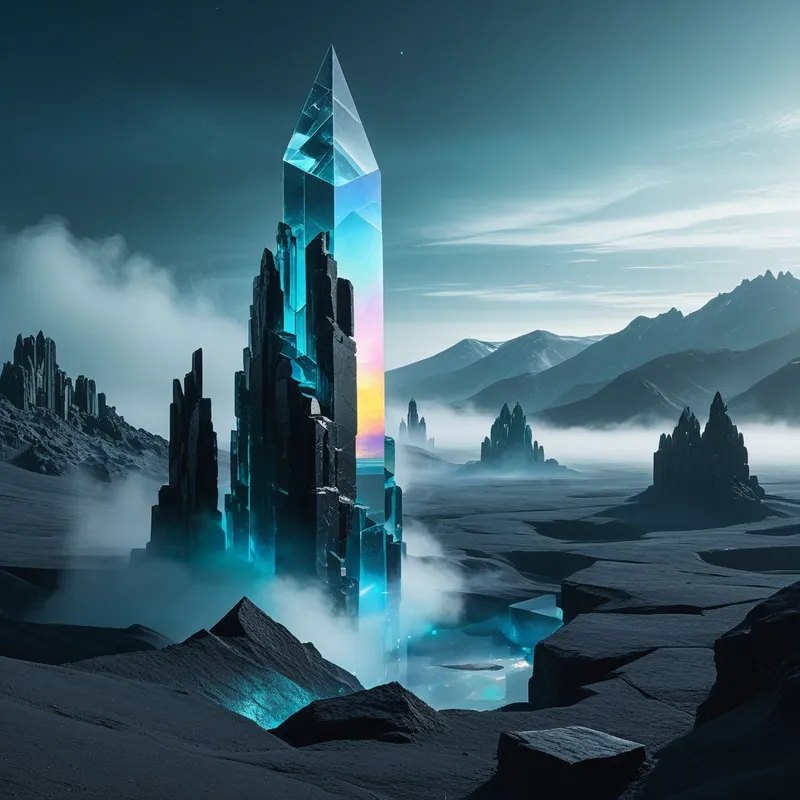
The dreamer stands in a vast, silent archive of impossible scale. The shelves, stretching into a starless dark, hold not books, but spines of glowing, crystalline data. There is no catalog, no guide. A profound knowing settles: one must choose a crystal to interface with, but each choice irrevocably closes a million other doors. The air thrums with the weight of all the stories that will never be read.
This is the alchemy of choice within the infinite: the terror of limitation is the very forge where a conscious self is crystallized from the fog of pure potential.

The False Lead
This theme is not about literal wanderlust or a simple craving for novelty. To mistake the dream’s vast, internal frontier for a call to quit your job and travel is to confuse the symbol for the street sign. It is not an escape from, but a descent into. The anxiety here is not the fear of "bad luck" in a new venture, but the more profound terror of structural dissolution—the feeling that the very ground of your identity is becoming porous, that the "you" who begins the exploration may not be the "you" who emerges. The shadow of this theme is not failure, but eternal, aimless wandering: the psyche lost in its own attic, opening doors that lead only to more doors, never committing to the transformative friction of a single, defining path.
Psychological Architecture: The Dissolution of the Known Self
When you dream of exploring the unknown, you are not a tourist in your own mind. You are a cartographer sent into a region where the old maps—your conditioned beliefs, your comfortable narratives, your "known" personality—are actively dissolving. This is the core of Shadow work within exploration. The unknown you encounter is often the disowned, the unintegrated, the parts of your potential you exiled because they did not fit the blueprint. To walk into that psychic wilderness is to consent to a death. The "you" that was, the sovereign of a small, well-lit kingdom, must relinquish control. This is the individuation process in its rawest form: the conscious ego, our internal ruler, stepping down from its throne to become a student of the vast, uncharted country it once feared to govern. The pressure is the weight of your own unlived life, and the heat is the friction of becoming someone you have never met.
Mythic Resonance
We see this eternal firmware in the story of Inanna, the Sumerian goddess who descends into the underworld, Kur. Her journey is not one of conquest, but of utter stripping. At each of the seven gates, she must surrender a piece of her regalia—her crown, her lapis beads, her royal robe—until she stands naked and bowed before her dark sister, Ereshkigal. This is the mythic truth of exploration: to know the true unknown, you must relinquish the symbols of your known power. You trade sovereignty for vulnerability, and in that nakedness, encounter a deeper, more terrible form of authority. The return journey, the reassembly of the self, is never a simple restoration; it is a transmutation. The crown that is reclaimed is heavier, imbued with the knowledge of the dark.
Symbolic Nodes
Common images in this terrain include: unfamiliar houses (the unexplored architecture of the self), dense forests or jungles (the tangled, organic growth of the unconscious), vast, empty landscapes (the potential space before creation), labyrinths and mazes (the complex, winding path of individuation), locked doors and hidden rooms (repressed memories or potentials), ancient, forgotten technology (dormant psychic functions or innate wisdom), and veils, mists, or thresholds (the liminal space between conscious and unconscious knowing).
Archetypal Resonance
The energy of this theme resonates most profoundly with The Explorer Archetype. The Explorer’s core drive is not to conquer, but to discover; not to possess the territory, but to be transformed by it. This archetype perfectly captures the somatic echo—that restlessness in the blood, the feeling that a truer home exists beyond the horizon of the familiar. Its shadow, the Aimless Wanderer, manifests as the terror of the dream: the paralysis of infinite choice, the refusal to be defined by any single path, which leads to a life of perpetual, ungrounded sampling. The alchemical potential lies in the Explorer’s ultimate discovery: that the most profound frontier is internal, and that by mapping the inner wilderness, one earns a sovereignty no external territory can provide.
The Alchemical Process: From Wanderer to Map-Maker
The transmutation here is from the anxiety of the infinite to the authority of the navigator. The prima materia, the base matter, is the raw, undifferentiated potential of the self—all that you could be, which feels like nothing you concretely are. The heat of the alchemical vessel is the intense psychological pressure of conscious choice within uncertainty. It is the act of choosing one crystalline data-spine in the infinite archive, knowing it negates a million others. This heat burns away the fantasy of having it all, the child’s wish for limitless possibility without consequence. The pressure is the weight of commitment to a path you cannot see the end of. Through this crucible, the vague wanderer is forged into the specific map-maker. You do not eliminate the unknown; you develop an intimate relationship with it. The grief for all unlived lives becomes the fertile soil for the one you are courageously living. Sovereignty is born not from controlling the territory, but from knowing how to move through it with purpose, even when the destination is only a feeling in the dark.
The Integration Protocol
Question 1: In the dream's unknown space, what was the quality of the silence? Was it pregnant with possibility, heavy with dread, or neutrally empty? This tells you your body's true relationship with the unexplored parts of yourself.
Question 2: What single, small item from your known world did you wish you had brought with you? This often points to the core psychological resource or identity you fear losing in the process of change.
Question 3: If the landscape itself could speak one sentence to you, what would it say? Let the unknown itself define its nature, rather than you projecting your fear onto it.
Action 1 (Somatic Anchoring): For five minutes upon waking, do not move. Hold the feeling-tone of the dream in your body. Locate it physically—is it a buzz in the hands, a hollow in the chest? Breathe into that space without trying to change it. This grounds the vast psychic experience in the simple reality of the flesh.
Action 2 (Unstructured Cartography): Take a large sheet of paper. Without thinking, let your hand draw the "map" of the dream's terrain. Use lines, shapes, scribbles—not representational art. Where does the pencil press hard? Where does it hesitate? Label areas with feeling-words, not logical names ("Sea of Static" not "Ocean"). This externalizes the internal geography for your conscious mind to behold.
Action 3 (Threshold Ritual): Physically enact a conscious crossing. This could be walking slowly across a specific bridge, stepping over a crack in the sidewalk with full intention, or lighting a candle to mark the end of your old "day" and the beginning of an intentional evening. As you cross, silently acknowledge: "I choose the path, knowing I cannot see its end." This ritualizes the Explorer's commitment, marrying inner intent to outer, symbolic action.
Final Validation
To dream of the unknown is to feel the foundations of your self tremble. It is deeply, humanly difficult. It asks you to trade the comfort of a familiar prison for the terrifying freedom of an uncharted wilderness. Honor that fear; it is the proof you are at a real frontier, not indulging a fantasy. But know this: the psyche only sends you to maps it believes you are ready to redraw. The anxiety is not a stop sign, but the engine heat required for transmutation. You are not being asked to have all the answers. You are being asked to develop a profound tolerance for the question, to become someone who can stand at the edge of the known, feel the somatic echo of the vastness within, and take the next step not in spite of the darkness, but because your own becoming lies waiting within it. The exploration is the integration. The map is drawn with the footprints of your courage.