
The Dream of Environmental Domination: From Being Ruled to Becoming the Ruler
The Somatic Echo
It begins not as an image, but as a pressure. A density in the air that makes each breath a conscious effort. The body feels not just in space, but pressed upon by it. Shoulders hunch against an unseen ceiling. The jaw clenches against a silent command. This is the visceral signature of environmental domination: the dream-space itself has become an antagonist. The walls are not a container but a compactor. The ground is not a foundation but a trapdoor. The light is not illumination but interrogation. Before any narrative forms, the nervous system registers the core truth: you are not acting within a world; the world is acting upon you. This is the somatic echo of a psyche that has externalized its own most rigid structures, projecting its internal governors onto the very fabric of reality.
The Dreamer's Log
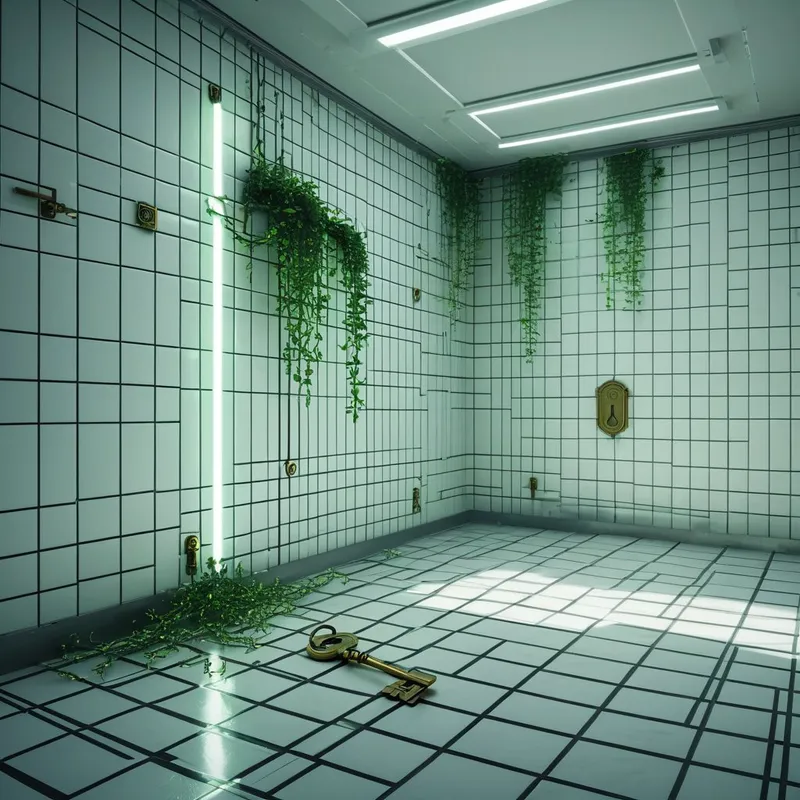
The dreamer finds themselves in a pristine, minimalist apartment. Every surface is white and smooth, every object placed with geometric precision. They try to leave, but the door handle dissolves into the wall at their touch. The windows, which offer a view of a vibrant city, are not glass but seamless, high-resolution screens. A calm, synthetic voice from no discernible source announces, "Ambient optimization in progress. Please resume your designated activity."
Here, the alchemical process is the key that has forgotten it is a key, believing itself to be merely another piece of the locked furniture.
The False Lead
This theme is not a simple dream of bad luck or external obstacles. A flat tire, a missed train, a sudden storm—these are the dramas of circumstance. Environmental domination is the horror of context. It is not that things go wrong within the environment; it is that the environment itself is the agent of wrongness. The distinction is crucial: in the first, you are a character facing a plot point; in the second, you are a specimen in a lab, a prisoner in a panopticon. Misinterpreting this as mere "stress about work" or "feeling trapped in a relationship" misses the architectural scale of the crisis. This is about the operating system of your perceived reality, not the applications running on it.
Psychological Architecture
To dream of a dominating environment is to encounter the shadow of your own internal governance. In the language of Internal Family Systems, these are the legacy "Managers" and "Firefighters" who have grown so powerful, so systemic, that they have ceased to feel like parts of you and have instead become the very atmosphere you inhabit. The relentless optimization of the white apartment? That is the part of you that fears chaos so profoundly it would rather be a prisoner in a sterile cell than a free agent in a messy world. The synthetic voice is the internalized logic of "should" and "must," now speaking with the authority of objective reality.
The individuation process here is a profound deconstruction. It requires you to stop fighting the walls and instead ask, "What in me built this?" The terror is not of the environment, but of the realization that you are complicit in its design. The grief is for the parts of yourself you exiled to maintain this false order. The work is to withdraw the projection, to reclaim that externalized authority from the dream-space and bring it back into the messy, human crucible of your own psyche. You must become the architect of your internal world before you can cease being the prisoner of its externalized blueprint.
Mythic Resonance
We see this eternal drama in the myth of the Minotaur and the Labyrinth. The monster is not merely in the maze; the maze is an extension of the monster's nature, a geometric manifestation of a twisted psyche. Theseus does not triumph by simply slaying the beast; he must first navigate the oppressive, mind-bending architecture, aided by Ariadne's thread—a symbol of conscious connection back to a self that exists beyond the confusing, dominating structure. The labyrinth is the environmental domination; the thread is the nascent awareness that "I" am separate from this system. Similarly, in Kafka's The Castle, the land itself, the bureaucratic village, and the distant, inaccessible authority are a totalizing environment designed to frustrate, obscure, and dominate K.’s every move, reflecting the soul-crushing weight of internalized, impersonal law.
Symbolic Nodes
- Impossible Architecture: Rooms that shift, doors that lead back to where you started, windows that are not exits but screens.
- Synthetic Nature: Plastic plants, artificial sunlight, recorded bird songs—nature stripped of its wildness and used as a control aesthetic.
- Pervasive Surveillance: Unblinking lenses in mundane objects, walls that feel like they are listening, a sense of being constantly graded or assessed.
- Assimilating Materials: Floors that become adhesive, furniture that shapes itself around you to restrict movement, fabrics that feel like living constraints.
- The Unseen Director: A public address system, a disembodied voice, subliminal messages in patterns on the wall—authority without a face.
Archetypal Resonance
The energy here resonates most powerfully with The Shadow Ruler. This is not the Sovereign who creates order for the flourishing of the kingdom, but the Tyrant who creates order as the kingdom, demanding that life contort itself to fit an immutable, rigid blueprint. The somatic echo of pressure and constriction is the Shadow Ruler's grip, mistaking total control for true power. Its core energy is the fear of chaos so absolute that it would rather fossilize life than risk its unpredictable flow. The alchemical potential lies in confronting this tyrant not to destroy it, but to heal its profound terror, transforming its need for external domination into the Sovereign's capacity for wise, internal governance—the ability to hold space for all parts of the self without any one part taking over the whole system.
The Alchemical Process
The transmutation of Environmental Domination is the Great Reclamation. The prima materia is the suffocating projection, the feeling that "the world is doing this to me." The required heat is the unbearable vulnerability of admitting, "A part of me built this world to feel safe." The pressure is the conscious endurance of the chaos that floods in when the rigid structures begin to dissolve.
This is not a gentle process. It is the psychological equivalent of taking a sledgehammer to the internal control room. You must sit in the ruins of your own defensive architecture and feel the raw weather of your own unmanaged emotions—the anxiety the walls were built to contain, the grief the optimization was meant to bypass. The alchemical fire is the willingness to feel utterly lost, to not know the rules, to be a beginner in your own life. From this dissolution, sovereignty is born. It is the realization that you are not the prisoner, nor the warden, but the very ground upon which the prison was built. You are the space that holds it all. The authority you perceived in the environment returns to you, not as a crown of control, but as a humble, steady presence—the capacity to say, "This is my inner experience, and I can be with it."
The Integration Protocol
Question 1: Where in your waking life do you feel a similar, subtle pressure to conform to an invisible, pre-set design? Where do you follow "ambient optimization" instead of your own desire?
Question 2: If the dominating environment in your dream were a part of you—a protector or manager—what is its most desperate, positive intention for you? What catastrophe is it trying to prevent?
Question 3: Imagine you could speak to the very substance of the dream environment (the wall, the floor, the synthetic air). What does it know that you have forgotten? What would it beg you to remember?
Action 1 (Grounding the Echo): For one minute, stand or sit and feel the actual, physical pressure of the atmosphere on your skin. Then, consciously shift your awareness to the pressure your body exerts back against the air, against the chair, against the floor. Practice this subtle reclamation of being an active agent within a mutual field of pressure.
Action 2 (Creative Deconstruction): Draw, paint, or collage your dominating dream environment. Then, on a separate layer or paper, draw the internal "part" or energy that you sense built it. Finally, create a third image where these two drawings are in dialogue or merging in a new way. Do not aim for art; aim for archaeology.
Action 3 (Ritual of Context): Choose a small, routine space you inhabit (a desk, a kitchen counter). For one week, deliberately alter one tiny, "non-optimal" thing about it each day. Move a lamp, leave a book open, place a found object like a stone or leaf in the center. Observe the subtle internal resistance and the subsequent loosening, reclaiming your role as the author of your context.
Final Validation
To have this dream is to feel the weight of a world you did not consciously choose. That weight is real, and the exhaustion it brings is valid. Honor the profound intelligence of a psyche that would rather stage this drama in the theater of dreams than have you live it unaware in daylight. You are not broken for sensing the invisible architecture of control; you are awakening. The very fact that you can dream of the prison means you are not, in your essence, the prisoner. You are the dreamer. And the dreamer, in the end, holds all the keys. The path from being dominated to becoming sovereign begins with a single, rebellious breath within the pressurized chamber—a breath that is wholly, unmistakably, your own.