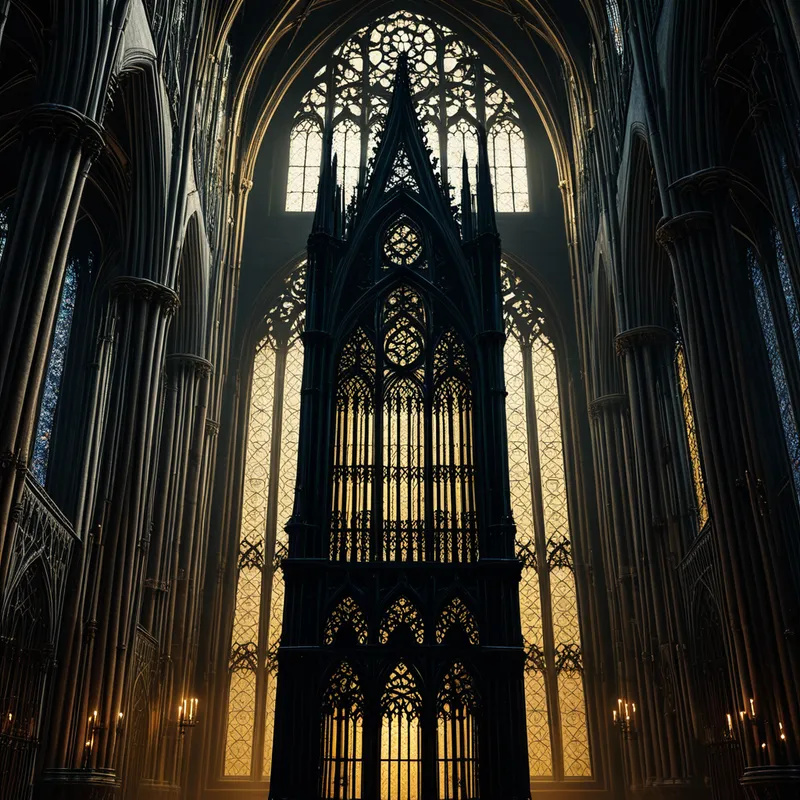
The Unseen Fortress: When Your Dreams Confront Dogma
The Somatic Echo
Before the mind conjures images of stone tablets or stern faces, the body knows. The dream of dogma announces itself first as a specific, visceral pressure. It is not the flutter of anxiety, but a deep, structural ache—a feeling of being encased. The breath feels shallow, as if the ribs have turned to lead. The jaw is tight, a silent keeper of unsaid words. There is a weight in the shoulders, not of burden, but of bearing; the posture of one who has been holding a prescribed shape for too long. This is the somatic echo of an internal architecture grown rigid, a psychic exoskeleton that once offered safety but now only confines. It is the feeling of your own mind sitting in a chair of its own making, unable to rise.
The Dreamer's Log (Case Vignette)
I am in a vast, silent library where every book is bound in identical black leather, without titles. A voice, without source, instructs me that the only truth is here, in this perfect order. I find one book, ancient and different, left open on a lectern. Its pages are blank, but when I touch them, my own handwriting—wild, chaotic, and full of color—bleeds onto the parchment. The silent library begins to hum with a low, disapproving vibration.
Alchemical Interpretation: The dream reveals the moment the psyche’s innate, creative intelligence (the living book) begins to assert itself against the internalized, impersonal system of meaning (the uniform library), initiating the alchemical solve—the beginning of dissolution.

The False Lead
This is not a dream about mere stubbornness or encountering an annoying, rigid person in your waking life. To mistake it for such is to remain on the surface. Nor is it a simple warning of "closed-mindedness." The dream of dogma points to something far more intimate and structural: it is the psyche confronting its own foundational operating system, the invisible laws you did not write but have come to live by. It is not about an external authority, but the internalized principle of authority that has taken root within your own mental family system, masquerading as truth to keep a fragile inner order intact.
Psychological Architecture
The work here is Shadow work of the most profound kind, for the shadow of dogma is not its opposite, but its secret twin: a terrified, orphaned part of the self that traded wild, uncertain freedom for the cold comfort of absolute certainty. Individuation—the process of becoming your undivided self—requires the dismantling of this inner cathedral. You must meet the internal priest, the inner bureaucrat, the ghost of every "should" and "must" that whispers not from love, but from fear. This is not an act of rebellion for its own sake, but of reclamation. You are not destroying a belief; you are differentiating your own living experience from a dead structure that has been using your energy to sustain itself. The grief that arises is real: it is the grief for the simpler world the dogma promised, the clear path it offered. To feel that grief fully is to begin the alchemical separation of the essential from the imposed.
Mythic Resonance
Consider the story of Prometheus, who defied the divine dogma of Olympus to bring the liberating fire of consciousness and craft to humanity. His punishment—to be chained and have his liver eternally devoured—is a perfect somatic metaphor for the cost of internal dogma: the perpetual consumption of one’s vital, regenerative essence by the very structure one serves. In a different vein, the Hindu concept of Maya—the cosmic illusion—is not a lie, but a rigid consensus reality. To see through Maya is not to see nothing, but to see the living fluidity behind the seemingly solid, dogmatic forms of the world. Your dream is your personal Promethean moment, your glimpse behind the veil of your personal Maya.
Symbolic Nodes
- Impersonal Megastructures: Endless identical corridors, featureless towers, vast bureaucratic halls, sterile laboratories.
- Unquestionable Texts: Stone tablets, immutable laws etched in metal, perfect uniform books, scrolling digital text that cannot be altered.
- Silenced or Mechanized Voices: Loudspeakers issuing decrees, mouths sewn shut, people moving in perfect unison, gears and clockwork where hearts should be.
- The Flaw in the System: A single cracked stone, a book with living pages, a wild plant growing through pavement, a silent character who makes eye contact.
Archetypal Resonance
The Shadow Sage is the dominant archetypal energy in the dream of dogma. This is the Sage corrupted, the teacher who has confused the map for the territory, the philosopher who worships the system instead of the truth it was meant to point toward. Its core energy is the rigidification of insight into doctrine, the transformation of open-handed guidance into a closed-fisted rule. The somatic echo of encasement and shallow breath is the direct physical experience of living under the Shadow Sage’s regime within your own psyche. Its alchemical potential, however, is immense: the heat of this confrontation is precisely what is needed to burn away the dogmatic crust and recover the true Sage’s gift—not absolute answers, but the profound, liberating capacity to ask authentic questions.
The Alchemical Process
The transmutation of dogma requires the heat of conscious contradiction. You must willingly hold, in full somatic awareness, the tension between the rigid inner rule and the living, contradictory truth of your own experience. This is the nigredo, the blackening. The pressure is the felt sense of betrayal—first by the structure that promised safety, then by yourself for having believed it. The process is not one of replacement, but of distillation. You are not swapping one dogma for another. You are applying the fire of your own attention to the frozen structure until it melts, separates, and reveals the tiny, precious seed of original need that was at its core—perhaps a child’s need for safety, for order, for love. That seed is the prima materia. You reclaim it, and let the dead, crystalline structure of the dogma fall away as dross. The sovereignty gained is not over others, but over your own meaning-making faculty. You become the author of your inner text.

The Integration Protocol
Question 1: Where in my current life do I feel a deep, visceral tension between what I "know to be true" and what I feel to be true in my body? Not in theory, but in my breath, my posture, my gut?
Question 2: If the internal voice of dogma in my mind had a form—an object, a room, a material—what would it be? What is its texture, temperature, and weight?
Question 3: What tiny, wild, or "unacceptable" thought, desire, or memory does this dogmatic structure exist to keep permanently contained or silenced?
Action 1 (Somatic Grounding): For one week, practice this upon waking: before engaging with any external information (phone, news, plans), place a hand on your chest and stomach. Breathe deeply into the areas that feel most rigid or heavy. Ask inwardly, "What does this know today?" Do not seek an answer in words. Just feel.
Action 2 (Creative Unbinding): Take a large sheet of paper. With your non-dominant hand, draw the "shape" of your internal dogma—let it be abstract. Then, using materials that feel antithetical to that shape (e.g., if it's sharp, use watercolors; if it's heavy, use feathery charcoal lines), deliberately and slowly "disobey" the drawing. Let the new medium interact with, bleed into, or dissolve the original shape. The process is the purpose.
Action 3 (Ritual of Nullification): Write a single, core "law" you realize you have been living by (e.g., "I must be perfectly prepared to be safe") on a small piece of paper. Speak it aloud to hear its sound. Then, through a conscious, deliberate act—burning it, burying it, dissolving it in water—nullify it. Immediately after, perform a simple, sensual act that is its direct opposite (e.g., take an unplanned walk, leave a small task imperfectly done). Note the somatic shift.
Final Validation
It is profoundly difficult to feel the walls of your own mind. To dream of dogma is to be granted a brutal grace: the chance to see the prison from the inside, while you still hold the key. The fear, the grief, the disorientation are not signs of failure, but of the structure’s reality and the magnitude of the work. This is not about becoming a rebel without a cause, but about becoming a sovereign with a heart. The fortress was built to protect something precious and vulnerable within you. Your task is not to rage against the stone, but to finally, gently, go and retrieve that treasure. When you do, the walls, their purpose fulfilled, will begin to turn to sand.