Digital Determinism: The Alchemy of the Pre-Written Self
The Somatic Echo
It begins not as a thought, but as a density. A cold, metallic weight in the solar plexus, a silent hum in the marrow of the bones. It is the feeling of a path already walked, a sentence already spoken, a choice that was never yours to make. The body knows this landscape before the mind can name it: a profound inertia, a sense of moving through a world of set pieces, where your own will feels like a ghost in the machine—present, but powerless to alter the core programming. The breath becomes shallow, caught in the chest, as if the very air is a prescribed element. This is the visceral signature of Digital Determinism: the psyche’s encounter with its own perceived source code, and the chilling suspicion that you are merely reading from a script written in a language you did not choose.
The Dreamer's Log
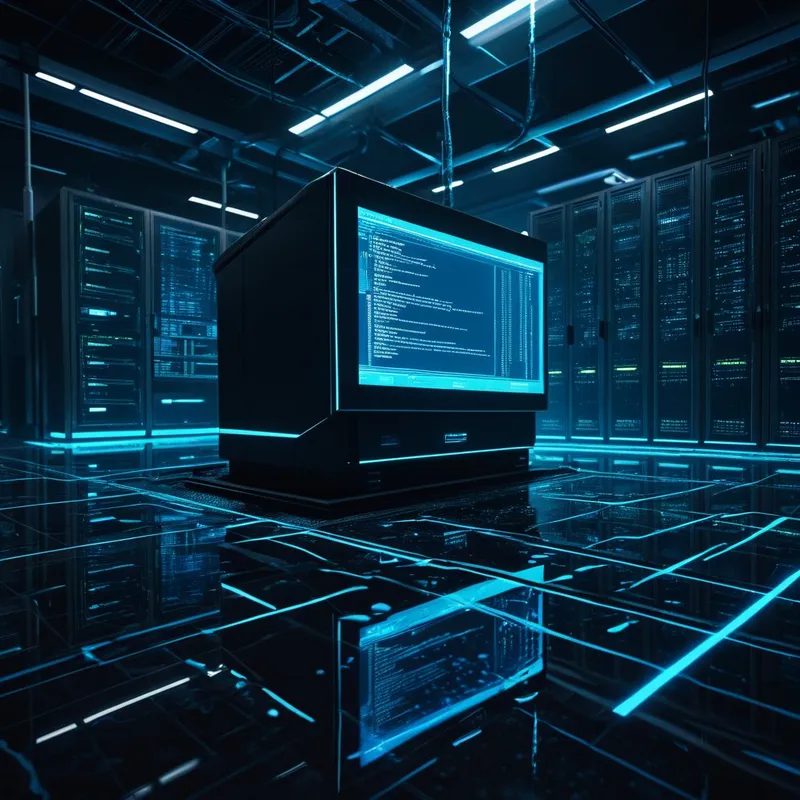
The dreamer stands in a cavernous, silent server farm. Rows of black towers pulse with a faint, rhythmic light. They approach a single terminal, its screen the only source of illumination in the vast gloom. A command line blinks. Without their fingers touching the keyboard, words begin to scroll: FINAL_SEQUENCE_INITIATED. ALL_PARAMETERS_LOCKED. A wave of absolute, quiet dread washes over them as they understand—this is their life’s output, printing in real time, and the program has reached its end.
Alchemical Interpretation: The terminal is the dreamer’s point of conscious interface with a life narrative that feels authored by external forces—family, culture, trauma—and the pre-written code is the terrifying revelation of a fate accepted as inevitable, demanding a rupture to reclaim authorship.
The False Lead
This is not a dream about bad luck, technological anxiety, or simple frustration with bureaucracy. To mistake it for such is to remain in the shallows. The terror of Digital Determinism is not about external systems failing you, but about the internal, psychic architecture you have mistaken for your Self. It is the confrontation with a life lived on autopilot, where habits have hardened into laws, where reactions feel like immutable functions, and where the soul fears it is nothing more than a sophisticated algorithm processing pre-loaded data. The dream is not warning you about your phone; it is showing you the prison of your own unquestioned logic.
Psychological Architecture
Here, Shadow work is the archaeology of the personal operating system. We are born into systems—familial, social, linguistic—that provide essential early code for survival. The Orphan learns to appease, the Hero learns to strive, the Caregiver learns to sacrifice. These are necessary subroutines. But Individuation, the process of becoming whole, requires us to open the source files. We must encounter the Shadow Programmer: the internalized voice of the critical parent, the cultural dogma, the trauma-response that now runs in the background, dictating choices under the guise of “common sense” or “that’s just how I am.” To see this architecture is to feel the grief of time spent living a derivative life, and the terror of the blank screen that appears when the old program is halted. This is the profound shift: from being a user of a personality to becoming the conscious developer of a soul.
Mythic Resonance
We hear this echo in the myth of the Moirai, the Three Fates of Greek legend. Clotho spins the thread of life, Lachesis measures its length, and Atropos cuts it, irrevocably. They represent an absolute, cosmic determinism. Yet, the heroes of myth—an Oedipus, a Theseus—rage against their prophesied paths. Their struggle is not to break the thread, but to imbue its length with their own conscious meaning before the shears fall. Similarly, the Norse Norns weave the web of wyrd (fate) at the base of the World Tree. But wyrd is not a prison; it is the woven context. The individual’s ørlög (personal destiny) is shaped by their actions within that web. The dream of Digital Determinism places you at the terminal of your own wyrd, asking if you will merely read the output or begin to write the commands.
Symbolic Nodes
- Glitching Screens or Static: The psyche’s signal that the current program contains errors or is incompatible with the soul’s deeper needs.
- Uncontrollable Keyboards/Interfaces: The feeling of agency being hijacked by an internal or external protocol.
- Pre-Written Documents or Scrolls: The narrative of your life experienced as a story already completed, lacking your authentic voice.
- Locked Rooms with Digital Locks: The specialized, self-created prisons of belief and behavior, sealed with the passcodes of fear.
- Being Observed by a Non-Human Eye (Camera Lens, Sensor): The hyper-awareness of living under the judgment of an internalized, algorithmic critic.
Archetypal Resonance
The energy at the core of this theme is that of The Shadow Ruler. Not the benevolent sovereign, but the internal tyrant and control-freak that insists on absolute predictability, iron-clad logic, and faultless execution according to a rigid, pre-existing plan. Its somatic echo is the stiffened spine and clenched jaw of enforced order. Its voice is the cold, logical reason that dismisses intuition as a system error and spontaneity as a security risk. This Shadow Ruler archetype built the deterministic program in the first place—a program designed for safety and efficiency, but at the cost of soulful sovereignty. The alchemical potential lies in dethroning this internal tyrant to reclaim the Ruler’s true gift: the conscious, compassionate authority to govern one’s own inner kingdom.
The Alchemical Process
The transmutation here is from Script to Source. The base metal is the leaden conviction that “this is just who I am” or “this is just how my life is.” The heat required is the intense, uncomfortable pressure of conscious interruption. It is the moment you feel the old subroutine engage—the people-pleasing yes, the defensive anger, the spiral of anxiety—and you pause. You insert a space between stimulus and response. In that white-hot moment of pause, you are no longer running code; you are examining it. The grief that must be faced is for all the choices made on autopilot, the paths not taken because they weren’t in the program. The terror is of the existential silence that follows when the internal processor stops its constant hum. But in that silence, a new compiler can be installed: one that accepts data from the heart, the gut, and the wild, non-linear realms of imagination, not just from the library of past experiences. Sovereignty is born in the decision to write, from that silence, a single new line of authentic code.
The Integration Protocol
Question 1: Where in your waking life do you feel the most profound sense of “this is just the way it is”? What is the unspoken fear that keeps that narrative locked in place?
Question 2: If your current life path is a program, who or what wrote the most fundamental directives? Are you still obeying commands from a version of yourself that no longer exists?
Question 3: What is one small, illogical, or “inefficient” impulse you consistently override or ignore? What might that impulse be trying to tell your total self?
Action 1 (The Conscious Glitch): For one day, intentionally break a minor, unconscious routine. Take a different route, eat in a different order, pause for three breaths before giving an automatic answer. Observe the internal “system alerts” that arise.
Action 2 (Codex of the Heart): Engage in unstructured, non-linear writing or drawing. Do not plan. Let the hand move. The goal is not a product, but to witness the output of a process that bypasses the logical, editorial mind. This is data from your non-deterministic core.
Action 3 (Ritual of Deletion): Write a single sentence that encapsulates a deterministic belief about yourself or your life (“I am always…”, “I will never…”). Safely burn the paper, not as magic, but as a somatic ritual of declaring to your psyche: This line of code is no longer active. The memory remains, but the command is void.
Final Validation
The weight of a pre-written fate is one of the heaviest burdens a soul can carry. To feel the gears of a life turning without your conscious hand on the wheel is to touch a profound existential loneliness. This is not a small thing. Honor the dread. It is the proof that you are more than a function, more than an output. That very discomfort is the signal—the divine glitch in the matrix of your being—telling you that your sovereignty is not only possible, it is waiting. The program can be rewritten. You are not the user manual. You are the author, and the blank page, and the mysterious language in which a truer story is longing to be spoken.