
The Dream of Coping: Somatic Blueprints and Alchemical Shields
We do not dream of our coping mechanisms when they are working. We dream of them when they are felt—when the elegant, silent software of survival begins to creak under a load it was never meant to bear in perpetuity. The dream is a somatic echo, a tremor in the deep substrate of the self that arrives long before the mind can form the word “overwhelmed.” It is the body’s log file, reporting a system running ingenious, exhausting code written in a forgotten language of childhood.
The Somatic Echo
Before the image forms, there is a sensation. It is not an emotion, but the architecture upon which emotion is built. It feels like a low-grade hum in the bones, a subtle pressure behind the eyes as if the skull is a sealed chamber. There is a specific quality of fatigue—not the sleepiness of the body, but the gravity of the spirit, a feeling of carrying an invisible, intricate weight. The breath becomes shallow, held not in the lungs but in the cage of the ribs, a held breath that has lasted for years. The jaw is a locked vault; the shoulders, permanent ramparts. This is the embodied signature of a coping mechanism: a brilliant, biological fortification that has, over time, become the very walls of the prison.
The Dreamer's Log
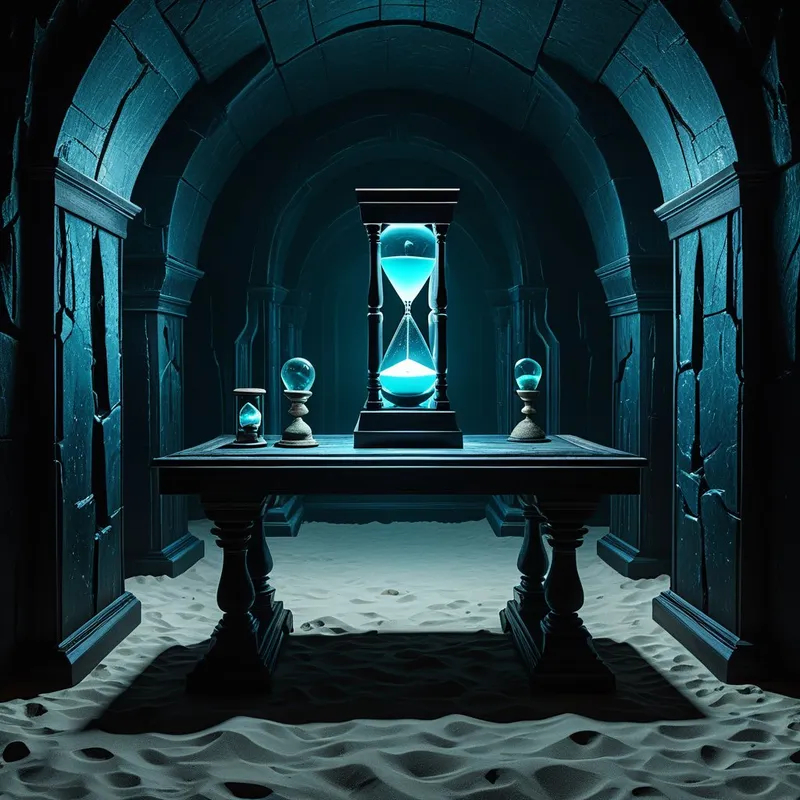
The dreamer stands in a cavernous, silent server room, the walls lined with obsidian monoliths emitting a faint, cold light. On a lone wooden desk in the center rests a beautiful, antique hourglass, but its sand is frozen in a perfect arc, neither falling nor resting. The dreamer’s task is to keep it that way, perfectly balanced, forever, and the hum of the servers is the sound of that immense, suspended effort.
Alchemical Interpretation: The psyche reveals its primary strategy: a magnificent, energy-intensive stasis, where the flow of life itself (the sand) has been arrested to avoid the perceived catastrophe of an ending, a change, or a feeling reaching its natural conclusion.
The False Lead
This theme is not a dream of failure or weakness. To interpret it as such is to mistake the blueprint for the collapse. The dream is not showing you that you are breaking; it is showing you the exquisite, costly design of what has been holding you together. It is not about the content of the trauma or stress, but about the form of the response—the psychic geometry you erected around it. The terror in the dream is not of the external threat, but of the unimaginable void that might exist if this intricate, familiar architecture were to dissolve.
Psychological Architecture
Beneath the conscious personality lies a council of exiles and managers, what some call the Internal Family. The coping mechanism dream is the moment a Manager—a brilliant, tireless part tasked with total control—files a report to the core Self. Its methods, once lifesaving, have become the entirety of the landscape. The Shadow work here is not to storm this inner citadel, but to be invited inside. It is to sit with the exiled part—the raw grief, the primal fear—that the fortress was built to contain. Individuation in this realm is the slow, courageous process of differentiating the Self from its own defenses. It is realizing you are not the fortification, but the living ground upon which it was built. The goal is not to destroy the structure, but to convert it from a military bunker into a observatory, from a shield into a lens.
Mythic Resonance
We see this in the myth of Atlas, condemned to hold up the celestial heavens for eternity. His coping—his immense strength—becomes his entire identity and his punishment; he cannot put the weight down without causing apocalyptic collapse. The dream asks: What heavens have you been holding up, and what catastrophic story do you believe will unfold if you finally shrug? Similarly, in the tale of The Gorgon Medusa, her petrifying gaze was not her nature but a coping mechanism, a divine punishment that turned her into a weapon to preemptively freeze any threat. Her myth asks what we have turned to stone—our own vulnerability, our capacity for connection—in order to feel safe.
Symbolic Nodes
- Frozen or Stuck Objects: Clocks with stopped hands, frozen rivers, gears jammed with sand.
- Impossible Architecture: Staircases leading into walls, doors that open onto brick, rooms with no exit.
- Fragile Containers: Cracked vases holding water by surface tension, overfilled bags, glass spheres under immense pressure.
- Perpetual Motion Machines: Treadmills, hamster wheels, engines running in a void, doing work that leads nowhere.
- Muted or Altered Senses: Trying to scream with no sound, moving through water or syrup, wearing a mask that has fused to the skin.
Archetypal Resonance
The energy here is most purely that of The Shadow Ruler. The Ruler’s gift is to create order, structure, and stability. In its shadow form, this need for control becomes absolute. The coping mechanism is the Shadow Ruler’s masterpiece: a totalitarian internal regime established to manage chaos. Its somatic echo is the rigidity of absolute control—the held breath, the armored posture. Its alchemical potential lies in the Ruler’s true purpose: not to dominate, but to steward. The transmutation occurs when the tyrannical control-freak, faced with the exhaustion of its own regime, surrenders its crown to the true sovereign—the integrated Self—who can govern with compassion, flexibility, and wisdom, turning rigid law into living order.
The Alchemical Process
The alchemy of the coping mechanism is the transmutation of rigid structure into conscious form. The prima materia is the exhausted, automatic defense. The heat is applied through conscious endurance—the willingness to feel the very thing the mechanism was built to avoid, without immediately activating the old pattern. This is the psychological crucible. The pressure is the tension of the pause, the moment between stimulus and your ancient, brilliant response. In that gap, a choice becomes possible. The old structure—the frozen hourglass, the petrifying gaze—is not smashed. It is warmed. It is held in the light of awareness until its components soften. The leaden weight of compulsive control becomes the gold of mindful choice. The shield, molecule by molecule, reorganizes into a window.

The Integration Protocol
Question 1: In the dream, what is the precise nature of the "holding" or "doing"? Is it preventing a flow, maintaining a balance, or enforcing a silence? What is the imagined catastrophe if you stopped?
Question 2: Where in your waking body do you feel the echo of that same held tension, that same vigilant posture? Can you describe its shape, weight, and temperature?
Question 3: If this coping mechanism were a loyal, overworked servant in your inner kingdom, what one sentence of truth does it most need to hear from you, its sovereign, right now?
Action 1 (The Unclenched Moment): Three times today, set a gentle alarm. When it sounds, stop. Do not change your activity, but for one full minute, withdraw all conscious effort from it. If you are typing, let your hands rest. If you are worrying, let the thoughts drift without pursuit. Simply inhabit the pause. Breathe into the space where effort was.
Action 2 (Blueprint Sketch): Without narrative, draw the architecture of your dream. Not the figures, but the structures—the stuck gears, the frozen river, the sealed door. Use only shapes, lines, and shades. Then, with a different colored tool, draw one small, gentle change occurring to that structure. A single grain of sand falling. A hairline fracture of light. Let the image be the dialogue.
Action 3 (The Ritual of Permission): Find a small, natural object—a stone, a leaf, a twig. Hold it and name it as your current coping structure ("You are the frozen hourglass"). Go to a body of moving water—a sink, a shower, a stream. Verbally thank it for its service. Then, with intention, place it in the water and let it go. Witness the water doing what the object could not: moving, flowing, carrying.
Final Validation
It is profoundly difficult to look with compassion upon the dream-self who is building fortresses in the dark, who is holding up the sky with bleeding hands. We want to shout instructions, to force a surrender. But the dream comes not to shame the architect, but to honor the ingenuity of a soul that learned to build a world in order to survive one. Your exhaustion is real. The weight is real. And so is the living ground beneath your feet, which does not need to be held up, but only to be stood upon. The integration begins not when the walls fall, but when you, from within them, remember you are also the sky they were built against.