The Dream of Control: A Call to Sovereignty
The Somatic Echo
It begins not as a thought, but as a texture in the body. A low-grade hum in the solar plexus, a subtle tightening of the jaw, a phantom weight on the shoulders. It is the sensation of a system running a background process, a silent, desperate scan for stability in a world that feels perpetually on the verge of tilting. The breath becomes shallow, held hostage by an invisible vigilance. This is the somatic echo of control-seeking: the body’s pre-linguistic confession that it feels the ground is not solid, that the self is not yet its own true home. It is the physical memory of a time when safety was conditional, when love was a transaction, when survival depended on reading the room with a precision that left no room for error. The mind will later construct elaborate narratives—plans, worries, lists—but first, the body knows. It knows the ache of a kingdom without a king, a ship without a hand on the helm.
The Dreamer's Log
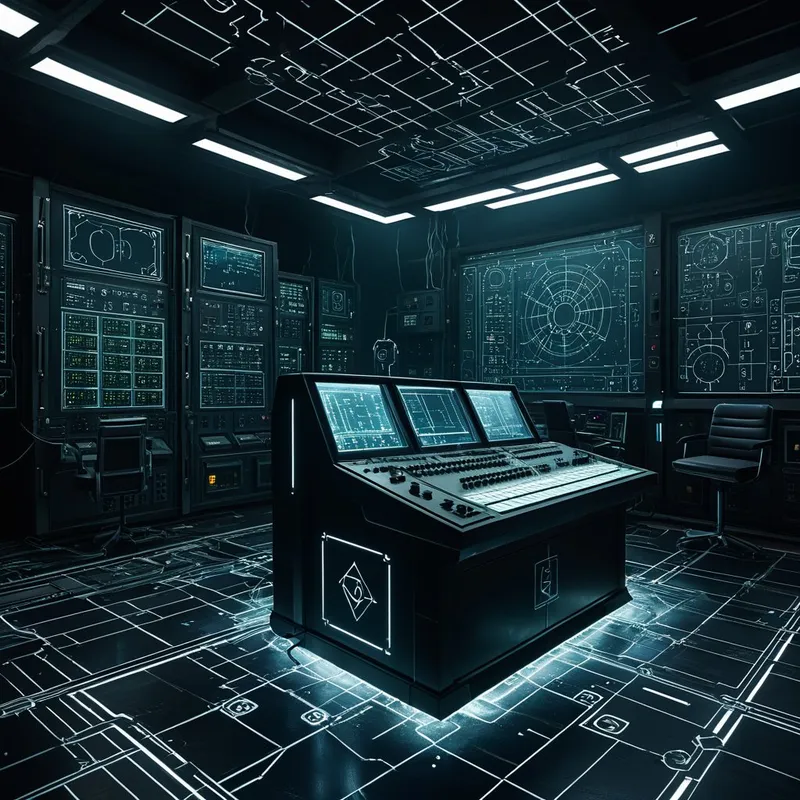
The dreamer stands in a vast, dim control room, walls lined with flickering glass terminals streaming data they cannot comprehend. Their fingers fly over cold, unresponsive keys, trying to input a command—any command—to stabilize the chaotic readouts. A single, critical wire has come loose from its port, snaking across the floor into shadow. The more they type, the more the screens glitch into static.
This is the alchemy of the unplugged cord: the frantic search for external levers reveals the one, simple, internal connection that has been severed.
The False Lead
This theme is not about mere organization or healthy agency. To mistake it for such is to confuse the lighthouse for the storm. The control we seek in these dreams is not the confident hand of a captain charting a known course, but the white-knuckled grip of a passenger on a runaway train. It is not about building a life, but about fortifying a prison of predictability against the terrifying specter of the unknown, the spontaneous, the truly alive. It is a defense against grief—the grief of lost innocence, of betrayal, of a world that refused to conform to our childhood maps. The dream is not critiquing your to-do list; it is illuminating the terror that lives beneath it, the silent belief that without total management, everything will collapse.
Psychological Architecture
Beneath the dream of frantic typing and broken systems lies a profound structural shift within the psyche’s inner family. The part that seeks control—let’s call it the Steward—is not a villain, but a traumatized guardian. It was born in a moment of rupture, when the native, trusting self (the Innocent) was met with chaos or neglect. The Steward made a vow: Never again. It took up the mantle of micromanaging reality, policing emotions, and forecasting disaster, all in a desperate bid to protect the vulnerable inner children from further pain.
The Shadow work here is to thank this exhausted Steward for its service, and then, with immense compassion, to relieve it of duties it was never meant to carry alone. The individuation process is the slow, often painful, reintegration of the exiled parts the Steward has been trying to manage: the spontaneous Joy, the rightful Anger, the helpless Grief, the wild Creativity. Sovereignty is not achieved by the Steward’s victory, but by its integration. It is the moment the internal system moves from a rigid hierarchy—a terrified ruler commanding frightened subjects—to a fluid council, where each part has a voice, and the central, conscious You learns to hold the space, not dictate the terms.
Mythic Resonance
We see this drama etched in the oldest stories. Consider the myth of King Midas. His wish for the golden touch was the ultimate control-seeking spell: a guarantee that everything he contacted would conform to his will, becoming a static, unchanging, and valuable version of itself. The tragedy was not the wish itself, but its unconscious totality. He sought to control the nature of reality, to make it permanently secure and brilliant, and in doing so, he lost the very essence of life—the warmth of his daughter, the taste of food, the fluid, messy beauty of the organic world. His dream became a nightmare of sterile control, showing us that sovereignty lies not in transmuting the world to our image, but in relating to it in its true, often uncontrollable, form.
Symbolic Nodes
- Malfunctioning Machines or Interfaces: Glitching screens, unresponsive controls, broken steering wheels.
- Futile Repetitive Tasks: Trying to lock a door that won’t stay shut, filling out forms that blur, chasing something that always eludes grasp.
- Architectural Instability: Shifting floors, crumbling walls, elevators moving sideways.
- Lost or Ineffective Tools: Keys that don’t fit, phones with dead batteries, weapons that turn to rubber.
- Being the Unheard Authority: Shouting orders in a silent room, conducting an orchestra that plays its own tune.
Archetypal Resonance
The energy at the core of this theme is that of The Shadow Ruler. This is not the mature Sovereign who governs with wisdom and order for the benefit of the whole kingdom, but the Tyrant or Control-Freak, gripped by the terror of chaos. Its somatic echo is that rigid jaw, that held breath—the body armoring itself against perceived insurrection from within and without. Its core motivation is a desperate, fear-based imposition of order, mistaking domination for leadership and rigidity for strength. The alchemical potential here is immense: to subject this shadow to the heat of conscious awareness is to begin the transmutation of anxious tyranny into authentic, embodied sovereignty. The Shadow Ruler must be dethroned so that the true Ruler can ascend—not to a fortress, but to a throne at the center of a living, breathing, and sometimes wonderfully unpredictable realm.
The Alchemical Process
The transmutation of control-seeking into sovereignty is an alchemy of surrender—not to external forces, but to internal truth. The required heat is the unbearable tension of not acting, of staying present with the anxiety, the helplessness, the grief that the control mechanisms were built to avoid. It is the pressure of allowing a system to glitch, a plan to fail, an emotion to erupt, without immediately rushing in to fix, manage, or suppress it.
This is the solve et coagula of the soul: first, you must dissolve the rigid structures of the false self, the obsessive plans and preemptive strikes. You allow the old, brittle kingdom of control to crack. Then, from that fertile rubble, you coagulate a new order—not one built on fear, but on conscious choice, flexible response, and deep trust in your own capacity to meet what arises. The base metal of anxiety is not discarded; it is the very ore. In the furnace of conscious attention, its energy is purified and reshaped into the gold of inner authority—the ability to respond from a center that is fluid, aware, and unshakably your own.

The Integration Protocol
Question 1: Where in my waking life do I feel the "low-grade hum" of vigilance? What specific situation, relationship, or internal thought-trigger feels like it requires my constant mental management to prevent collapse?
Question 2: If the frantic part of me that seeks control (the Steward) could speak, what is its deepest, most fearful prophecy? What does it believe will happen if it stops managing everything for just one day?
Question 3: What tiny, beautiful, or messy thing have I recently prevented, avoided, or sanitized in the name of maintaining control? What was the genuine life or feeling I was trying to quarantine?
Action 1 (The Pause Protocol): Next time you feel the somatic surge of anxiety (the jaw tightens, the breath shallows), stop. Do not think. Do not plan. Set a timer for 90 seconds. For that time, do nothing but feel the physical sensations in your body without labeling or changing them. This is the practice of allowing the system to glitch without input.
Action 2 (Creative Surrender): Take a blank page and a drawing tool. Set an intention to draw "control." Then, deliberately surrender control of the outcome. Use your non-dominant hand. Close your eyes. Make a mess. Let the lines be awkward, the shapes nonsensical. The goal is not art, but to physically enact the release of the Steward's grip and witness what emerges from the unmanaged space.
Action 3 (Ritual of the Unplugged Cord): Find a small, broken, or obsolete electronic item (a wire, a dead remote, an old cable). In a quiet moment, hold it. Acknowledge it as a symbol of a system you have been trying to force into operation. Then, with conscious ceremony, dispose of it—bury it, place it in recycling, or set it aside in a "relics" box. As you do, internally state: "I release my need to force connection here. I trust a more authentic circuit to emerge."
Final Validation
It is profoundly difficult to feel the ground move beneath you. The impulse to grasp, to plan, to fortify is not a character flaw; it is the ancient, intelligent cry of a soul that learned, too well, how to build walls against the storm. Honor that intelligence. And then, dare to listen for the quieter, deeper call beneath it—the call of the sovereign who does not need to control the storm, because they have learned to build a self that can stand, centered and awake, in the midst of its awesome, liberating fury. The control you sought outside was always a misplaced map. The territory, wild and whole, is waiting within.