
The Dream of Control & Limits: An Architecture of the Psyche
The Somatic Echo
Before the image forms, the body knows. It is a specific, hollow tension—a held breath in the solar plexus, a subtle clenching in the jaw as if bracing against an invisible pressure. The shoulders feel the phantom weight of an unseen yoke. Sometimes, it manifests as a cold, metallic taste at the back of the tongue, the flavor of a system pushed to its limit. This is not the adrenaline of fear, but the deep, systemic hum of a structure under strain. It is the somatic echo of a boundary being tested, a law of your inner universe whispering that it is nearing its tensile strength. The dream arrives not to announce a breakdown, but to conduct a stress test on the very frameworks you call self.
The Dreamer's Log
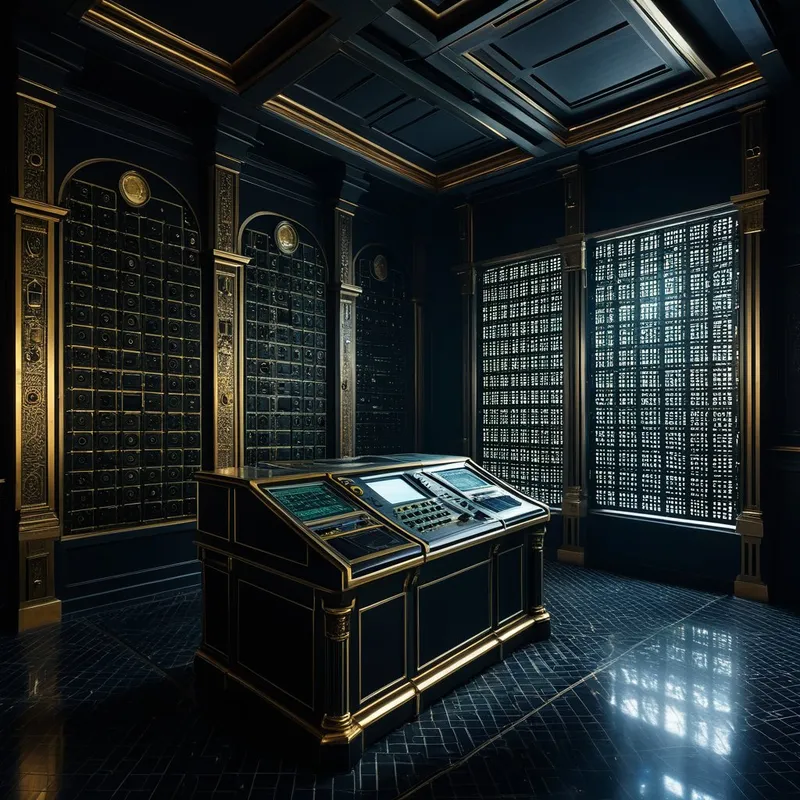
You stand in a cavernous, dimly lit control room. Walls of dark, dormant screens reflect no image. In the center of the room, on a dais of polished obsidian, sits a single, ornate brass lever. You know, with dream-certainty, that pulling it will set a vast, unknown machinery into motion. You reach for it, your hand closing around the cool metal, and pull with all your might. It does not budge. It is not stuck; it is simply a sculpture, a beautiful, useless artifact disconnected from any system.
The dream alchemizes the illusion of agency, revealing that the lever we clutch is often just a symbol, while the true machinery of our lives operates on laws we have yet to comprehend.
The False Lead
This theme is not about external misfortune or simple frustration. A dream of a missed train or a broken tool speaks to anxiety, not to the architecture of Control & Limits. The core here is structural, not situational. It is the difference between hitting a red light and discovering the steering wheel in your car is not connected to the wheels. The former is an event; the latter is a revelation about the fundamental operating system. Do not mistake the terror of a collapsing bridge for the grief of a traffic jam. One is about the failure of a perceived law of physics; the other is merely an inconvenient rule of the road.
Psychological Architecture
To dream of control is to encounter the Shadow of your own sovereignty. The psyche, in its wisdom, constructs internal governments—rules, hierarchies, and automated processes to manage the chaos of being. We have an inner Ruler, a Magistrate, a Systems Administrator. In waking life, this is necessary. In dreams, this architecture is made visible, and its limits are tested. The shadow work here is to depose not the ruler, but the tyranny of the blueprint. It is to realize that the prison you feel is not built of external walls, but of the very beams and rivets you installed for safety. The individuation process demands you become the architect of your own containment, and then, consciously, its alchemist. You must feel the grief of the limit—the "I cannot, I must not, it is not possible"—not as a final verdict, but as the raw ore of a new possibility. The boundary is not the enemy; it is the crucible.
Mythic Resonance
Consider the tale of Sisyphus, condemned by the gods to roll a boulder up a hill for eternity, only to watch it roll back down. The common interpretation is one of futile punishment. But seen through the lens of Control & Limits, Sisyphus is the ultimate systems operator. His limit is not the weight of the stone, but the immutable law of his universe: the stone will fall. His entire existence is defined by operating within that absolute parameter. His rebellion and his punishment are fused into a single, eternal process—a perfect, terrible system. His dream would be of a lever that changes the law of gravity itself. Our dreams ask us: what is our personal, Sisyphean law? And what would it mean to stop fighting the boulder, and instead question the hill?
Symbolic Nodes
- Frozen Levers, Unresponsive Buttons, Dead Control Panels: The interface of will that yields no output.
- Impenetrable Walls, Unclimbable Fences, Endless Corridors: The geometry of a limit made manifest.
- Broken Tools, Useless Keys, Maps That Refold Themselves: The failure of known methods and technologies of navigation.
- Gravity Shifts, Time Loops, Altered Physics: The fundamental rules of the dream reality itself becoming fluid or oppressive.
- Being a Passenger, Not the Driver: The visceral experience of agency removed.
Archetypal Resonance
The Shadow Ruler is the archetypal energy most active in this theme. Its core energy is the obsession with order devolved into tyranny, the need for sovereignty twisted into a desperate, brittle control over all variables. This resonates perfectly with the somatic echo—that clenched, bracing tension is the Shadow Ruler's body, armoring itself against the chaos it fears. The alchemical potential lies in the fire of its own failure. When the control panel goes dark, when the lever comes off in your hand, the Shadow Ruler's paradigm shatters. This is the necessary death that allows the true, integrated Ruler to emerge—not as a controller of events, but as a sovereign who can hold the tension between order and chaos, who can design systems that are living, adaptable, and ultimately, in service to the soul's expansion, not its confinement.
The Alchemical Process
The transmutation of Control & Limits is the Great Dissolution of the Blueprint. The intense psychological heat required is the sustained, conscious endurance of helplessness. Not the passive victimhood of the Orphan, but the active, searing surrender of the Magician who realizes his spells are only affecting himself. You must sit in the control room with the dead screens and not leave. You must feel the full, terrifying weight of the disconnected lever. This pressure cooks away the illusion that sovereignty is about command-and-control. The base metal of "I must be in charge" is heated until it liquefies into the raw experience of "I am subject to." From this molten state, the gold is precipitated: a sovereignty based on response-ability. True power is not in forcing the lever to work, but in understanding the entire room, the nature of the dais, and eventually, walking outside to discover you are not in a control room at all, but standing under an open sky. The limit, fully embraced, becomes the horizon.
The Integration Protocol
Question 1: Where in my waking life do I feel the most hollow, metallic tension—the sense of pushing against an immovable system? Is this system external, or is it an internal law I have unquestioningly accepted?
Question 2: If the lever in my dream is disconnected, what is the true source of motion or change in the scenario it represents? What unseen forces or deeper laws are actually at play?
Question 3: What would happen if I stopped trying to fix the control panel and instead simply observed the quality of the darkness on the screens? What wants to emerge from that void?
Action 1 (The Grounding Surrender): For five minutes, sit or lie down and focus only on the sensations of gravity. Feel the weight of your body being fully supported by the earth or chair. Do not try to relax; simply notice the absolute, non-negotiable law of this pull. You are not controlling it; you are being held by it. Breathe into that reality.
Action 2 (The Blueprint Burn): Take a piece of paper and draw the most absurd, inefficient, Rube Goldberg-esque machine or flowchart you can imagine for achieving a simple goal in your life (e.g., "Making Tea" or "Starting My Day"). Let it be convoluted, with unnecessary levers and gates. This externalizes the often-byzantine internal systems we mistake for necessary control.
Action 3 (The Ritual of the Useless Tool): Find a small, broken, or purely decorative object—a old key, a dead remote, a costume jewelry ring. Place it on your altar or a windowsill. For one week, each time you see it, acknowledge one "lever" in your life that you have been straining against, and consciously release the strain for that moment. Let the object be a monument to surrendered effort.
Final Validation
It is profoundly difficult to have the foundation of your will questioned in the sanctum of your own sleep. To feel your most reliable tools turn to props is a unique kind of grief. Honor that disorientation. It is the sign of a psyche courageous enough to audit its own governance. These dreams are not failures of your spirit; they are its most advanced diagnostics. The limit you encounter is not a cage, but the exact contour of your current self. And a contour, by its very nature, defines a shape that is ready to grow. Your sovereignty awaits not in mastering the old controls, but in daring to inhabit the vast, unprogrammed silence that comes when they finally, mercifully, go dark.