The Alchemy of Pressure: On Dreams of Containment and Release
It begins not as a thought, but as a felt geometry. A tightening in the solar plexus, a subtle clenching of the jaw that has become so familiar it feels like bone. It is the somatic echo of a silent, internal architecture—a pressure vessel holding something vital, volatile, or vast. You carry this vessel within you. Its walls are made of unspoken words, unwept tears, unlived potentials, and the polite agreements that keep the world from crumbling. To dream of containment and release is to feel the very seams of this vessel strain against its contents. The body knows the truth long before the mind can articulate the dream of the locked room, the rising flood, the cage with the open door.
The Dreamer's Log
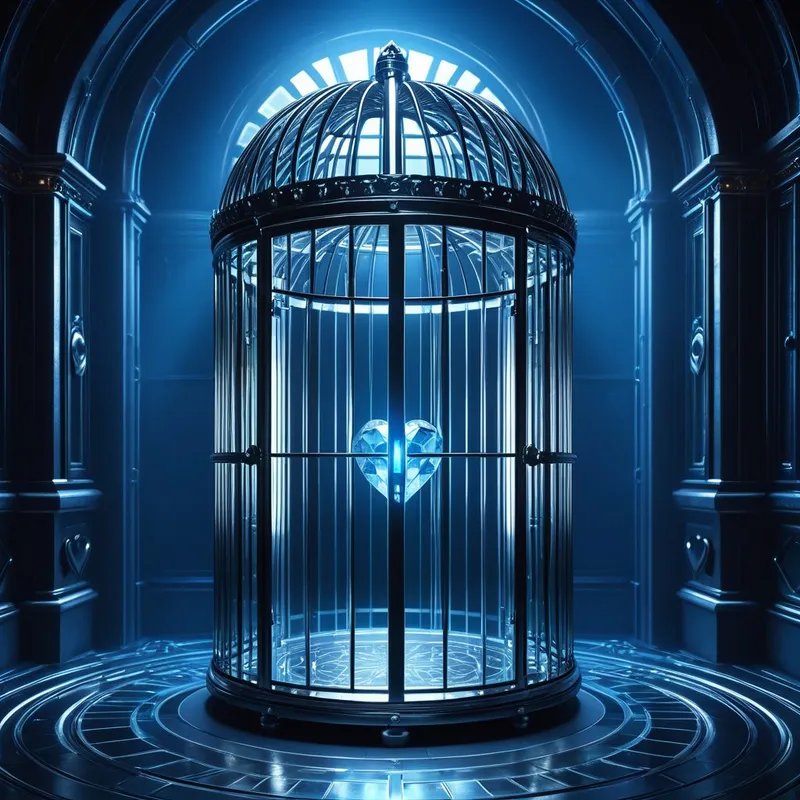
The dream is always the same: I am in a vast, sterile facility of polished chrome and silent corridors. I find my way to a secure vault. Inside, on a pedestal, sits a small, ornate silver cage. Within it, a pulsing, heart-like crystal of deep blue light. I know, with absolute certainty, that I must not open the cage. But my hand, moving as if guided by a will not my own, reaches for the latch. As my fingers touch the cold metal, I wake, my own heart hammering against my ribs.
Here, the alchemy is clear: the conscious mind (the sterile facility) has safely housed a core emotional truth (the blue crystal), but the soul’s imperative for integration is now overriding the command for containment.
The False Lead
This theme is not about mere circumstance—a bad job, a difficult relationship, a spell of “bad luck.” Those are the external costumes the drama wears. To mistake the costume for the actor is to remain forever in the audience of your own life. The containment is internal, structural. The release is not an escape from something, but the integration of something. It is not about blowing up the dam, but about understanding why the river was held back in the first place, and learning to channel its power.
Psychological Architecture
The work here is the shadow work of sovereignty. It involves confronting the internal warden—the part of you that believes you are not ready, that the world cannot handle your full intensity, that your grief is too vast or your joy too disruptive. This warden is not a villain; it is a protector, a legacy of old survival strategies. Individuation demands we thank this protector for its service, and then, with great respect, relieve it of its duty. The process feels like a civil war within the internal family system: the Rebel clamors for freedom, the Orphan fears the exposure, the Ruler insists on control, and the Sage whispers that both the cage and the key are constructs of the same mind. To hold this tension without acting out or collapsing is the crucible.
Mythic Resonance
We see this in the story of Pandora, often simplified to a tale of unleashed evils. Look deeper. Zeus gives Pandora a sealed pithos—a large storage jar, a container—not as a gift, but as punishment for humanity. Her curiosity, her inability to abide the sealed unknown, compels her to open it. All the world’s sufferings fly out. But at the bottom, forgotten in the rush to label her act a catastrophe, remains Elpis—Hope. Not naive optimism, but the enduring, resilient capacity to face what has been released. The myth is not about the folly of opening the jar; it is about the necessity of enduring the contents to find the transformative element hidden beneath the chaos. The true containment was the illusion that life could be sterile and safe. The true release was the acceptance of a complex, suffering, yet hope-anchored reality.
Symbolic Nodes
- Cages, Jars, Vaults, Dams, Wombs: The structure of containment itself.
- Floods, Volcanic Eruptions, Explosions, Burst Pipes: The chaotic, overwhelming mode of release.
- Keys, Broken Locks, Unlatched Doors, Melting Walls: The mechanism of transition.
- Swelling Fruits, Pregnant Animals, Overfilled Cups: The pressure of imminent, organic release.
- Silent Screams, Gagged Mouths, Muted Sounds: Contained expression.
Archetypal Resonance
The energy of this theme resonates most powerfully with The Rebel Archetype. Not its shadow aspect of wanton destruction, but its pure form: the sacred destroyer of outworn structures. The Rebel’s somatic echo is that precise tension—the coiled spring, the held breath before the cry. It does not seek anarchy for its own sake, but revolution for the sake of authenticity. Its alchemical potential lies in its terrifying, necessary function: to apply precisely the right amount of force to the fault line in the internal prison wall. The Rebel is the archetype that honors the pressure within the vessel as a truth-teller, and whose ultimate act is not demolition, but the careful, deliberate creation of an opening where before there was only solid wall.
The Alchemical Process
The transmutation here is from pressure to presence. The contained material—be it rage, creativity, grief, or love—is a potent prima materia. The alchemical heat is applied not by avoiding the pressure, but by turning toward it with focused awareness. It is the heat of honest self-confrontation: What have I walled away? Why did that seem necessary? What part of me still believes I am not safe enough to feel this fully? This introspection is the furnace. The pressure of the unanswered question, the unfelt feeling, builds until the old container—the identity built around “the one who holds it together”—can no longer hold. The release is the solve, the dissolving of that old form. The integration is the coagula, the reforming of a self that can contain these energies consciously, as a channel, not as a prisoner. Sovereignty is born when you are no longer the warden or the inmate, but the architect of the entire facility.
The Integration Protocol
Question 1: Where in my body do I feel the most constant, familiar tension or numbness? If that sensation had a voice, what one word is it holding?
Question 2: What is one old agreement I am still keeping—with my family, my culture, or a past version of myself—that now feels like a cage? What would break if I stopped?
Question 3: Imagine the thing I have contained finally, safely, released. Does it feel more like a destructive flood, or a nourishing river? What is the difference?
Action 1 (Somatic Mapping): For one week, carry a small notebook. Each time you feel that familiar clench of anxiety, frustration, or stifling, do not analyze it. Instead, immediately draw a simple, abstract shape on the page that represents the sensation. Let the pressure move through your hand onto paper as form, not thought.
Action 2 (Voice of the Vessel): Set a timer for 10 minutes. Write a letter from the thing that feels contained (the grief, the anger, the wild idea). Let it speak. Do not write about it. Let it complain, plead, rage, or sing. Use its voice, not yours. Burn or bury the letter as a ritual of acknowledgment.
Action 3 (Controlled Breach): Identify one microscopic, safe expression of the contained energy. If it’s anger, perhaps yell into a pillow for 60 seconds. If it’s stifled creativity, make a deliberately “bad” and messy drawing. If it’s grief, allow yourself to watch a film that makes you cry. Create a tiny, ritualized outlet to prove to your internal system that release can be survivable, even sacred.
Final Validation
This work is not for the faint of heart. To feel the walls of your own making, to hear the murmur of what you have silenced, requires a courage that is often quiet and always profound. The terror of the flood is real. The grief for the collapsed dam is real. But so is the truth waiting in the water: that you are not the fragile vessel, but the very force of the river. The containment was a lesson in power. The release is the practice of flow. You were never meant to live forever in the silent vault. You were meant to learn its secrets, and then, with the key you forged in the dark, step out into the unbearable, brilliant light of your own unbound sky.