The Dream Theme of Conscience: Forging the Inner Law
The Somatic Echo
Before it speaks, it tightens. A fist in the solar plexus, a cold stone in the gut. It is the body’s ledger, a ledger written not in ink but in tension. The jaw clenches to hold back a confession the mind has already made. The shoulders hunch under a weight no one else can see—the phantom burden of a transgression, real or imagined. This is the somatic echo of conscience: a deep, pre-verbal knowing that something within the system is out of alignment. It is not the sharp pain of a fresh wound, but the dull, persistent ache of a bone that healed wrong. It is the body remembering what the ego wishes to forget, a physiological memory of a fracture in your own integrity. You feel it as a hollow behind the ribs, a space where your breath catches, as if the air itself is waiting for an apology you have yet to formulate.
The Dreamer's Log
I am in a narrow, rain-slicked alley at night. I am holding a heavy, ornate brass key that feels both foreign and familiar. Before me is a locked, rusted iron door, covered in indecipherable glyphs. I know I must open it, but a profound dread tells me I am not the one who locked it, yet I am the only one who can—and must—unlock it.
This dream is an alchemical summons: the key is the nascent, integrated conscience, and the act of turning it in the rusted lock is the terrifying, necessary process of assuming responsibility for a truth you did not create but now must hold.

The False Lead
Conscience is not the voice of external morality, nor is it merely the ghost of parental disapproval echoing in an empty hall. It is not a simple alarm for “bad behavior.” To mistake it for these is to remain a child in a courtroom of your own making, forever on trial before a judge whose face you refuse to see. This theme is not about the superficial guilt of a social faux pas or a white lie. It is the profound, structural signal that your internal governance—the sovereign law of your own being—has been breached, ignored, or is yet to be fully written. It points not to a mistake, but to a foundational misalignment.
Psychological Architecture
To engage with conscience is to enter the deepest chamber of Shadow work. Here, you do not battle monsters; you audit accounts. You meet the exiled parts of yourself—the one who cut a corner, the one who remained silent when they should have spoken, the one who took more than was given, or gave more than was theirs to give. This is the Internal Family System of the soul laid bare. The “Manager” parts that rigidly enforce brittle rules, the “Firefighter” parts that numb the pain of dissonance with distraction or blame, and the wounded “Exiles” who carry the raw shame—all must be witnessed. Individuation here is the slow, painstaking process of moving from a psyche governed by reaction and compensation to one governed by a conscious, self-authored code. It is the shift from being haunted by guilt to being informed by integrity. The grief is for the simpler self you must leave behind, the one who could plead ignorance. The terror is in realizing you are now both the lawmaker and the citizen, accountable to yourself above all others.
Mythic Resonance
This universal firmware runs deep in our stories. Consider the myth of Orestes, who, after avenging his father by killing his mother, is pursued not by external police, but by the Furies—chthonic goddesses of conscience made manifest. Their torment is not punishment from the gods, but the eruption of his own shattered inner law. His resolution comes not through escape, but through a trial in a new court, the Areopagus, symbolizing the arduous integration of primal blood-justice into a conscious, civic code. His conscience is not silenced; it is transformed into the foundation of a new social order within and without. Similarly, the Book of Genesis offers not a tale of simple disobedience, but of consciousness awakening to moral distinction. Upon eating the fruit, Adam and Eve’s first reaction is not joy, but the somatic echo: “And the eyes of them both were opened, and they knew that they were naked.” They feel the visceral shock of self-awareness and separation—the birth pangs of conscience itself.
Symbolic Nodes
- Keys, Locks, and Doors: The means and barriers to accessing hidden truths or responsibilities.
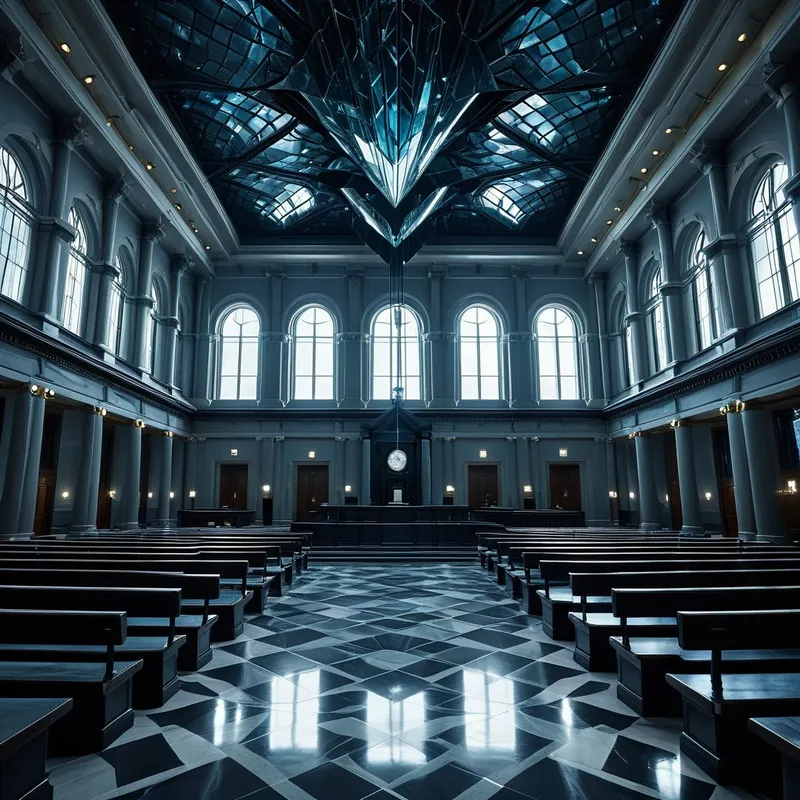
- Scales, Judges, and Courtrooms: The internal apparatus of judgment, measurement, and verdict.
- Mirrors (especially cracked or distorting): Forced self-reflection and the fractured perception of the self.
- Unmarked Graves or Hidden Objects: Buried truths, unresolved acts, or secrets the psyche is tasked with exhuming.
- Being Pursued or Watched: The feeling of inescapable accountability, often by a faceless or amorphous presence.
- Trying to Clean or Wash Something that Won’t Get Clean: The futile attempt to purge a stain on the soul through mere action.
Archetypal Resonance
The energy of conscience is most potently embodied by The Ruler Archetype, specifically in its nascent or shadowed form straining toward sovereignty. The Shadow Ruler is the internal tyrant—the harsh, dogmatic judge that metes out cruel and disproportionate sentences, creating a psyche ruled by fear and rigidity. The call of conscience, however, is the Ruler’s true mandate awakening: the drive to establish order, justice, and benevolent law within the inner kingdom. Its somatic echo is the weight of the crown—the profound responsibility of self-governance. Its alchemical potential lies in transmuting the raw, chaotic energy of guilt and shame into the structured, life-giving authority of personal integrity, where one truly becomes the sovereign of their own experience.
The Alchemical Process
The transmutation of conscience is an operation of intense psychological heat and pressure. The prima materia is the leaden weight of guilt, shame, and dissonance. The furnace is the unbearable tension of holding two opposing truths: “I did this (or failed to do that)” and “I am still worthy of wholeness.” The heat is applied through radical, uncompromising self-honesty—staring directly at the breach without the anesthesia of justification or the diversion of blame. This is the nigredo, the blackening, where everything seems lost in the shadow of your own actions.
The pressure comes from sustaining that gaze, allowing the pain of the fracture to be fully felt in the body, not just thought in the mind. In this crucible, the crude ore of guilt begins to crack. It does not vanish. It differentiates. The dross of neurotic, free-floating shame—the feeling of being bad—separates from the pure, golden thread of remorse: the clear, clean sorrow for a specific act and its impact. Remorse is active, focused, and contains within it the seed of amendment. This is the albedo, the whitening, the moment of clarifying insight. The new substance formed is not a clean slate, but a forged integrity—a conscience that is no longer a punitive warden, but a wise, internal guide. It is a law written in the flexible language of compassion and context, yet unwavering in its commitment to inner truth.

The Integration Protocol
Question 1: When you feel the somatic fist of conscience tighten, what is the specific, unspoken sentence your body is trying to deliver? Complete this phrase with the first words that arise, without censorship: "The truth I am carrying is..."
Question 2: If your conscience were not a judge, but a loyal advisor to the sovereign of your inner kingdom, what one piece of counsel—firm but compassionate—would it be whispering to you now?
Question 3: What exiled part of yourself holds the key to the locked door in your dream-log? What does that part need from you—not forgiveness, but perhaps witnessing, understanding, or a specific amendment—in order to return home?
Action 1 (Somatic Amnesty): When you feel the physical grip of conscience, place a hand gently on the area of tension (solar plexus, chest, throat). Breathe into that space for three cycles. On the fourth inhale, imagine drawing breath into the clenched area; on the exhale, silently offer the phrase, "I feel you. I am listening." Do not seek to dissolve the tension, only to acknowledge its message.
Action 2 (The Unsent Letter): Engage in a creative, unstructured writing ritual. Write a letter to the person, situation, or even to the younger version of yourself that is implicated in your conscience-dream. Do not write to apologize or explain. Write to describe the weight with precise, sensory detail. Describe the shape, temperature, and texture of the burden as if it were a physical object you are laying down on the page. Burn or safely destroy the letter as an act of releasing the form, while retaining the clarified insight.
Action 3 (Ritual of Amended Architecture): Perform a small, tangible act that symbolically amends the inner breach. If the conscience revolves around a taken resource, donate quietly to a relevant cause. If it is about a silenced truth, speak a small, honest word in a safe context today. If it is about a neglected self-duty, perform one concrete, nurturing act for yourself with the solemnity of a sovereign keeping a promise. Let the action be a brick in the rebuilding of your inner law.
Final Validation
To feel the full weight of conscience is a terrifying privilege. It means your soul has not gone numb; it means your inner compass, however rusted, still points toward true north. This burden is the raw material of your sovereignty. The path is not toward a state of being guiltless, but toward becoming answerable—to yourself, from a place of fierce and merciful authority. The locked door is yours. The key is in your hand. The turning is the bravest act of creation you will ever undertake: the forging of your own law.